



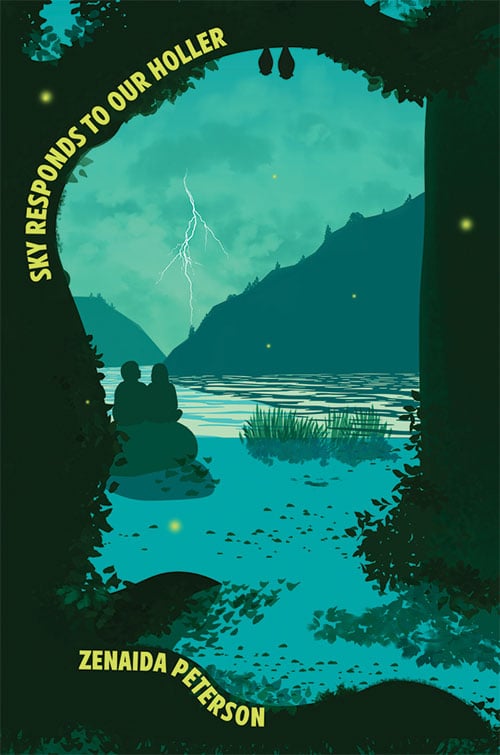
Sky Responds to Our Holler
Reviewed by Catherine Wald
August 1, 2026
By Zenaida Peterson. Game Over Books, 2025. 64 pages. $18/paperback.
I don’t want to be beautiful / I want to be listened to —from “Everytime I Have Butterflies I Am Self Conscious but What If I Just Flew Away”
This is the voice of a self-described “Black southern Quaker mystic,” a nonbinary poet who is active in the queer and poetry communities. I’m a White northeastern Quaker woman who may or may not be a mystic, who has limited involvement in the queer community, and this Friend speaks my mind. I, too, want to be known for who I am, not how I present myself to the world. Don’t we all?
These poems speak frankly about sex, gender, racism, injustice, and the enforcement of social norms. I admire Peterson’s courage, outspokenness, and openness to adventure: in sexuality, in nature, in spirit, in language, and in living in the present.
In the opening prose poem, “In the North Georgia Mountains,” the poet describes a camping adventure with friends, telling ghost stories and being blasted by a thunderstorm. It strikes them as a spiritual experience. “Are the gods not calling our names in all this dark and damp? Weren’t we meant to be this alive? . . . Isn’t living in the way the sky responds to our holler with more thunder?”
An important theme in the book is family relationships: how they are and how they might be. The poem “July 2021: A Weekend with My Dad He Probably Doesn’t Remember” describes an intimate conversation that may or may not have happened, in which the father and child talk frankly about gender and identity—theirs and his—and then settle down to watch TV, the longest time the two have spent together since the narrator was in high school. The poet feels heard. “Before we go to bed he knocks on my door and whispers, / ‘congratulations on your nonbinary-ness.’”
In another, “If I Became the Daughter they Expected Me To Be,” they imagine themself living with a doctor husband in a house they keep clean, with a job and wanting a baby. They hate their body and never show emotion. “I smile. / I am happy. / I am a good girl / . . . / I am empty.”
In “My Pronouns are Black,” they struggle to come to terms with their mother, “who don’t wanna hear / ’bout the things white people taught me anymore.”
I tell her, “white people didn’t teach me
how to be Black,
how to overcome,
how to gender, mama,
my body taught me that,
our ancestors taught me that.
You, you taught me that,
I watched you.”
Prayer and spiritual experience are important concerns in the book. In four separate “How to Pray” poems scattered throughout the book, Peterson explores the meaning and practice of prayer, and how it intersects with daily life, including life under the inequalities of capitalism, where, as “How to Pray (step two)” attests, prayer seems to favor those “who have the capacity to imagine a better world / . . . [and] design it through resistance”:
buying less and creating more
talking about how no
one needs a billion of anything
except maybe molecules of clean air
drops of water
kisses on their forehead over multiple lifetimes
This poet insists on the importance of mystery: “To pray is not to fear God / it is to fear a life without unexplainable things” (from “How to Pray (step three)”).
If there is stubbornness and rage in this book, there is also optimism. The poet looks hopefully to the future, not with naïveté but based on the power they have experienced while building community and flaunting stereotypes. They affirm, “It is not that we invented ourselves / but put up windows where there used to be / cement . . .”
Peterson is an alum of the Quaker Voluntary Service (QVS) program in the Boston, Mass. house (2016–2017). They have stayed connected with QVS since their service year in various roles and are now the director of equity and empowerment and the Boston coordinator. In 2020, they served as artist-in-residence at Philadelphia Yearly Meeting’s annual sessions.
This is Peterson’s first poetry collection. As the founding director of Feminine Empowerment Movement Slam, they are experienced in coaching teams that have ranked in the top ten in national poetry slams and also winning awards themself. You can hear the voice of the slam poet in these poems: the attention to sonics, surprising ideas, and turns of phrase.
In the end, it seems, it’s all about authenticity. In “My God Body,” when the poet’s mother complains that her child’s bra strap is showing, they respond, “it doesn’t matter what I look like.”
God knows me
like this.
God knows me
back open,
chest open,
naked,
and loves my blasphemy.
Catherine Wald lives in New York City and worships at Morningside (N.Y.) Meeting.
We want to hear from you, not an AI! Please be thoughtful and use your own words. Comments on Friendsjournal.org may be used in the Forum of the print magazine and may be edited for length and clarity.