



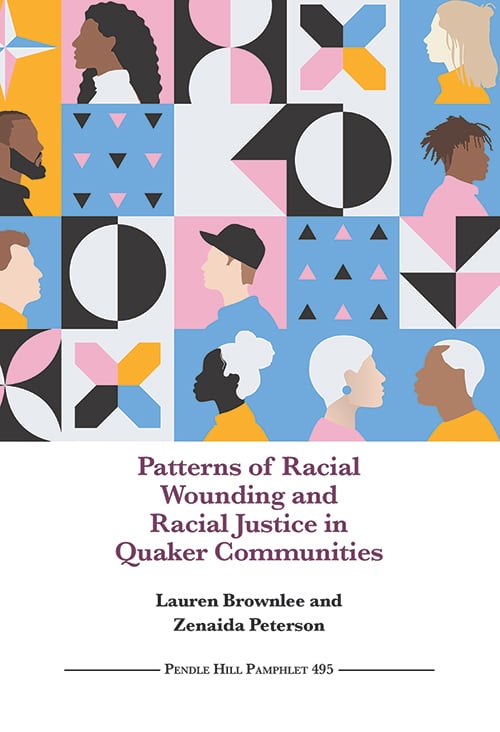
Patterns of Racial Wounding and Racial Justice in Quaker Communities
Reviewed by Abigail E. Adams
March 1, 2026
By Lauren Brownlee and Zenaida Peterson. Pendle Hill Pamphlets (number 495), 2025. 36 pages. $8.50/paperback or eBook.
Friends Lauren Brownlee and Zenaida Peterson open this pamphlet with a powerful promise:
Racial justice work is not only a commitment to your personal growth, it is also an integral part of the spiritual work to which Friends are called. . . . Spiritual bodies that are wrestling with their internalized racism have deeper relationships and trust and are then better suited for deepening with the Divine.
As a White Friend, I experienced the truth of this promise when I served with one of the authors and two others on a Friends Committee on National Legislation (FCNL) working group to consider an historic but racially wounding building name. It is a pleasure to read this pamphlet that shares more experiences, more possibilities, and more spiritual deepening by using clearly written, relevant examples; adoptable practices and skills; and insightful naming.
The authors are two Black Friends who worship in “mostly unprogrammed Quaker meetings” on the East Coast of the United States; they both work in Quaker organizations and serve on the steering committee for the Quaker Coalition for Uprooting Racism (QCUR), “with a mission to build a more racially liberated Religious Society of Friends.” They write from their “lived experience with unprogrammed meetings in the United States . . . [that] assumes meetings mostly composed of white people because that is largely the case in the Quaker spaces we inhabit.”
Brownlee and Peterson structure the pamphlet into five sections, each of which addresses a pattern they’ve witnessed “in Quaker settings: conflict avoidance, ‘guardians of the status quo,’ denying oppression exists within Quakerism, performativity, and inattention to right relationship with time.”
Each section opens with short fictional scenarios of racial wounding that happen in “status quo” Quaker settings (meetings, organizations, and schools). The authors discuss with compassion and specificity how Friends as individuals and as organizations remain stuck in each pattern and then explore how the scenarios might better play out in Quaker settings grounded in “love and liberation.”
They are clear that in each of the fictional scenarios (as in most relationships), people experience hurt; “[t]he liberated future is not harm-free.” These scenarios explore the pain of racial wounding and the difference that can result when responses are made within the context of love and liberation. When the responses are right-sized and rightly timed, a harmful event need not add to trauma, and the parties involved can grow in introspection and responsiveness. Brownlee and Peterson are careful for the most part in describing widely shared feelings and experiences, while avoiding over-generalization and stereotyping. I did smile at the statements “Change is uncomfortable” and “We shy away from conflict” when I thought of the relief people often seek in change and of the high-conflict Friends I have known.
The fictionalized scenarios are relatable. One scenario, for example, provided in the Guardians of the Status Quo section, explores a concern felt by board members of SQ (status quo) Friends School. They share their worries with the head of school that SQ Friends School is becoming less Quaker as the staff increases its racial diversity every year. They feel that the school needs Quaker staff in order to maintain Quaker values. I wonder how many other readers nodded in recognition at that scenario!
I resonated deeply with their naming of the five patterns. Responding to the authors’ observation of the cost of “guardians of the status quo,” I think of how many times I’ve witnessed people not being taken seriously in Friends meetings when their expressive style falls outside the narrow parameters for “weighty” speech: slow, near-monotone, and formally educated; or my discomfort when, in a common combination of “denial of oppression within Quakerism” and “performativity,” non-Quakers bestow upon me an unearned and undeserved credit because of Friends reputation in some freedom struggles.
Thank you, Friends Brownlee and Peterson, for providing my vision statement for this coming year: “Every bit of progress we have made to become freer started with ideas that seemed impossible.” This pamphlet—timely, clear, specific, and compassionate—helps me (and I hope others) envision that other possible Friends world of racial justice.
Abigail E. Adams worships with New Haven (Conn.) Friends. She serves on the General Committee of FCNL. Recently retired as an anthropology professor, she continues work in urban forestry in Central America and on immigrant concerns. Although she was unexpectedly elected to town office, she dreams of serving as a Connecticut tree warden.
2 thoughts on “Patterns of Racial Wounding and Racial Justice in Quaker Communities”
Leave a Reply
We want to hear from you, not an AI! Please be thoughtful and use your own words. Comments on Friendsjournal.org may be used in the Forum of the print magazine and may be edited for length and clarity.
I don’t believe this. Quakers have and are most of the time respectful and considerate of non-white Quakers and attendees. Quakers should be lauded in their historical treatment of non-whites. Instead of celebrating this, you write something that cuts them down, that focuses on what are probably very isolated incidents and prone to interpretations. I went to Quaker boarding school in the 80s with black and brown people and we all got along and that was how I got to know the sub-cultures in America, by existing with them. What a shame. But everyone wants to get on the train of division and deconstruction. It sells stories. It sells books.
Ooo, Vickie. Well, you’re not conflict-avoidant, that’s for sure. Your comment verges on insult, ascribing primary financial motive for sincere efforts to raise consciousness. You consider yourself to be free of racial prejudice, don’t you. (Not a question.) My growth came when I realized it was not my fault that I, a White woman, feel more comfortable and less intimidated by a Black person of any educational/social status than by a White person of similar status. Why not my fault? Because I was born and raised in the U.S. of A., land of prejudice and murder from the getgo- just ask a Native American. (But I love the best of my country, just not in a nationalistic way.) So what l can do is to be aware of my prejudices and learn, learn, learn. As a young woman student, I patted the back of a young Black woman student sitting next to me for some reason or other. With a forced smile, she said to me “Why did you do that?” (I had no answer.) I never forgot it, and I try never to assume a familiarity/friendship with a Black person until it is offered and invited from their side. Lucky me, I never have to wait long.
Peace and love, Vickie.
Suzanne Vardon