



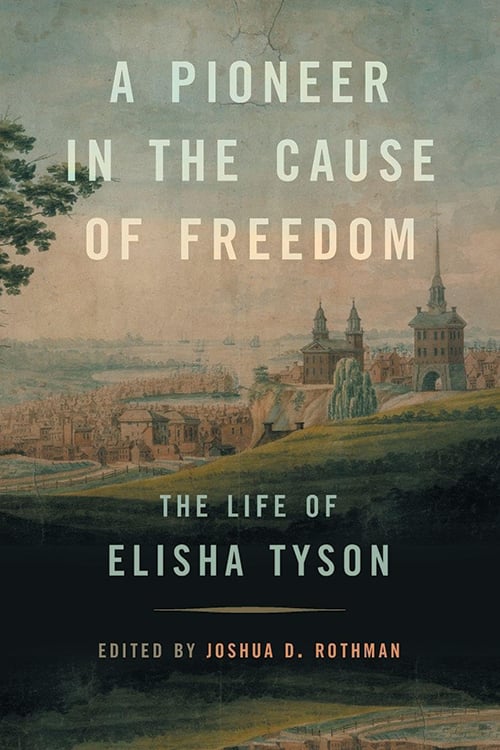
A Pioneer in the Cause of Freedom: The Life of Elisha Tyson
Reviewed by Thomas D. Hamm
March 1, 2026
Edited by Joshua D. Rothman. University of Georgia Press, 2025. 200 pages. $119.95/hardcover; $24.95/paperback or eBook.
Joshua D. Rothman is a distinguished historian of American slavery, race, and the antebellum South who teaches at the University of Alabama. He has not previously had a particular interest in Quaker history, but his focus on the history of resistance to slavery in the United States drew him to Elisha Tyson (1749–1824), a Baltimore Friend. Not one given to uncritical appraisals of historical figures, Rothman, in the first paragraph of this book tells readers that Tyson “became legendary for his devotion to the cause of antislavery and his commitment to improving the circumstances of free Black people in the United States.”
This book has three sections. The first is Rothman’s introduction, which provides an overview of Tyson’s life as a philanthropist, opponent of slavery, and supporter of free Black people. The second is an annotated reprint of the 1825 biography by Elisha Tyson’s nephew John Shoemaker Tyson, Life of Elisha Tyson, the Philanthropist. The last section is an appendix of supplementary materials, including letters, reminiscences about Tyson, and documents from organizations in which Tyson was a leader.
The introduction is a critical evaluation of Elisha Tyson’s career. Born into a Quaker family near Philadelphia, Pa., he moved to Maryland as a young man. In Baltimore, he became first a flour miller. As he prospered, he invested in shipping and other businesses. By the early 1790s, he was one of the city’s wealthiest residents.
Wealth gave Tyson the leisure to devote himself to good causes, and he took a deep interest in Black people. In 1789, he was one of the founders of the Maryland Society for Promoting the Abolition of Slavery, and the Relief of Free Negroes, and Others, Unlawfully Held in Bondage. The group made some progress. It filed lawsuits that freed dozens of free Black people who had been kidnapped and enslaved, and it opened a school in Baltimore for Black children.
By 1810, a quarter of Maryland’s Black population was free. But it faced the entrenched political power of Maryland slaveholders, and legislative successes were few. White supporters fell away, although Maryland Blacks persevered in the battle against slavery. Nevertheless, Rothman concludes, “[F]ew white supporters and allies were willing to join them in that battle with greater devotion than Elisha Tyson. If anything, the seemingly shrinking base of support from other white Marylanders led Tyson to become more resolute in his efforts and more audacious in his approach.”
Rothman notes that Tyson does not always live up to contemporary standards of antiracism. He was inconsistent about aiding fugitive slaves and could sometimes be patronizing in his relations with Black people. But, he concludes, Tyson “personally enabled thousands to live as free people rather than as slaves, and he devoted his time and his money to bringing about legal, social, and cultural changes that made freedom possible for thousands more both in and beyond Maryland.”
Elisha Tyson was an admirable Friend. Joshua D. Rothman deserves our gratitude for bringing him to contemporary attention.
Thomas D. Hamm is a member of West Richmond (Ind.) Meeting, emeritus professor of history and Quaker scholar in residence at Earlham College, and president of Friends Historical Association.

We want to hear from you, not an AI! Please be thoughtful and use your own words. Comments on Friendsjournal.org may be used in the Forum of the print magazine and may be edited for length and clarity.