



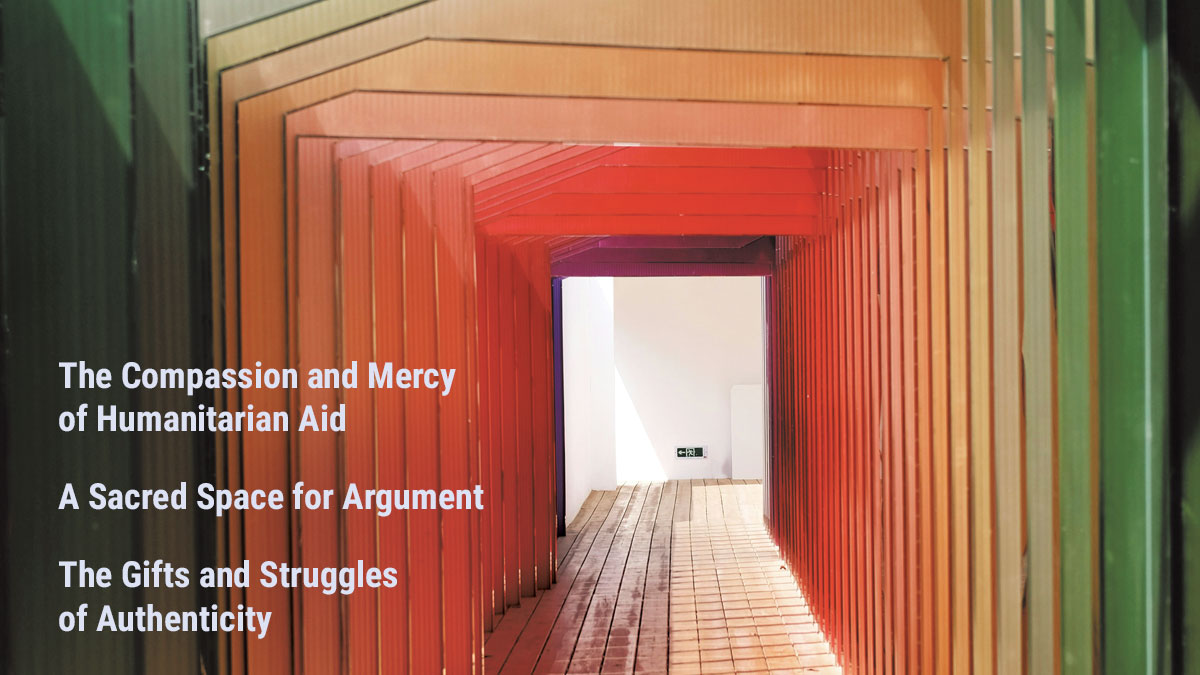
While many of the authors we feature in Friends Journal do not make specific reference to it in their pieces, the truth is that we are all crafting and sharing stories of our Quaker experience in a time of profound global political, environmental, and social instability. For me, this faith is a source of reassurance, community, and grounding. One of the things that keeps me coming back to Quakerism, day after day, is knowing that we are, all of us, using a shared set of tools. These are gifts handed down to us by generations of Friends and spiritual seekers striving to exist in a way that honors and expresses God’s abundant light, in which we all share and partake. No matter the perils around us, it is indisputable that the human diversity among Friends, coming from different families, different places, different cultures, and different personalities, is a strength.
In her piece “The Compassion and Mercy of Humanitarian Aid,” Brandy Witthoft educates readers about the human impact of the work she was a part of as a Quaker professional at USAID, the international aid agency that, early last year, was a casualty of the instability I mentioned above. The profound human cost of capricious leadership decisions only continues to rise, and it’s important that we calculate and tell the truth about this cost. And it is also important to recognize that the faith in humanity that sustains those who find a calling in good works is not subject to the whims of any government.
Speaking of a thriving movement of Quaker women’s work alongside Indigenous communities in Guatemala City, Ana Cabrera Vega professes a similar sentiment: “When God is the center and compass of our lives, generations may come and go, but that faith will remain alive.” In her piece “Celebrating Diversity for God’s Glory,” readers will glimpse an approach toward evangelism that stands in contrast to the cultural imperialism that has marked the history of Christian missions in the past.
This time of year is exciting not only for the shoots and blossoms of spring that are appearing where I live, but also because it’s the start of new seasons of QuakerSpeak and the Quakers Today podcast. Video producer Layla Cuthrell’s first QuakerSpeak this year profiles Smedley Butler, the “fighting Quaker” who bloodied his hands as a military commander in American wars of empire in the late nineteenth and early twentieth centuries before becoming a vocal critic of the intersection of capitalism and violence. At 25 minutes, it’s a mini-documentary that ought to spark reflection and dialogue in today’s world where the echoes of Butler’s wars are still ringing. Watch it today, or better yet: arrange a viewing and discussion with your meeting, church, or First-day school.
Quakers Today returns this month with a new cohost, Diana Gisel Yañez, joining Peterson Toscano. The season will explore how Quaker values can offer bold, grounded, and often surprising alternatives to dominant financial narratives. It will feature stories of individuals and meetings practicing reparative economics, collective discernment, impact investing, and mutual aid—all while navigating the practical, emotional, and spiritual complexities of money. Diana and Peterson will draw on over 20 interviews with Friends from around the world. I encourage you to queue it up wherever you get your podcasts, or at QuakersToday.org.
We want to hear from you, not an AI! Please be thoughtful and use your own words. Comments on Friendsjournal.org may be used in the Forum of the print magazine and may be edited for length and clarity.