



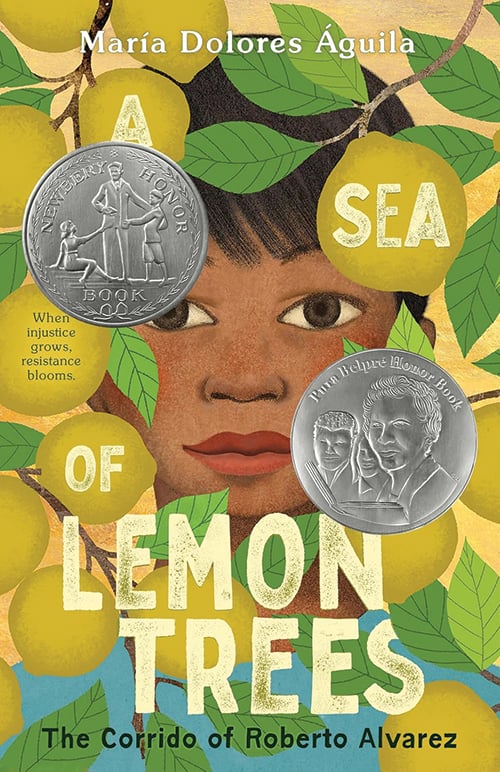
A Sea of Lemon Trees: The Corrido of Roberto Alvarez
Reviewed by Anna Birch
May 1, 2026
By María Dolores Águila. Roaring Brook Press, 2025. 304 pages. $17.99/hardcover; $2.99/eBook.
This novel in verse introduces readers to the Lemon Grove Incident, a little known but important legal case in the history of Mexican immigration to the United States. In July of 1930, Mexican students who were enrolled at the Lemon Grove Grammar School in California were suddenly instructed to report to the Olive Street School instead. Their desks and other supplies had been moved to the former barn, now characterized as an “Americanization” school. Among other threats, any student who refused reassignment would be considered truant and expelled after 20 absences. Residents of the neighborhood organized, and with the help of the Mexican consulate, they obtained legal counsel to successfully oppose the decision in court.
The short poems that make up the text are written as if in the voice of Roberto Alvarez, the lead plaintiff. Roberto, aged 12, was chosen because he was an exemplary student. Through his eyes, we see other figures in the story: the school principal who does his best to stand in the way of the unfair decision and the two lawyers who argued for the students’ right to a more egalitarian education at their former school.
Running alongside Roberto’s story is that of his best friend, David, whose family is deported. In David’s story, we see the fate of thousands or perhaps millions of others who suffered during the period between 1929 and 1939, the interval called the Mexican Repatriation. During this time, little care was taken to differentiate between those deportees who might also be U.S. citizens and those who were not.
The poetic form proves particularly appropriate for a historical fiction tale characterized in the subtitle as a corrido, a traditional Mexican narrative ballad. These are narrative songs composed to spread the tales of heroes among people who might not otherwise get news of their exploits. In the end pages, the author briefly recounts the changes in the history of border crossings between Mexico and the United States. She also details the economic changes in the United States that account for severe alterations in the reception and treatment of Mexicans in a part of the world where border crossings and migration had once been easy.
Though marketed as a middle-grade novel, this book might easily be read aloud to some younger children and enjoyed by adults. The characters are sensitively and believably portrayed. The plot is suspenseful. Roberto Alvarez’s story and that of others in his world could easily spark discussion in Quaker homes and meetings.
Anna Birch, co-recording clerk of Santa Fe (N.M.) Meeting, is a retired librarian.

We want to hear from you, not an AI! Please be thoughtful and use your own words. Comments on Friendsjournal.org may be used in the Forum of the print magazine and may be edited for length and clarity.