



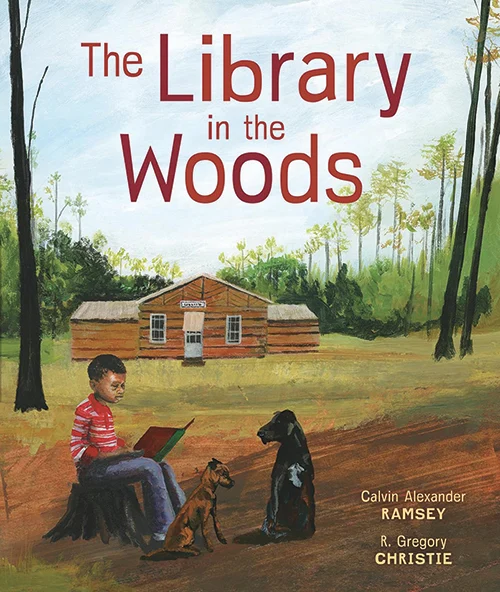
The Library in the Woods
Reviewed by Jerry Mizell Williams
May 1, 2026
By Calvin Alexander Ramsey, illustrated by R. Gregory Christie. Carolrhoda Books, 2025. 32 pages. $19.99/hardcover; $9.99/eBook. Recommended for ages 7–11.
“Literacy” is the protagonist in this moving story: it is an esteemed childhood friend whose presence in the life of the author occupies center stage. Literacy expands his world and deepens a loving family relationship.
The year is 1959, and nine-year-old Junior witnesses devastating acts of nature (a drought followed by a hail storm) that destroy crops and uproot his family. Forced to abandon a farm for a house in Roxboro, N.C., the family slowly transitions from the comfort of rural life to the dense environment of a town. Junior, who must now wear shoes, learns to navigate roads and traffic and to explore his surroundings. His greatest adventure begins upon discovering that his school friends have books in their homes and that there exists in the woods a segregated log cabin library for Black residents.
Spellbound by the abundance of books and their shelving according to genre, Junior takes the advice of the kind librarian to check out three books, notably poetry by Phillis Wheatley for his mother and a biography of George Washington Carver for his father. Almost two weeks pass as every night Junior watches his father “sit out on the porch in his rocking chair holding his book.” In a tender exchange between mother and son, the child learns that Daddy can’t read because his parents sacrificed his education for his younger siblings to attend school, while he, the eldest, worked in the fields. Junior’s response will move readers ages seven to eleven.
This story transported me back to childhood when I obtained my first library card and enjoyed the sense of possibility it afforded. In the author’s note, Ramsey recounts that in 1959, he first understood the magical power of books and reading through his brother Junior and, in turn, became an avid reader. Rural libraries during the Jim Crow era were scarce yet provided a meeting ground for Black children. These libraries aided adult literacy at a time when “farm culture produced a different type of intelligence” that was required to produce crops and livestock and raise a family. Ramsey’s essay informs us how schools for Blacks were constructed in the rural South primarily through community fundraisers and the patronage of philanthropist Julius Rosenwald.
R. Gregory Christie’s artwork enhances the narrative and brings to life each episode of Junior’s odyssey. I believe that this book will also be of interest to adults who either are or are not familiar with the history of segregation and its insidious impact on education in the United States. It deserves a place in Quaker and non-Quaker school libraries.
Jerry Mizell Williams is a member of Green Street (Pa.) Meeting, where he serves as archivist. He is the author of numerous books and articles on colonial Latin America.

We want to hear from you, not an AI! Please be thoughtful and use your own words. Comments on Friendsjournal.org may be used in the Forum of the print magazine and may be edited for length and clarity.