




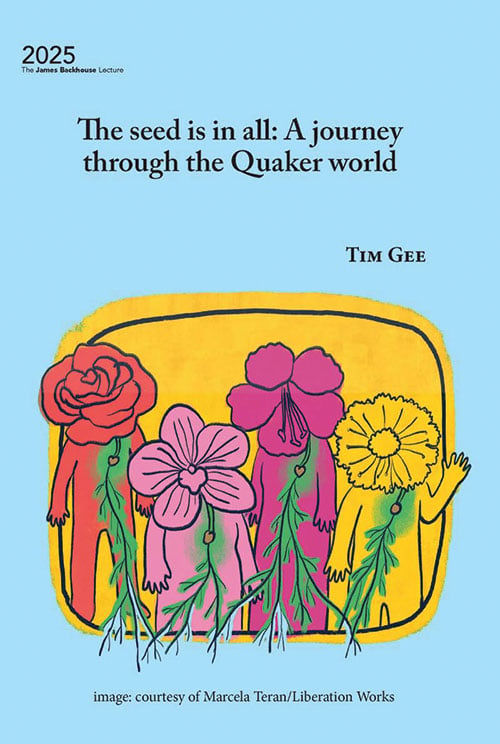
The Seed Is in All: A Journey through the Quaker World
Reviewed by Harvey Gillman
August 1, 2026
By Tim Gee. James Backhouse Lectures, 2025. 64 pages. $13/pamphlet; $7/eBook.
The role of Australia Yearly Meeting’s annual Backhouse Lecture is to offer fresh insight and to be a source of inspiration. In this Tim Gee, the general secretary of Friends World Committee for Consultation, has fulfilled his brief.
The lecture is a call to Friends to explore together our rich diversity and hence to offer a vision to the many seekers who are “sensing a profound inward spirituality but [are] searching for a community to help them interpret it.” It is a summons both to inward exploration and an outward task. At the same time, Gee reflects on his own evolution from the British Liberal quiet tradition of Friends to a recognition of the gifts of Friends worldwide. As well as the Quaker tradition of his childhood, he now recognizes and values the role of vocal prayer and song among African Friends. He has indeed written songs for the World Quaker Songbook and adds some of them to the text of the lecture.
The Seed Is in All is an optimistic journey through the Quaker world, but at the same time, Gee acknowledges difference and possible conflict among diverse Quaker cultures. The two issues to which he refers and which exemplify these differences are the role of the Bible (and of Christianity) and the acceptance or not of same-sex relationships. I write the word “optimistic” because Gee—as a man devoted to the pursuit of peace and a belief in the Light within all people—believes that the issues may be, if not resolved, at least not remain a source of conflict among Friends. Interestingly, he does not deal with these matters from a theological perspective as much as from one of culture and geography, as well as from differing interpretations of Quaker tradition.
How much we can disentangle culture from theology is not quite touched upon. I personally often wonder how many of us have a tendency to let our own needs and prejudices influence how we interpret the promptings of love and truth. The question of discernment is largely implicit in this lecture but underpins much of what Gee is exploring.
One of the unexpected references was to the Epistle of James, which Gee considers to have had a great influence on early Friends. I had not considered this before, but it is significant that this letter places stress on the practical consequences of Christian faith: “faith without deeds is dead” and “I will show you my faith by my deeds.” It is an epistle that has made several mainstream Christian theologians uneasy, including Martin Luther. It points however to the heart of the Quaker tradition. In this way, Gee is indeed bridging the gap between a biblical faith and a social activism, which are marks of the worldwide Quaker movement.
In the section “Some Predictions,” Gee points out: firstly, that Global North Quakerism will be influenced by the growth of Global South Quakerism; secondly, that there will be a blurring of Quaker traditions through online connections; thirdly, that English will no longer be the default language; and fourthly, that Liberal Quakerism will “pass.” He does not discuss these predictions in detail—it is a lecture not a book—but it would have been good to have had more indications of what they might mean. As at a good lecture, you want to stay behind and engage in a leisurely conversation with the speaker. Perhaps these points could form the basis of discussion at local meetings and churches. They would also make a fascinating basis for dialogue between the different branches of the Quaker world.
I came away from the lecture musing on the comments of a Burundian Friend who told Gee that, “when you become a Quaker, your life gets better.” At the end of the lecture, Gee passes this question on to his listeners and readers: “Is your life better for being a Quaker?” Now that is a challenge. I would add: Is the world a better place for having Quakers in it?
Harvey Gillman was outreach secretary for Britain Yearly Meeting for 18 years. He has traveled widely amongst Friends both at home and abroad, exploring the Quaker way and reflecting on issues of spirituality, outreach, inclusivity, language, and hospitality, both in his writings and in workshops and retreats. His most recent publication is an anthology of poems titled Epiphanies.
We want to hear from you, not an AI! Please be thoughtful and use your own words. Comments on Friendsjournal.org may be used in the Forum of the print magazine and may be edited for length and clarity.