



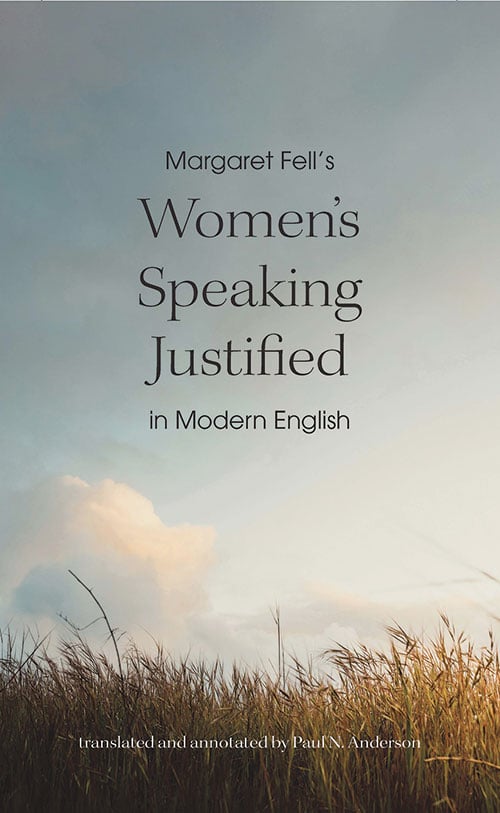
Margaret Fell’s Women’s Speaking Justified in Modern English
Reviewed by Barbara Birch
August 1, 2026
Translated and annotated by Paul N. Anderson. Barclay Press, 2026. 76 pages. $31/hardcover; $19/paperback.
In 1968, I took a job aptitude test in high school, and my highest score was “nun” because that was the only church ministry job for girls on the test. My friends and I laughed at the result because I was a Lutheran and the celibacy requirement didn’t appeal. Still, I knew that in the hierarchy of my own church, pastoral positions were restricted to men only. Some women worked as “deaconesses,” low-level social workers who could teach Bible and theology classes to women and children. That position didn’t appeal to me either, so I had to consider other career possibilities. The second wave of women’s liberation had not yet reached my Midwest hometown, so I didn’t question anything, but soon afterward, I rejected the church that did not value my passions or skills.
Sadly, it’s too late for me, but nowadays, some churches allow women pastors, and there’s even a female Archbishop of Canterbury in the Church of England: Sarah Mullally, who was installed earlier this year. However, many other denominations, including some of the largest, still don’t allow female pastors. This controversy harkens back to Eve in Genesis, and the epistles of the apostle Paul in early Christian history, whose cryptic words have been deliberately interpreted misogynistically for millennia. Such exclusion is a crime against humanity: it’s a crime that half of the population are deprived of church leadership, but it’s also a crime that churches are—with few exceptions—deprived of women’s vision and skills in leadership.
After I became a Quaker in 1985, I learned about Margaret Fell and her landmark pamphlet Women’s Speaking Justified. Fell (1614–1702) wrote and published her essay in 1666 while imprisoned in Lancaster Castle, with a postscript added in 1667. Fell’s writing can be placed into the later period of Early Modern English (roughly 1500–1700), that is, the two centuries from the Tudor period to the restoration of King Charles II. Early Modern English was a time of great linguistic change and innovation due to the rise and spread of printing, literacy, and publication. Some Early Modern English writers can be read easily (I’m looking at you, Isaac Penington), but other writers, including George Fox at times, can be understood only with considerable effort. (Interested readers can find the original text of Fell’s pamphlet by searching online.)
For me, Women’s Speaking Justified falls on the difficult side of the range, so I was pleased to hear that Paul Anderson, a well-known Quaker historian and theologian, had published a translation into Modern English. When I compared the translation to the original, I saw that the main problem is how wordy Fell’s sentences are. To modern readers like me, her convoluted syntax and semantics are hard to parse, and that makes her careful logical argumentation hard to follow. Anderson’s translation faithfully preserves the tone, word choice, and meaning of Fell’s original while making her perceptive thoughts and feminist intentions clear. Here’s the first sentence in the original pamphlet:
Whereas it hath been an Objection in the minds of many, and several times hath been objected by the Clergy, or Ministers, and others, against Womens speaking in the Church; and so consequently may be taken, that they are condemned for medling in the things of God; the ground of which Objection, is taken from the Apostles words, which he Writ in his first Epistle to the Corinthians, chap. 14. vers. 34, 35. And also what he writ to Timothy in the first Epistle; chap. 2. vers. 11, 12. But how far they wrong the Apostle’s intentions in these Scriptures, we shall shew clearly when we come to them in their course and order.
Anderson presents the following translation:
Whereas women’s speaking in churches has been objected to by many—including clergy, ministers, and others—condemning them for ‘meddling in the things of God’ (based on 1 Cor 14:34–35 and 1 Tim 2:11–12), they are wrong in misunderstanding the Apostle’s intentions.
There is real artistry in translation, and Anderson meets the challenges with respect and care. A tiny quibble might be that Fell’s original introductory sentence seems bolder and more “in your face” than Anderson’s translation. The rest of the pamphlet is clearer, more similar to the many letters she wrote as she organized the early Quaker movement, and Anderson lets Fell’s personality shine through the prose, faithfully conveying her intelligent, courageous, and resourceful style of writing.
Anderson also helpfully separates out the Bible passages from Fell’s words and adds explanatory information in additional essays, footnotes, and in the text itself. Compare the final sentence of each version of the pamphlet, where I highlighted in italics the clarifying material in Anderson’s slightly longer translation.
Fell wrote: “Christ Jesus, who goes on Conquering, and to Conquer; who kills and slayes with the Sword, which is the Words of his Mouth; the Lamb and the Saints shall have the Victory, the true Speakers of Men and Women over the false Speaker.”
Anderson translates: “And in the end, Christ Jesus, who goes on conquering, slays with the Sword of his mouth, continues to speak through his Saints, which include women’s speaking, as well as men’s. Thus, the Lamb and the Saints shall have the victory: the true speakers of men and women over the false speakers of the world.”
In making her case, Fell’s arguments are subtle and nuanced. She didn’t have the benefit of more recent biblical scholarship that questions the authorship of the epistles to Timothy, making “clobber texts” like 1 Tim. 2:11–12 disputed and weaker. The verses “Let a woman learn in silence with full submission. I do not permit a woman to teach or to have authority over a man; she is to keep silent” may have been inserted later by male writers with ulterior motives.
Unfortunately, these days, women still face both institutional and individual censure and censoring in their faith communities, and for the same “biblical” reasons that women faced in Fell’s day. That deplorable fact makes Paul Anderson’s new translation an extremely important contribution for everyone inside and outside the Quaker community. For readers interested in Quaker history, feminist theology, or the literature of dissent, Anderson’s Women’s Speaking Justified in Modern English is an excellent entry point.
It also invites an easier encounter with Fell’s words. Read together, her seventeenth-century text and Anderson’s modern rendering illuminate one another: one preserving her authentic voice, the other revealing the force and precision that an antique style of writing can hide. The art of translation is to make an original work comprehensible; an excellent translation keeps the original text forceful and engaging. Anderson does exactly that in this pamphlet.
Barbara Birch is a member of Strawberry Creek Meeting in Emeryville, Calif., and a board member at Ben Lomond Quaker Center outside Santa Cruz, Calif. Author of Lectio Divina: Revelation and Prophecy (Quaker Quicks), Barbara facilitates online lectio divina programs and publishes her musings at yourwifey51.medium.com.

1 thought on “Margaret Fell’s Women’s Speaking Justified in Modern English”
Leave a Reply
We want to hear from you, not an AI! Please be thoughtful and use your own words. Comments on Friendsjournal.org may be used in the Forum of the print magazine and may be edited for length and clarity.
I taught Margaret Fell’s pamphlet to Freshmen at a Southern Baptist college. Faculty approved it for a unified University-wide course.