




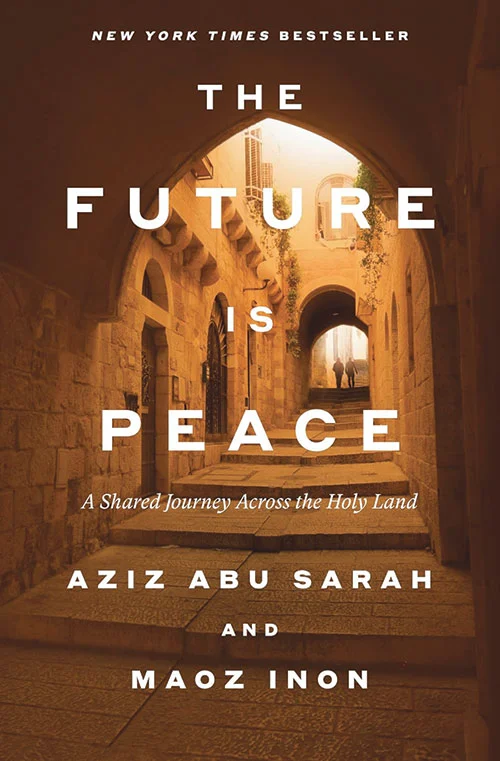
The Future Is Peace: A Shared Journey Across the Holy Land
Reviewed by Max L. Carter
September 1, 2026
By Aziz Abu Sarah and Maoz Inon. Crown, 2026. 240 pages. $30/hardcover; $14.99/eBook.
In 2002, I participated in an international Quaker study trip to Palestine and Israel sponsored by American Friends Service Committee. While in Jerusalem, our delegation met with Naomi Chazan, then a deputy speaker of Israel’s Knesset. She summed up the challenge of peacemaking between the two “sides” with these words: “The great tragedy of our situation is that there are two narratives of our history together that are both true, but don’t meet.”
That observation of two competing narratives is the basic theme of The Future Is Peace, and the coauthors seek to share in the book from their Jewish Israeli and Muslim Palestinian experiences how finding a way to comprehend the other’s story can forge a pathway to a just peace. It wasn’t an easy path for either. Israeli Maoz Inon lost both his parents in the Hamas attack on October 7, 2023, and Palestinian Aziz Abu Sarah’s brother died from injuries inflicted by torture in an Israeli prison. After initial rage and grief, they reached out to each other, recognizing that revenge would only lead to further violence, and understanding that the actions that led to their loved ones’ deaths did not rise out of a vacuum. Both Inon and Abu Sarah had backgrounds in the travel industry, and they joined in taking a trip together through Israel and the Occupied Palestinian West Bank to share their histories through the sites they visited.
In Jaffa and Tel Aviv, Inon shared the lively debates among Jews about the nature of Zionism and the structural inequalities in Israel. For his part, Abu Sarah described how Jaffa was a vibrant Arab city of 120,000 before 1948 and the establishment of the modern state of Israel, and a year later, it was a city with only 4,000 ghettoized Arab residents.
Visiting Jerusalem, Inon described the Jewish attachment to the city through its religious and political history, sharing the narrative on which he was raised of a city under constant siege. Abu Sarah described the strictures placed on Palestinian Arab residents in an effort to “Judaize” traditionally Arab East Jerusalem and thus create a unified Jewish Jerusalem. Their insight is that it is important to stop seeing Jerusalem as a prize to be claimed and instead see it as a sacred trust to be shared.
Traveling through the West Bank, their stories are of both Jewish and Arab connections to the land, while pointing out that Israel’s military occupation and the spread of settlements has adversely affected the occupied population, particularly through the confiscation of water resources, settler attacks, and the treatment of Palestinians by the military and security police. Abu Sarah relates how Islamic texts do not dispute a Jewish presence in the land, but he opposes the West Bank settlements owing to discriminatory laws and practices. Inon explains a source of Israeli fear of Palestinians in the West Bank by relaying the story of two army reservists who mistakenly entered Ramallah on their way to a nearby army base and were beaten to death. Although he doesn’t mention it, the narrative in Ramallah is not that the two soldiers “took a wrong turn” but that they were found in a car (at the front gate of the Friends Boys’ School!) with electronic equipment monitoring a funeral procession and then were attacked by angry mourners. Though Palestinian police attempted to protect them, the crowd overwhelmed the police and killed the soldiers. Competing narratives! They are abundant.
In Nazareth, Inon visits one of the guesthouses he had arranged in the Arab part of the Israeli city: one of several he once had established throughout Israel in his effort to promote “tourism as peacebuilding.” While it was operating, the guesthouse helped revitalize the once rundown section of Nazareth. Now, however, it is closed because of the ongoing conflict. Both he and Abu Sarah see this turn of events as symbolic of how Israelis and Palestinian Arabs once lived side by side as in Nazareth but are now divided by bureaucracy, segregation, and even physical walls. The Israelis that Palestinians now meet are usually only soldiers or settlers; most Israelis rarely encounter Palestinian Arabs, and they stereotype them all as a threat.
Abu Sarah and Inon view the challenge to peacemaking to be a result of embedded competing narratives, of the lack of equity and justice, and of the difficulty in connecting in meaningful ways with “the other.” In the face of these roadblocks (sometimes literal ones!), they cite the resilience and steadfastness of those seeking a just peace, the long hope people maintain for a better future, and the commitment of many people on both sides to take action for peace. They describe a cycle of trauma and vengeance that leads to death and destruction, but they also lay out a way to “defeat the monster” by looking one another in the eye: to humanize the other—not to “normalize” an unjust system but to connect with one another in a mutual search for a future of a just peace.
Max L. Carter is the emeritus William R. Rogers Director of Friends Center and Quaker Studies at Guilford College. He is a member of New Garden Meeting in Greensboro, N.C., and serves on the Board of Friends Publishing Corporation, publisher of Friends Journal.

We want to hear from you, not an AI! Please be thoughtful and use your own words. Comments on Friendsjournal.org may be used in the Forum of the print magazine and may be edited for length and clarity.