




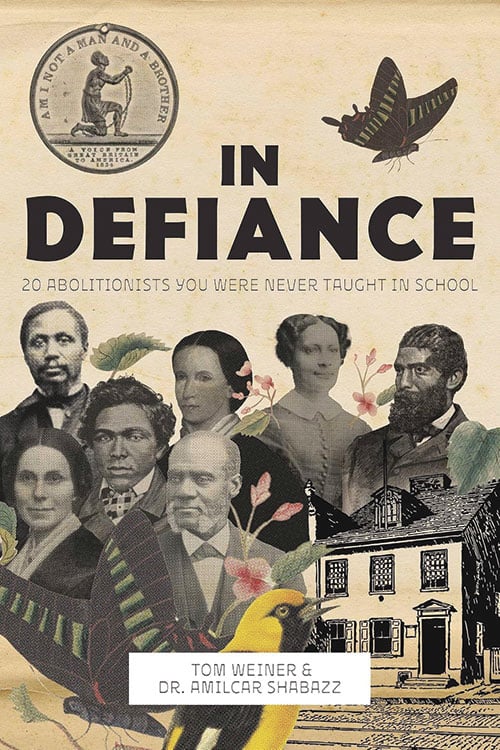
In Defiance: 20 Abolitionists You Were Never Taught in School
Reviewed by Jerry Mizell Williams
September 1, 2026
By Tom Weiner and Amilcar Shabazz. Olive Branch Press, 2025. 248 pages. $25/paperback.
Narratives about abolitionists can sometimes miss the mark by homogenizing the very individuals they portray, depriving them of their individuality and integrity, and confusing the impetus behind the conviction that propelled them onto the stage of history. In an attempt to revise how “our collective human history” needs to be studied, Weiner and Shabazz highlight examples of profiles in defiant abolitionist courage that challenge and inform our understanding of such complex lives. The authors’ critical handling of each story humanizes the 20 subjects, many of whom were influenced by their proximity to and knowledge of Quakerism.
The first chapter profiles manumitted Belinda X (later identified as “Belinda Sutton of Boston in the County of Suffolk, Widow”) and the six petitions initiated in 1782 and presented to the Massachusetts General Court on her behalf for reparations in the form of a pension from the estate of former enslaver Isaac Royall Jr. of Medford. Each petition cites biographical information that ranges from her passage aboard the slave ship from her native Ghana and her bondage under Royall to why she demanded justice for herself and her infirm daughter in the form of payment for the labor that had enriched the Royalls. The authors link Belinda’s fruitful efforts to those of Quakers and antislavery Evangelicals who sought to compensate freed slaves for their bondage.
In “Sarah Mapps Douglass: Against Patriarchy,” the authors provide a broad context for both Sarah’s thinking and actions as she confronted the acceptable threshold for racism at Arch Street Meeting in Philadelphia, Pa. (where her mother Grace Douglass was relegated to sitting on a back bench). Traditionally and unfairly presented as a victim and Black woman deprived of agency in a white Quaker meeting, multi-talented Sarah (1806–1882) emerges as a defiant Quaker whose “life begins in a space that was not the norm for people of African descent.” A skilled lecturer, Sarah collaborated with the Grimké sisters and fundraised for William Lloyd Garrison’s The Liberator. Among her notable attainments as she followed her antislavery mission were operating the school she cofounded with her mother; cofounding the Female Literary Association in 1831; and later, the Philadelphia Home for Aged and Infirm Colored Persons, and she was vice president of the Women’s Freedmen’s Relief Association. In 1862, after her husband of six years died, Sarah taught women students at the Banneker Institute. As Sarah slowly reconciled with Quakerism, she remained steadfast in her defiance when questioning the extent to which the Quaker benchmark for injustice at Arch Street could be faithfully embraced.
Sarah Parker Remond (1826–1894), “Firebrand Defying Limits of Age and Sex,” was an ardent Black feminist and prolific speaker who garnered an early victory when she successfully sued a Boston theater for denying her seating. Active participation in the American Anti-Slavery Society and a speaking engagement at the Women’s Rights Convention in 1858 in New York City netted alliances with Susan B. Anthony and Abby Kelley Foster, and a friendship with Frederick Douglass and spouse Helen Pitts Douglass. During years spent abroad, Sarah earned degrees in nursing and medicine, and she delivered antislavery speeches in France, England, and Italy. Besides denouncing sexual exploitation of enslaved Black women, she championed the blockade of Southern ports by workers at British manufacturing companies, and campaigned for the property rights of married women. Owing to the extreme prejudice Sarah endured in the United States, she chose to live and practice in Italy, where she died.
I found compelling the espousal of Sallie Holley (1818–1893) to the rights of enslaved and free Blacks, particularly women, while she lectured widely and educated students at the Holley School in Lottsburg, Va., that Caroline Putnam founded and named in appreciation for Sallie. Holley’s story reflects the victorious fight of orator John Stewart Rock (1825–1866) to be admitted to the bar of the U.S. Supreme Court in 1865 in which he defended the rights of Blacks. Her story also reflects the stance of Quaker Elizabeth Buffum Chace (1806–1899) against slaveholding Quakers and the inequality in education that women and free Blacks endured. The well-chronicled deeds of Francis Pastorius; Benjamin Lay; Anthony Bénézet; and Robert Morris, a crusader for school integration in Boston circa 1849, support the authors’ choice to include an equal number of Black and white men and women.
Readers will appreciate the manner in which the authors situate the interpretative stories “into the urgency of our now” by referencing existing battles for justice led by today’s advocates. In Defiance contains a number of lesser-known abolitionists who have earned a place in the annals of narrative abolitionist history and who deserve greater prominence in the awareness of our younger readers. The essays not only relate to Quakers and Quaker values but also to the historical foundations of our institutions.
Jerry Mizell Williams is a member of Green Street Meeting in Philadelphia, Pa., where he serves as archivist. He is the author of numerous books and articles on colonial Latin America.

We want to hear from you, not an AI! Please be thoughtful and use your own words. Comments on Friendsjournal.org may be used in the Forum of the print magazine and may be edited for length and clarity.