




Can Our Songs Melt Hearts?
You may come here with your warrants, you may come here spreading fear.
But no human can be illegal
And we’ll sing it through our tears.
—Protest song
Three days a week, a buoyant crowd gathers in front of the Boston Field Office of Immigration and Customs Enforcement (ICE) in Burlington, Massachusetts. The Wednesday protest, called Bearing Witness, has consistently had 200 show up, and some weeks as many as 700. It’s colorful as a circus but with a dead-serious purpose. Inside the nondescript office building, our federal government has weapons, small cages for humans, and conducts ruthless interrogations.
I’ve shown up many weeks during the last 12 months. Now when I approach this innocuous business park—hiding a sign under my jacket—the building looms ominously. I say to myself, Spirit, guide my feet. Please help.
I go through moments of both joy and outrage when I’m in front of the ICE building. Like the hymn based on Psalm 13 asks, “How long, dear Lord, how long?” The people do not support ICE. When ICE contracted to rent this building in 2019, the government claimed that “no detainees will be lodged overnight.” Yet reports from people detained stated that they slept crowded on concrete floors and had inadequate bathrooms. I cringe thinking of how humiliating the detention can be, especially when no crimes were committed.
When will it end? Can our songs melt hearts? Can protests stop the bullets? My singing group, BVOCAL, rouses the crowd. Fervor builds among us in front of the ICE office. Many union, political, and religious groups show up. Quakers are among them, some driving 50 miles to protest the ICE machine. Resistance singing invites harmony.
Voices were floating above the flags:
Everyone, oh everyone, yes everyone,
of these people (immigrants) are ours; and we are theirs.
We belong to them, and they belong to us.
The beat becomes staccato. Signs say “End the ICE Age” and “Stop Facism.” I see a sleek van with tinted windows moving to the ICE building. A poster next to it says, “When injustice becomes law, resistance becomes duty.” The chorus directs the next song to the ICE agents:
It’s OK to Change your Mind. Show us your Courage. Leave this behind.
It’s OK to Change your Mind. And you can Join us; join us anytime.
The song is a prayer for change. Britain Yearly Meeting’s Faith in Practice includes an extract from Quaker peacemaker Gordon Matthews: “We need both a deeper spirituality and a more outspoken witness. . . . Out of the depths of authentic prayer comes a longing for peace and a passion for justice.”
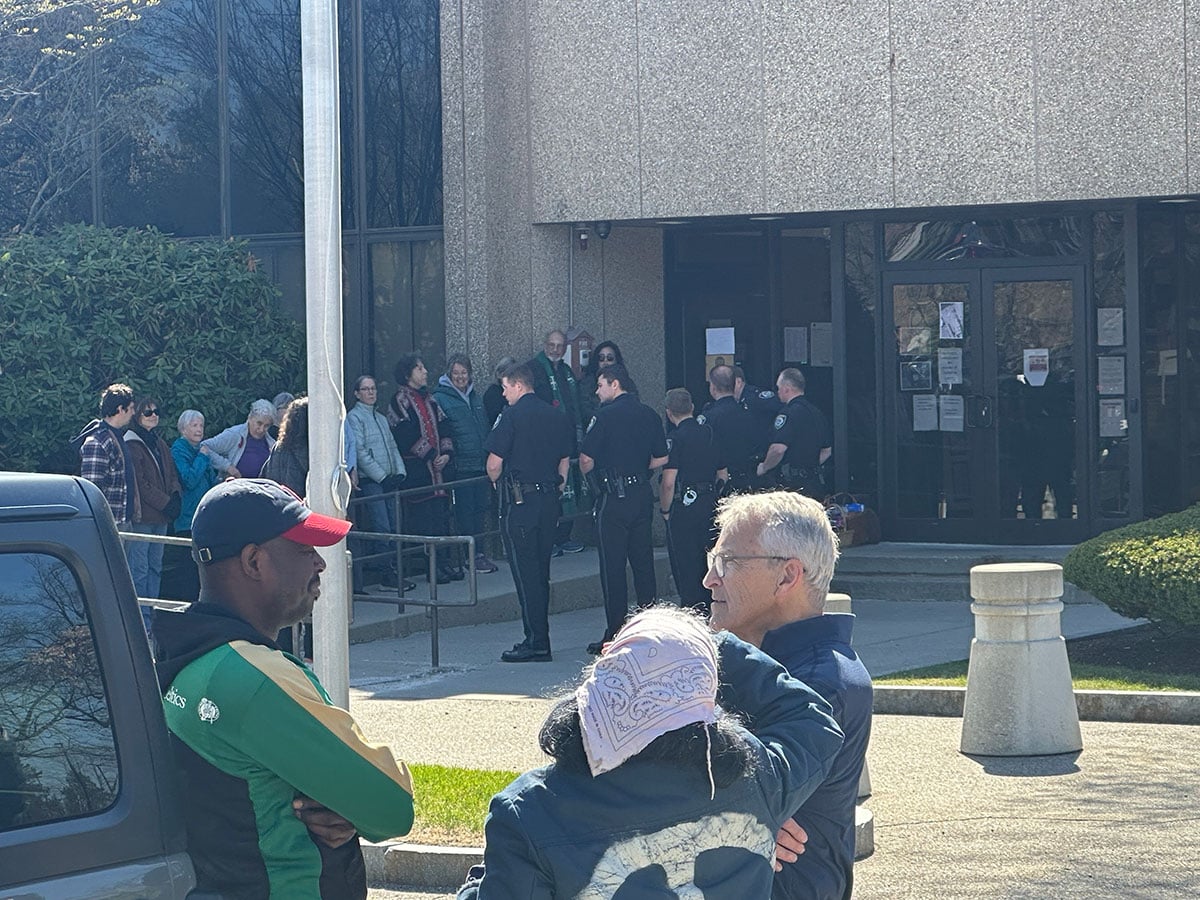
Quaker practice deepens my prayer and deepens our prayer. Beacon Hill Meeting in Boston, Mass., organizes a monthly worship at Burlington. Four local Quaker meetings participate in a circle of prayer, no matter how bitter the weather. Friends often hold vigils by military gates or at the pillars of weapons manufacturers. This circle of 10 to 20 Friends watches the ICE activities.
It’s gut-wrenching for me as I pray for justice for immigrants and watch cars bearing shackled people arriving at the immigration prison. My heart feels like it’s ripping from my rib cage. Worshiping affects my nervous system differently from the way protesting does; my intention is different. At protests, I want the end of cruelty and the abolition of ICE. In Quaker worship, I listen. I hear birds, and I sense the earth with a faint smell of lilacs. Worshiping outside, I connect to a power much greater than guns. The web of life dissolves my dismay. God’s power, the Ocean of Light, is palpable. Abolishing ICE is about presence, not absence.
During April worship, a car carrier pulled up to the corner as expensive cars rolled into the ICE back parking lot. My heart leapt to my throat. I didn’t blame the driver nor the deliverer. Yet I began crying at the harm in front of me. I was grateful for other Friends praying, because I was in grief. I felt the pain of all this tax money spent on these new vehicles while Boston children are hungry and sometimes afraid to go to school. I was incensed and vowed to do more than pray. I was convinced to do more than protest to stop this madness.
How does one fight an evil system? I prayed to Quaker ancestors. The Quaker prophet Bayard Rustin says, “We need in every community a group of angelic troublemakers. Our power is in our ability to make things unworkable. All we have is our bodies. We need to tuck them, tuck them in places.”
My body felt this truth, like a key that turns in a locked door. My resolve inside grew firm. And then providentially, I got a call from Rob Levine of Portland (Maine) Meeting to join a group that would knock at ICE’s door asking for humane treatment.
We decided to challenge that locked building that holds torture and fear. One song I taught was the following:
We are a movement; we are liberation moving,
for every single human we have come to love.
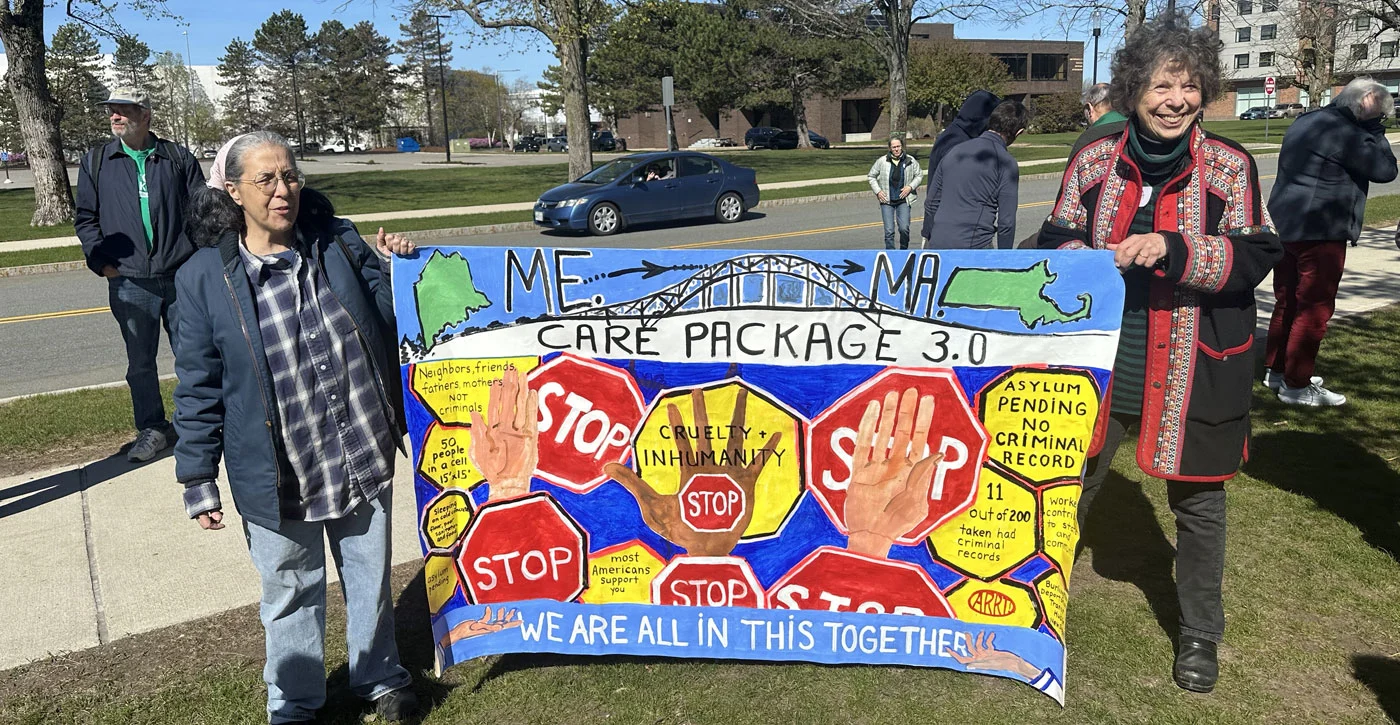
Our action was called Care Package #3 or CP3 for short (in the winter of 2025, two other smaller groups had tried to deliver care packages). We organized under the radar by choosing encrypted messaging. Forty of us planned the action for April 28, 2026. Our outward goal was to deliver baskets of food. One basket had a small bottle of maple syrup for the ICE employees, who are also victims of a malicious system. Another goal was to break the barrier of ICE security, knowing that many neighbors were being denied due process, leading many people to hide in their homes because of the color of their skin. I prayed; would I be up for it? How could I not try to break down the barriers? This felt like the next step of putting our bodies in front of the locked door, asking to offer comfort and hygiene. In general, I wanted to offer love sprinkled with courage as an antidote to fear.
Early morning on April 28th, I joined other people of faith to enter the Burlington ICE facility. We had six baskets of food with some toiletries. At the last minute, some bright dahlias were added. We took these gifts to the door and were refused entrance (as had happened to the earlier care package protests). Why did we persist in knocking at ICE’s entrance?
We wrote to those detained:
We are heartbroken—and outraged—at what is happening to you. We bring personal items as symbols of our care. We stand in nonviolent, committed opposition to the policies and the people who are holding you. We lift our voices to remind you that you are not alone. We are willing to be arrested to show our solidarity with you.
We are grateful for your presence in this country. . . . In this difficult moment, we are praying for you, and we are using every tool we have to advocate for you.
We will not abandon you. . . . We extend to you our friendship, our commitment, and our love. From the Care Package Team
We also sent out a press release in other languages (French, Portuguese, and Spanish): !No pierdan la esperanza! Les entendemos nuestra compromise y nuestro amor. I was rather proud of our organized press releases. I realize our message won’t get much publicity, so here is the open letter to ICE employees across the nation:
Dear ICE Employees,
We arrive this morning on your doorstep with heavy hearts. We have watched as our neighbors, family, and colleagues have been taken away by ICE over the past year. These incidents often leave behind a trail of shattered car windows and equally shattered lives. We come to bring care packages to the detainees.
We also offer a care package to you. We seek to love you, just as we love the prisoners in your care. We are all in this together, in fact we belong to each other, whether we like it or not.
We offer you two hands this morning. One hand is facing out, saying “stop,” insisting that you cease the cruel treatment of immigrants, that you end your role in the mass detention of our neighbors (and yours). With this hand we signal that we will not cooperate with this cruelty, and we will deter your efforts through nonviolent means at every turn.
Our other hand is outstretched in invitation. We invite you to make a different choice, to disentangle yourself from this cruel and unjust system. And we will be here for you when you are ready. There is a place set for you at our table, if you choose to join us. That might be for a single meal, or for an ongoing dialogue. We belong to each other.
The 12 of us at CP3 were arrested by the entire Burlington city police fleet (ten cars) within an hour. The handcuffs were painful; the police captain was bellicose. I had to remember to breathe, using breath as the pathway to prayer. We were an older crowd and pale skinned. Our privilege protected us, and certainly we didn’t fear deportation. We were using our privilege to draw attention to our country’s xenophobic, racist immigration policy. We were sent home without an arraignment, expected to get court papers with charges of trespassing and disturbing the peace.
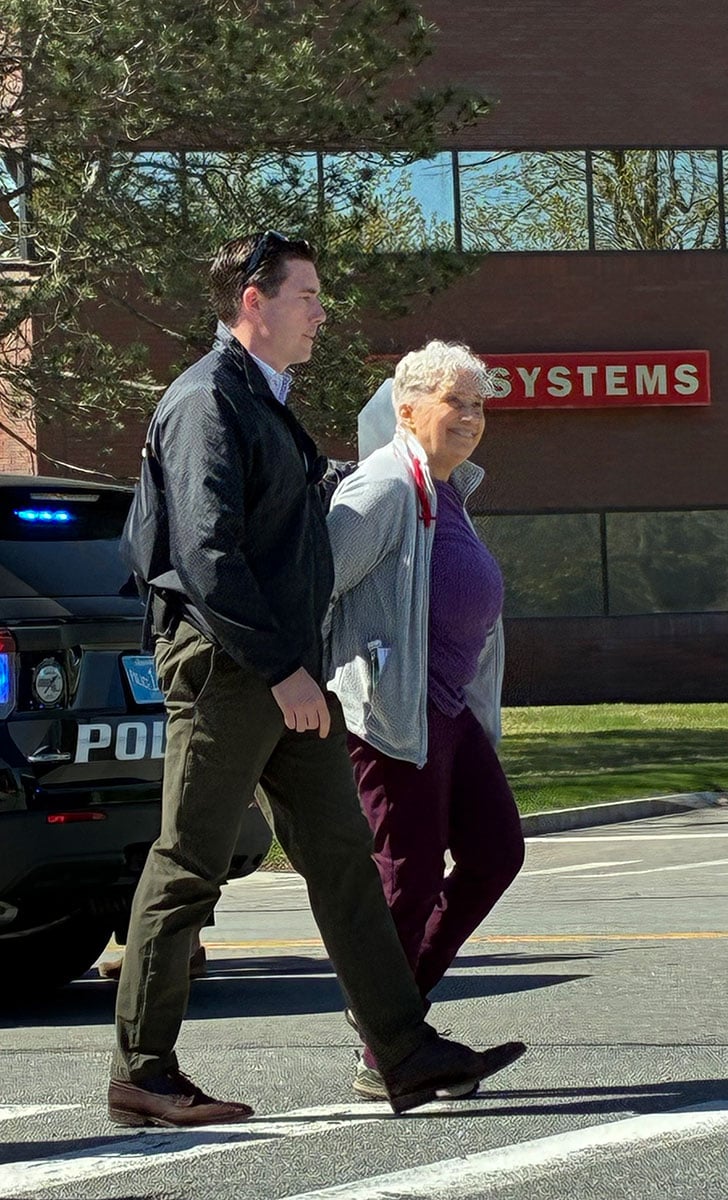
Several media stories came out. I was quoted in the April 29 Boston Globe as saying, “this system breaks up families, detains people in vile conditions, and kills innocent people is evident. It affects me and the safety of my neighborhood.”
Three letters from the editor were also published in the May 5th issue in the opinion section of the Globe. Of the three, I wrote one, and Bruce Neumann of Fresh Pond Meeting in Cambridge, Massachusetts, penned another. He said:
Good-hearted people stood outside the facility to draw attention to the terror that ICE has wrought all over the country and to the poor treatment of detainees at 1000 District Avenue in Burlington. . . . At a time when human rights are regularly being violated by a federal agency, it is our responsibility to state clearly: “This is Not OK.”
My letter to the editor ended with the following: “As an officer put me in handcuffs, I wondered: Is it worth the inconvenience—me a psychotherapist with clients—to be arrested and not able to see my patients?” Immediately I thought of Arthur Berto, a 13-year-old from Everett taken by ICE in October 2025. Yes, I thought, if I can save one child from the trauma, it’s worth it. And if my disturbing the peace by attempting to give care to detainees draws attention, might others ask, “What are the real crimes happening in Burlington? How can we stop the trauma to our neighbors?”
We want to hear from you, not an AI! Please be thoughtful and use your own words. Comments on Friendsjournal.org may be used in the Forum of the print magazine and may be edited for length and clarity.