



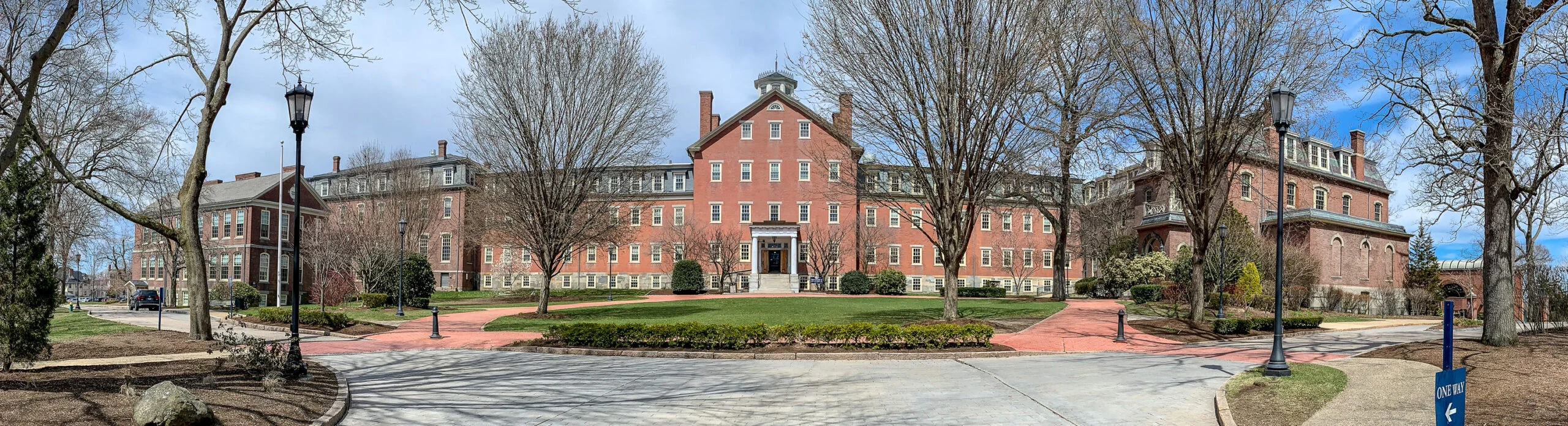
I sit on my couch in almost-June, remembering a season familiar from my time as a student: when nostalgia for the year that was collides with the push towards finals and the imminent relief of summer break. Now, at the end of my first year of teaching, my viewpoint has shifted slightly. I am less concerned with finishing this year and more occupied with aspirations for next year’s cycle.
Last September, I returned to teach ninth and eleventh grade English at the Quaker school I attended as a student. I was raised a Friend, and I feel that there was something distinctly Quaker in the education I received before going off to college. Now, as a teacher, I want to perpetuate that ethos, but I struggle to define what it means to practice a Quaker pedagogy—especially considering that few of my colleagues and students are Friends.
When I speak to non-Quakers about Quakerism, I sometimes reflexively attempt to define our tradition according to beliefs. I offer a jumble of historical tendencies and values. I know many convinced Friends who felt called to join Quaker communities after learning about those Quaker values. But the few times I’ve tried to articulate any coherent answer to the question “What do Quakers believe,” I fumble for words: are we Christian? Libertarian? To what extent does tradition dictate the truths we hold? If there is no single authority on spiritual truth, how can we possibly call any belief distinctly “Quaker”?
My friends from school also struggle to articulate what exactly defines a Friend. Some talk about the testimonies, in the same way they might recite the Pythagorean theorem. But they prefer to talk about the experience of attending a Friends school: the promise and challenge of the silence, the care for community, and the relationships between students and teachers who see one another as equals.
Two defining components of Quaker tradition are recognized by yearly meetings globally: faith and practice. Books of faith and practice are multivocal. When Friends put things down in writing, we don’t necessarily seek to make things clearer. Faith and practice are not entirely distinguishable, especially considering elements like testimonies, declarations of shared experience that are part reality, part aspiration. But we still offer both as words within our vocabulary of self-definition, suggesting that faith and practice are in some way distinct.
The word “faith” scares some people. Many don’t know what it means. It can denote a boundary; some people have it and others do not. “Practice,” on the other hand, invites engagement. If you are not “of the faith,” you can still engage in the practices that define it. And the practices we carry out—the example we set with our hands, bodies, and relations—often self-perpetuate in unpredictable ways. I shudder to imagine how my ninth graders would react if I told them what to think. But if I give them a practice, a task with clear expectations, they at least attempt to follow the road map I’ve laid out. Sometimes, they end up teaching me.
I don’t know how to teach Quaker values, in part because to teach in a values-based way implies that my own values should matter to my students: that they should emulate me. This is the opposite of what I seek from them. And preaching Quaker values in the classroom would invite learning through call and response, giving up on the enduring struggle of education: the grappling, the conflict, the disagreement, the rigorous processes of communal dialogue and self-reflection shared between the best classrooms and the most deliberate Quaker communities. As I develop and revise my Quaker pedagogy, my teaching ignores the faith, values, and beliefs of Quakerism altogether in exchange for a rich history of practices.
My friends from school also struggle to articulate what exactly defines a Friend. Some talk about the testimonies, in the same way they might recite the Pythagorean theorem. But they prefer to talk about the experience of attending a Friends school: the promise and challenge of the silence, the care for community, and the relationships between students and teachers who see one another as equals.
My English class centers around discussion. This is unremarkable. Students discussed the reading in every literature course I took in high school, college, and graduate school. Yet each of those discussions had its own pacing and tone. The best were collaborative and conversational, with the teacher positioned as a facilitator. When I left high school and entered college, many classrooms turned into “spoked wheels,” where a professor filtered and reacted to each student’s contribution. These classes cultivated a shallow performance of dialogue reliant on an academic’s intellectual authority.
Certain values were implicit in this higher education model. The classroom became obviously hierarchical (students addressed the adult in the room). Knowledge was understood as something acquired through specialization and expertise (that adult had a PhD). Learning often felt like a process of accumulating knowledge rather than exploring recursively. I don’t think my worst professors could have identified these flaws in their classrooms, but their practices conveyed their priorities to those around them more clearly than the values they professed to hold. As a student, I found community in spaces where my teachers ceded their authority to me and my peers, giving us the opportunity to test ideas with each other and correct our own mistakes.
In my ninth- and eleventh-grade classes this year, I asked my students to run “discernment dialogues,” a structured exploration of Quaker practice. I’ll admit that the ground rules I offered were certainly based on particular values. The instructions begin with three “fundamentals of corporate discernment,” adapted from our school’s book of faith and practice:
- We listen for what individuals are saying and for an emerging sense of the collective, allowing for silence between points.
- We cooperate, refusing to take sides in a collaborative, constructive process.
- We gather wisdom in the assumption that the truth available to the group is greater than the knowledge of any one individual.
I try to frame even these provisional values through the lens of action. The phrases “We listen,” “We cooperate,” and “We gather wisdom” communicate their substance through verbs. Values are embodied and enacted in tangible ways. It’s easy to see when a student is listening (or not). Cooperation is a skill we develop constantly in the classroom. And as a teacher, I can assess whether a student’s written reflection takes many contributions into account or just a few.
We read these fundamentals together, and my students practice them reasonably well. But I do not ask them to reflect on these ground rules or question their meaning or relevance. In short, I don’t really teach them. I simply offer these vague expectations—and then I step away. Two or three clerks generate a few queries on a passage of text. One facilitates, offering the queries one by one and calling on their peers, while the remaining records minutes. For homework afterwards, the clerks reflect on the discussion. “Did a resolution or answer arise? If not, why? Where did the group diverge?”
Students come to me with questions throughout the process. They want to know which queries are “good.” They look to me to tell them when to end discussions. Generally, I refuse to answer their questions except by saying something like, “What do you think is best?”
Many of my students find this process frustrating. They struggle to hold the silence. They struggle to refrain from referencing prior points explicitly. In their written reflections, they often hallucinate a sense of unity—and gain no bonus points for doing so. In my ninth-grade class especially, however, my students were better discussion participants after a few discernments. They became better listeners. They responded to their peers’ insights without my prompting and cooperated to generate deeper, more emotionally rich insights about the novels we read.
When we premise Quaker identity on practices we share, we need not be threatened by disagreements over the words we use to describe ourselves. Let us simply seek to find friends “where two or three are gathered,” whoever they may be, waiting on unlikely words that may surprise us out of certainty.
I do not want to imply that Quakers don’t have values. The testimonies certainly reflect an orientation that prioritizes some ethical viewpoints over others. Friends can look back on a rich history of social action, but that history is no guarantee of a righteous future and values do not teach themselves. Knowledge of how to exist well with others derives from practices of intentional living and deep listening.
Values are inculcated through consistent habits and things-done: gathering in silence, listening to minority opinions, and refusing the urgency of distraction pervasive in this world. To state a belief, to argue for a particular value over others abstracted from its context is to posit an unquestioned and unquestionable moral certainty that is much like the attitude the first Quakers so vehemently opposed in the institutionalized Church. Meanwhile, to facilitate a communal practice, regardless of the beliefs of those involved, invites the kind of collective care summed up in the name “Friends.”
The phrase “Quaker values” sounds a lot like doctrine and suggests that we privilege the acquisition of expert knowledge over the profundity of the sacred experience. If we were to exorcise this phrase from our vocabulary and talk more about the practices we carry out—contemplative wanderings, lengthy deliberations, and engagement with the world as it is and as it could be—our communities could be richer and more fluid, more accommodating to those who aren’t quite sure what they believe, like the riotous, skeptical, wonderful people I teach.
This shift I advocate is itself a practice. We will fail; I include myself in that “we.” We will imply an objective truth when we feel challenged by the insecurity and uncertainty of the subjective. We will struggle to hear dissent, from those who count themselves as members of the Society and those who do not. But when we premise Quaker identity on practices we share, we need not be threatened by disagreements over the words we use to describe ourselves. Let us simply seek to find friends “where two or three are gathered,” whoever they may be, waiting on unlikely words that may surprise us out of certainty.
We want to hear from you, not an AI! Please be thoughtful and use your own words. Comments on Friendsjournal.org may be used in the Forum of the print magazine and may be edited for length and clarity.