



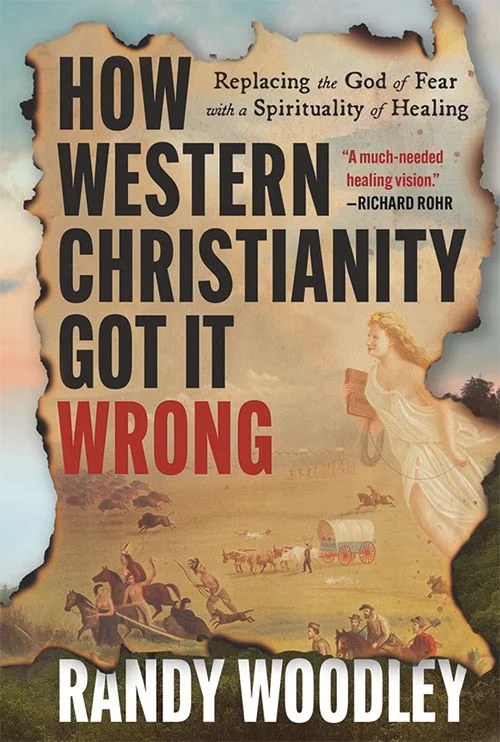
How Western Christianity Got It Wrong: Replacing the God of Fear with a Spirituality of Healing
Reviewed by John Andrew Gallery
October 1, 2026
By Randy Woodley. Broadleaf Books, 2026. 262 pages. $28.99/hardcover; $18.99/eBook.
At the start of his new book, Randy Woodley writes the following: “Over the years, [Western Christianity] has told (and shown with its actions) lies about who God is and why Jesus came.” And: “The values adopted by Western Christianity are, foundationally, the opposite of the teachings of Jesus.” These are strong statements. However, by the time I finished reading his book I was convinced that Woodley was right, and I think many Quaker readers will feel the same way.
Woodley is the author of numerous books, a lecturer, an activist, and a farmer, among other things. He is of mixed White and Native American (Cherokee) heritage whose spirituality combines both the teachings of Jesus and Native American wisdom. Throughout the 12 chapters of the book, Woodley shows how Western Christianity’s values and practices are in stark contrast to those two traditions. He is interested in the process that led to such dramatic differences, not just the results. The first step in that process was Christianity’s merger with the Roman Empire under Constantine, followed by placing itself in the service of other empires in order to position itself as the “one true religion.” Along the way, it adopted beliefs and practices designed to enhance its own position and power, unrelated to or often in conflict with the teachings of Jesus. Woodley gives many persuasive examples of this: two of which are the issues of inclusion and the attitudes toward land and nonhuman creation.
The first of these, inclusion, tells of the many beliefs and practices of Western Christianity having an us-vs.-them character—or, as the Woodley chapter describes it, “How Platonic Dualism Ruined Everything,” which delves into the philosophical concept developed by Plato that “separated reality into two parts by privileging the ethereal (unseen, metaphysical) world over the material (seen, physical) world.” A significant and influential example of this was the Doctrine of Discovery that gave moral sanction to the empire-building activities of European nations by declaring the inhabitants of the lands they conquered to be less than human, thereby promoting forced conversion, displacement, and death. Woodley points out that there continues to be an us-vs.-them mentality to Western Christianity in the United States today.
By contrast, Jesus’s approach was much more inclusive. He ate with, taught, and healed people of all backgrounds; he believed God had no favorites; that God was a loving God, not one to be feared, and one that extended mercy and compassion equally to all individuals and nations. Similarly, there is ample evidence that Native American tribes had a welcoming, inclusive attitude toward European settlers, even believing that it was possible to share the use of land with them.
The second topic, attitudes toward land and nonhuman creation, is discussed in terms of Western Christianity’s—and consequently Western civilization’s—understanding that the earth and its resources are there to be exploited for the economic benefit of humans. Native Americans believe—to paraphrase George Fox—that there is something of God in all creation. Human beings are just one part of the web of life and not necessarily the dominant one. The challenge for humans is to live in harmony with the rest of creation which creates an attitude of respect for the land and its nonhuman inhabitants. Woodley’s view is that Jesus’s frequent references to the natural environment suggests he too believed that there was something of God in all creation.
In contrasting the differences between Native American views and Western Christianity, Woodley reminded me of the power of Native American wisdom. The belief in the sacredness of all creation led to practices of respect and gratitude from which we can still learn today, and this doctrine is much more inspiring than the simple notion of stewardship. He also provides interesting insights about Jesus. He points out that if original sin was simply a human invention—that there was no original transgression by Adam that gets passed on to everyone ever born—then there is no need for a savior to reconcile humanity with God. What is important about Jesus is not his death but his message. Woodley also suggests that the debate about whether Jesus was divine or human is both irrelevant and distracting: irrelevant because it can’t be proven either way and distracting because it draws attention away from Jesus’s practical and concrete teachings. That is the challenge Woodley sees for Western Christianity today: to rid itself of the accretions that have distorted Jesus’s teachings over the centuries and return to a focus on his actual message. “The time for Jesus to be emulated is now,” writes Woodley.
Woodley’s critique of Western Christianity made me consider whether the Liberal unprogrammed meetings that I attend in Philadelphia exhibit any of the same characteristics. It made me wonder if even such things as participation in current protest marches over our government’s policies is speaking spiritual truth to power or just aligning ourselves with one side versus another in the secular power struggle. It also made me wonder if Friends’ focus on the often abstract idea of an Inner Light has led us too far away from the challenges provided by the insights and specificity of Jesus’s teachings.
How Western Christianity Got It Wrong is both an informative and provocative book. It helped me clarify some of my own spiritual values, and it may do the same for you.
John Andrew Gallery attends Chestnut Hill Meeting in Philadelphia, Pa., and Middletown Meeting in Lima, Pa. He is a frequent contributor to Friends Journal. Website: johnandrewgallery.com.

We want to hear from you, not an AI! Please be thoughtful and use your own words. Comments on Friendsjournal.org may be used in the Forum of the print magazine and may be edited for length and clarity.