


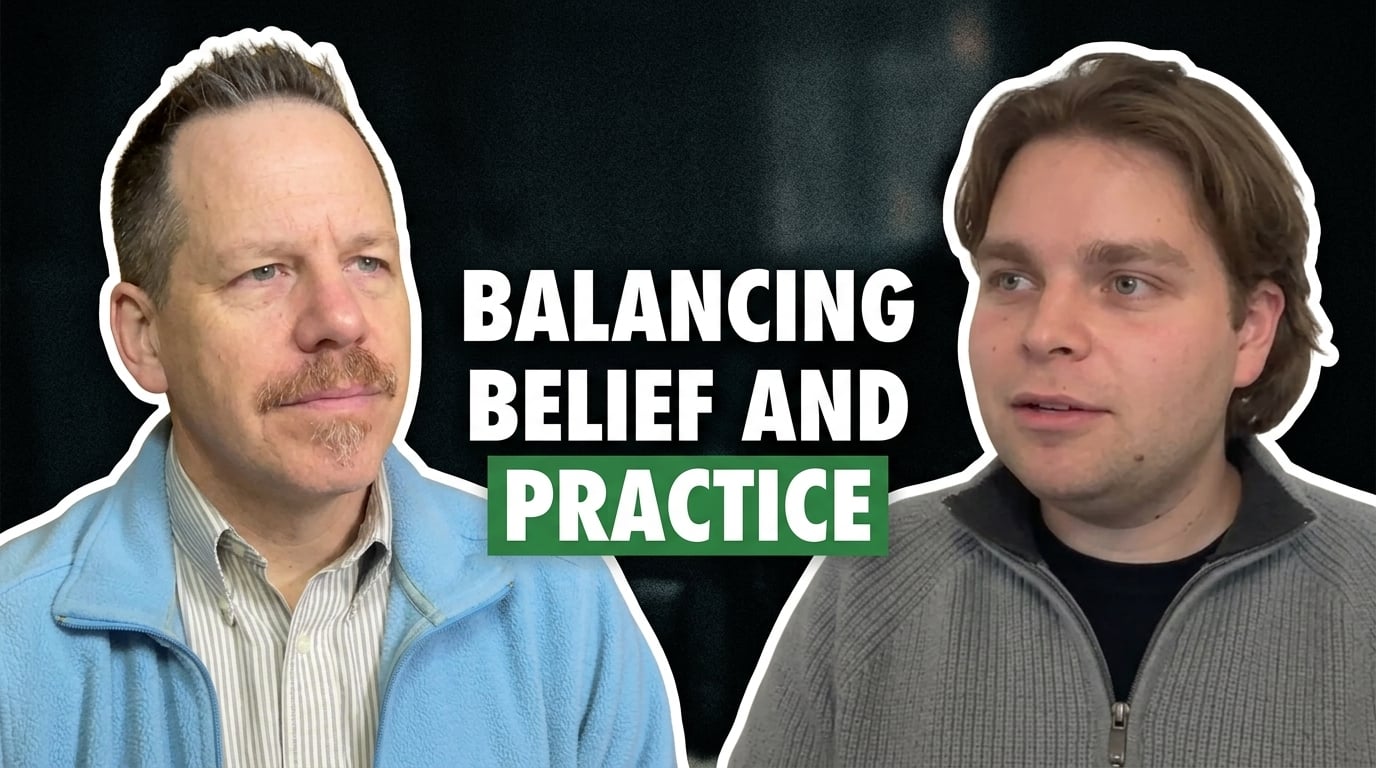
A conversation with Jack Tripp, author of “Toward a Quaker Pedagogy.”
How do we talk about Quakerism? Do we start with our beliefs or our practices. Senior editor Martin Kelley talks with Quaker educator Jack Tripp about what it means to be a Quaker, how Quaker practices are taught and experienced, and how to introduce newcomers to Quaker worship and community.
Bio
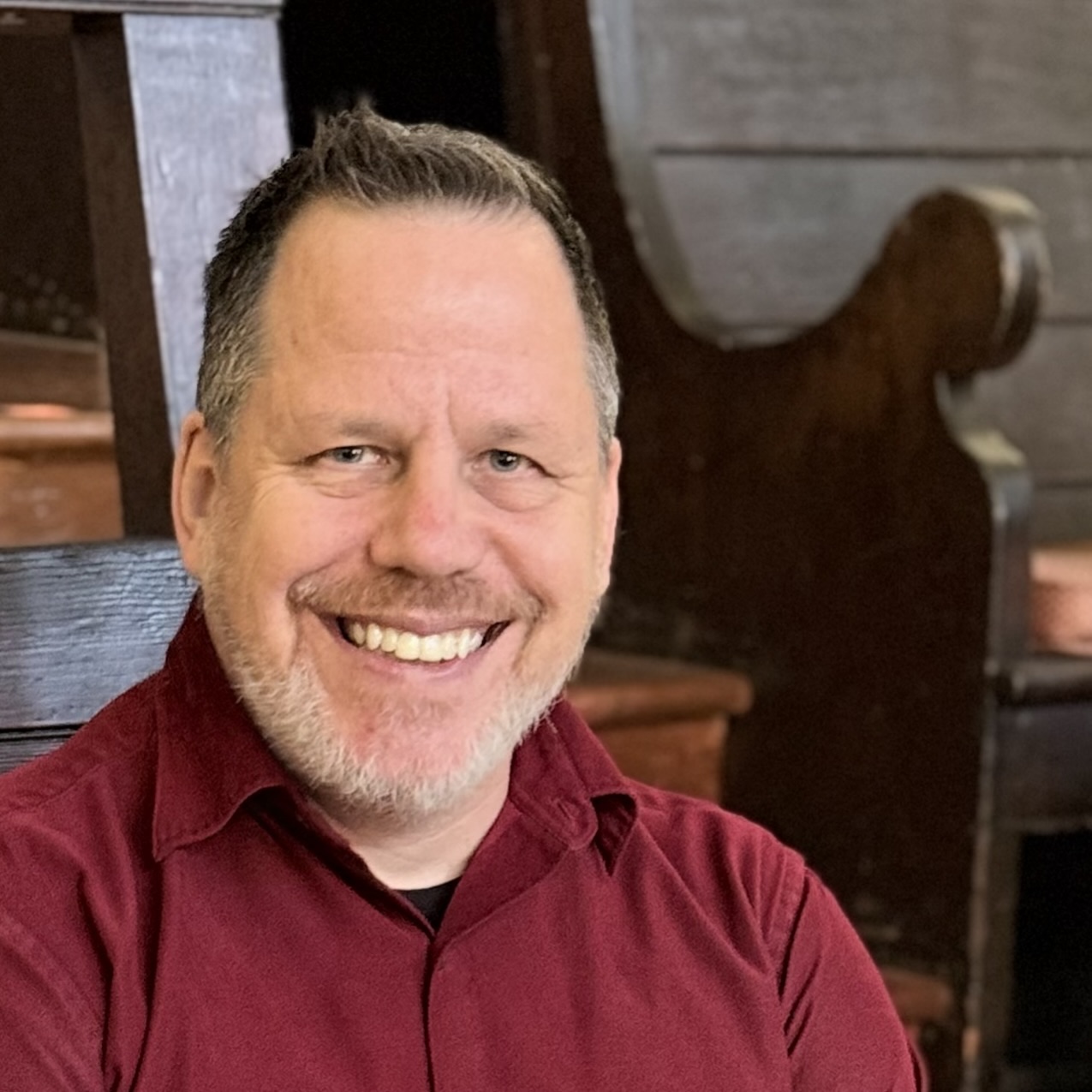
Jack Tripp grew up attending Allens Neck Meeting in South Dartmouth, Mass., and Moses Brown School, a Friends school in Providence, R.I., where he returned to teach English after graduate school.
Transcript
Martin Kelley (00:01.404)
Hi, I’m Martin Kelly, and this is Quaker Talk, the occasional Friends Journal podcast where we talk to authors. And today we’re going to talk about what it means to be a Quaker and how we describe what it means to be a Quaker. So I don’t know about you all, but when I’m in the public and someone says, Well, what do Quakers believe? You know, there’s that moment where you’re just like, and you stop and you start calculating, like, are they being polite? Do they just want a 20-second answer so they can move on with their day?
Are they looking for 300 years of history and battle and so forth? what has happened with Quakers? And are they talking about all Quakers? Are they talking about Quakers in the area that they might run into? it can be quite a a challenge to describe. so today I’m here with Jack Tripp, who teaches at Moses Brown School and has to teach what it means to be a Quaker. Hi, Jack, welcome.
Jack Tripp (00:56.406)
Hi, very happy to be here.
Martin Kelley (00:58.871)
and you have a a a great story here. So you were a student at Moses Brown School in Providence, Rhode Island. then you went off in college and grad school and teaching certifications, I suppose, and then you you came back.
Jack Tripp (01:13.078)
Yes, and I’m very happy to be back.
Martin Kelley (01:16.037)
Yeah. And what what’s it like to to be back in the other side of the the the table there?
Jack Tripp (01:21.666)
You know, there were certain things that were unnerving at first. I remember especially realizing how much teachers talk about students, just mainly out of necessity, and realizing, wow, my teachers talk about me this much. And yeah. Which is especially apparent when the teacher talking to you about a student was your ninth-grade teacher, was your
Martin Kelley (01:44.836)
I’m sure you must have some of your own teachers now as colleagues.
Jack Tripp (01:47.757)
Yeah, yeah, yeah. No, my department head is my ninth grade teacher and one of the other English teachers in the department was my eleventh grade teacher. and it made me grateful that I was calling them by their first names while I was a student. So there was no adjustment there, even if there were on other registers. Yeah.
Martin Kelley (02:07.3)
Right. So that’s a common thing for Friend school to to call not use it’s the old not using honorifics, I guess. So you don’t have the Mr. or Mrs., you have just the first name. that’s right.
Jack Tripp (02:16.866)
Yeah. Yeah. We have a few teachers who so who choose to go by Mr. Mrs., but but almost all of our teachers in the upper school, especially, are first name. Yeah.
Martin Kelley (02:27.425)
and and friend schools, too. For those who don’t know, probably most of your students, the great majority are are not Quaker.
Jack Tripp (02:33.932)
Yeah, no, I think in the entire student body of seven hundred and fifty students, we have maybe seventeen Quakers. yeah, so usually it hovers around two percent of the school is Quaker at any one time.
Martin Kelley (02:40.216)
Okay.
Martin Kelley (02:47.0)
Sure. And so how do you describe? Because I mean there’s no sort of beating kids on the head over what Quakers should be, that they should all be Quakers. but there is you’re our teaching Quakerism. There is probably a meeting for worship, there often is, at some point during the week. So so how do you how do you do this? How do you describe what Quakers believe to all these mostly non Quakers, 95% non-Quakers?
without scaring them off, without dumbing it down. what’s the challenge?
Jack Tripp (03:18.274)
Yeah. Yeah. I mean, we have Meeting for Worship every week. and you know, especially among my friends who are alums and who are not necessarily Quaker, as they look back on it, they really see Meeting for Worship as the central experience of of Quakerism for them at school. and in my classes I find that, you know, when I lead with a discussion about values or beliefs.
That can often actually shut down conversation. whereas when I lead with a practice like introducing class with silence, or having student-led discussions, where they’re supposed to come to some sense of the group, that’s much more tangible for students. and that’s much more accessible. And they can adopt that without necessarily identifying as Quaker.
Martin Kelley (03:54.781)
Jack Tripp (04:15.628)
You know, it’s much easier for them to take a practice and incorporate that into their own lives. and then if later down the road they want to identify as Quaker or firmly decide against it, you know, that’s really not my concern at all. especially when we think about, you know, a history of Quakers as a non-prostitizing tradition in the ideal form, although of course there was a rich history of proselytization among Quakers. Yeah.
Martin Kelley (04:16.596)
Yeah.
Martin Kelley (04:39.842)
Mm-hmm.
Martin Kelley (04:43.977)
True. Yeah. but you often, I mean, I I I think that graduates of friend schools are one of the sort of entry points for for Quakers. I’ve met plenty of people who, you know, they’re in their 20s, they’re in their 30s, they’re looking for religious tradition, and they went to a friend school and I go, yeah, you know, I might have complained about that meeting for worship at the school at the time. And what are we doing here? And is it just a you know, sitting around, but
They’re they’re seeking it out and they they come back to friends. So there are people who come to friends because of their experience in friend school.
Jack Tripp (05:17.418)
Absolutely, absolutely. And, you know, my friends who are now ten years out of school and are not Quaker and haven’t been going to Mean for Worship, they really miss it. and they really miss the experience of being in a Quaker community. I think especially since that Quaker community was not saying, you know, providing rigid confines for how to be Quaker. and was letting students find their own way in a way that was autonomous and felt empowering for them.
Martin Kelley (05:49.109)
So so how do you what what kind of things if you know someone comes up to you, you know, what do Quakers believe or how do Quakers practice? Do you have a the elevator pitch, the 30 seconds that you can describe? Or do you have that moment where you’re just trying to calculate are are they looking for the quick pitch? Are they looking for details?
Jack Tripp (06:06.19)
Absolutely, all the time. All the time. and I’ve I’ve, you know, I’ve started saying something like actually it’s it’s really hard to say what Quakers believe. and it’s actually impossible to say what all Quakers believe. because Quakerism from its founding was actually grounded in the experience of sacredness. and that’s not something that I can explain to someone else.
In its fullness and in its richness. and if someone asks what Quakers believe, I I the best I can do is invite them to Meeting for Worship. and the best I can do is invite them into a Quaker community and let them have that experience for themselves. and let them find that definition on their own. yeah.
Martin Kelley (06:47.017)
well, great. And you are you also grew up as a Quaker, not just as a student. do you still participate in that community? I I don’t know the geographies of where you grew up and how close it is to the school and
Jack Tripp (07:08.384)
Yeah. Yeah, I do. The community that I grew up in is about forty-five minutes away. so honestly, I don’t often make it out on Sundays. but it’s still a place that’s very special to me. and it’s a place that I love to visit and go to. but during the school year, most of my I f feel like I’m practicing my Quakerism at school. and the experience of sitting down to meeting for worship with four hundred students.
last week we had an all-school meeting for worship and that was a thousand people. it’s something yeah, no, much bigger than any meeting, right? Any meeting, any meeting since yeah, for a few centuries. I think we’re the biggest weekly meeting for worship in New England. and maybe and maybe in North America. and that’s that’s a really it’s a really rich space.
Martin Kelley (07:43.002)
lot bigger than my meeting. Yeah.
Martin Kelley (07:58.055)
Mm-hmm. We probably are, yeah.
Jack Tripp (08:08.65)
And so that’s yeah, that’s that’s where I get my quakerism in. And actually right after this call, I’ll be off to meeting for worship. Yeah. Yeah.
Martin Kelley (08:16.407)
Lovely. Yeah, we had we we used to have this writing program. sorry, we don’t anymore, but for students at Quaker schools to write about various topics and we would have a prompt. And on the sort of the intake form for it, there’d be a question about what is your, you know, do you have a Quaker affiliation? Many wouldn’t, and that was fine. but if you do, what is what is your meeting? And some of them would write down the the school’s meeting for worship.
Was there was there they identified their Quake as Quaker and it was the school’s meeting for worship. And you know, first I was like, that’s not proper, but then I was like, Well, yeah, I mean, if they are doing this worship with a thousand people every week and it’s just a core part of their sort of spiritual understanding, then yes, that that is Quaker.
Jack Tripp (09:04.598)
Yeah, yeah. And we’re a nursery through twelve school. so if a student starts a nursery and continues through our upper school, they will have gone to a lot of meeting for worships, even if they you know, didn’t grow up in a meeting. they sort of did. They grew up in the meeting of the school. Yeah.
Martin Kelley (09:21.485)
Yeah. Well, that’s lovely. I I mean I think that one of the things we have these days is that there’s so many different ways to be Quakers. Like fifty years ago it was, you know, you had to go to a specific monthly meeting and and attend and participate. But you see all sorts of, you know, there’s online worship now, there’s all sorts of discussion boards where people are discussing and debating what it means to be a Quaker. Like there’s so many different routes. And I think part of our you know
problem now ideas, our challenge is to figure out well, how do we incorporate all that? You know, what what is the that Quaker identity if it can be all sorts of things and people are identifying as Quakers, even you know, if they’re not part of our old institutional structures.
Jack Tripp (10:03.33)
Yeah. Yeah. And those many different avenues in provide so many more accessible ways to to access that experience, right? As long as people are, you know, coming to a place and sitting down with other people. I mean, I think that is sort of the fundamental unifying principle, the, you know, sitting in silence with each other. and often I find, you know, I will have friends who are interested in Quakerism.
And go to a Quaker meeting and, you know, like may love the experience. but w in Quaker meeting we don’t talk about what we do or, you know, what it means to sit in the silence in in any structured way. and I’ve been to meetings where there’s actually really no explanation ahead of time. You know, people are expected to show up and sort of just know what to do. which those of us who have been attending meeting for a long time do, but if
Martin Kelley (10:41.144)
Any point?
Martin Kelley (10:50.531)
Yeah.
Jack Tripp (10:58.37)
You want to experience a Quaker community and you want to show up as a newcomer to Meeting for Worship. walking into a room where everyone’s already sitting silently is I think a terrifying experience. And that’s very human and very normal. and I like the idea of, you know, having more conversation about how we’re opening ourselves to people who are not Quaker, and how we’re communicating who we are and what we do.
Martin Kelley (11:09.037)
Yeah.
Jack Tripp (11:28.256)
Especially that what we do part, to people who are not already friends and maybe have no experience in meeting for worship.
Martin Kelley (11:35.421)
And and as as a Quaker teacher, I’m wondering what advice you would have to meetings. I mean, I’m thinking my own meeting, we’re we’re gonna have an open house this next weekend. We’re inviting community to come and maybe it’ll be ten people, maybe it’ll be more, hopefully, you know, 30, 40 people might come. and it’s
introducing them to to who we are and we’re gonna have like a little bit of mini worship during it and some people talking about it. But how can meetings make that easier for newcomers to give them explanations? I mean should there be some sort of programming at the beginning where we describe what it means to to be worshiping? Should there be more programs afterwards? just from the educational standpoint, what would be a good way of of pulling people in and not just
Tossing them in a deep end.
Jack Tripp (12:24.256)
Yeah, I think my favorite things that I’ve taken away from friends I know are when they describe w what they’re doing during Meeting for Worship. you know, some people say they’re meditating, some people are focusing on something. I had a second grade teacher who described how she had a little man who came into her head and swept all the thoughts away.
And then the thoughts came back, and the ones that really came back were the messages or were the leadings, or were the things that were significant. And I I think about that little man very often in meeting for worship. Yeah. He’s a little old man, he’s harmless. He yeah. He’s sweeping very diligently. but I think talking ahead of time about what actually goes on for us as individuals.
Martin Kelley (13:04.35)
great metaphor. A little scary, but fascinating, yeah.
Okay.
Jack Tripp (13:20.448)
in Meaningful Worship, you know, individuals as sort of the the unit of Quakerism in a certain way. and how we’re experiencing our movings or our light or our voice within. and then talking about the experience after and giving newcomers the opportunity to reflect on that experience. I had an interesting conversation once with someone in my I went to divinity school.
and did a master’s in religious studies. and I spoke with someone once who was running a Buddhist meditation group. and she was like, You don’t she was so surprised that we don’t reflect at the end of meeting what happened to us. because she thought, yeah, in in especially in a meditation training, for a lot of people it can be a very intense experience.
Martin Kelley (14:00.011)
Mm-hmm
Martin Kelley (14:11.531)
That’s a normal practice for them, yeah.
huh.
Jack Tripp (14:19.926)
sitting in silence for 45 minutes or an hour, even half an hour. and so part of the meditation training procedure was to make sure that there was space afterwards to wind down, to move out of the space, or to think about how you were incorporating what you experienced in the space of the meditation in your sort of you know, talking, waking, noisy life.
Martin Kelley (14:48.65)
Yeah. That sounds that sounds great. trying to think how I would incorporate that into worship. you know, we do have these kind of rituals, you know, we have the the breaking of the the worship with the shaking of hands and greetings, and some meetings have, you know, long announcement sessions and coffee hour afterwards can be helpful. So I mean we have these kind of traditions that we don’t
Jack Tripp (15:08.684)
And coffee hours, right? Yeah.
Martin Kelley (15:14.577)
think of as part of worship, but maybe they really are, you know, they are kind of coming down off the worship. so interesting. And maybe we should think about how to be more intentional. sometimes it’s all the regulars and, you know, we don’t need that, you know, describing. But even then maybe we do. I I know we’ve had some religious head where we talked about what we all believed. We watched a video, talked about what we all believed. And I I was surprised, you know, people I’ve been worshiping with for years, you know, what they would say.
Jack Tripp (15:16.194)
Yeah. Yeah.
Jack Tripp (15:42.522)
And something I’ve loved, especially I’ve seen it introduced recently in New England meetings. I’m sure it’s been done longer in other meetings, but like the introduction of a joys and concerns period. when you’re not necessarily sharing the things that might have been moving you to speak during Meaning for Worship, but you might be sharing things that came up for you, and may not quite be messages, but are certainly things that are on your mind. and that feels like a space bridging that.
intensity of meaningful worship, and yeah, and the life outside the meeting house.
Martin Kelley (16:21.081)
Sure. And some meetings have afterthoughts too, which is another kind of technique we have for doing that kind of bridging. So yeah, useful to think about just as part of the worship and as a way of educating and bringing people together. well, thank you, Jack. This has been really great. And I’m I’m jealous that you get to go off to one thousand person worship now or however many show up this today. Four hundred today.
Jack Tripp (16:35.848)
Mm. Yeah, absolutely.
Jack Tripp (16:47.662)
Four hundred today, but still. Yeah.
Martin Kelley (16:50.115)
Amazing still. I hope it’s it’s very deep and moving for everyone.
Jack Tripp (16:55.128)
Thank you. Thank you very much, Martin. It was great to chat. Yeah.
Martin Kelley (16:56.954)
Thanks for being here.
We want to hear from you, not an AI! Please be thoughtful and use your own words. Comments on Friendsjournal.org may be used in the Forum of the print magazine and may be edited for length and clarity.