



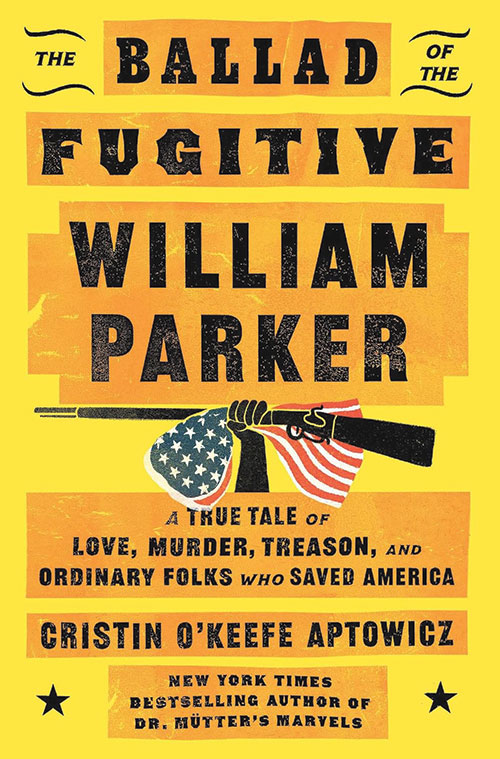
The Ballad of the Fugitive William Parker: A True Tale of Love, Murder, Treason, and Ordinary Folks Who Saved America
Reviewed by Cameron McWhirter
November 1, 2026
By Cristin O’Keefe Aptowicz. Simon & Schuster, 2026. 448 pages. $31/hardcover; $16.99/eBook.
On September 11, 1851, a clash erupted at a farmhouse in rural Pennsylvania that would make national headlines, lay bare the weakness of the federal government, and push the nation closer to a bloody civil war over slavery.
White slaveholder Marylander Edward Gorsuch arrived at the house in Christiana, Pa., with law officers, a posse, and federal arrest warrants to recover what he claimed was his “property”: Black men who had fled enslavement. The farmhouse was the home of William Parker, a Black man who had escaped slavery years ago. His home became known as a safe place for Black people escaping from the South. Gorsuch demanded the men come out of the house. They refused, and Parker came out and told the posse to leave. After an alarm was sounded, armed Black neighbors and white Quakers arrived to surround the house.
“I’ll have my property or go to hell!” Gorsuch yelled. Fighting and shooting erupted. Within minutes, Gorsuch was dead and his son critically wounded. The rest of the posse fled. National uproar ensued.
The so-called Compromise of 1850, which included the Fugitive Slave Act, divided the nation into free and slave states and allowed slaveholders to go into “free” states and round up alleged slaves. The events at the farmhouse revealed the compromise to be an unworkable and immoral sham. It was a key moment in the nation’s descent into bloody Civil War.
What became known for generations as the “Christiana Riot” has been written about before, and by some excellent historians. Now Cristin O’Keefe Aptowicz has brought her poetic and narrative skills to the story, which she first encountered while researching her Pennsylvania ancestors’ involvement in the Underground Railroad. She has made a concerted effort to give the Parkers, the men who escaped Gorsuch, and others a larger part of a narrative that for too long emphasized white participants. In the past, Quakers, who played a significant role in the Underground Railroad and in Christiana specifically, were often made the saga’s heroes, even though it was actually the Black free men and escaped enslaved people who fought off the posse.
“The public had become invested in a narrative of resolute Quakers conducting a righteous crusade for liberty—with the weapon-wielding, Bible-quoting, hymn-singing, and fiercely defiant Black resisters relegated largely to the role of nameless minor characters,” Aptowicz writes.
With this book, she sets out to change that. Learned in the history of Philadelphia and Pennsylvania, Aptowicz does a masterful job setting the stage for that violent day and detailing its aftermath. Her pace is brisk and her style taut, though the effort is flawed by some factual errors and the taking of liberties with evidence to present colorful scenes to the reader.
Quakers are a large part of the story, but Aptowicz works hard to make sure Parker, who was forced to flee to Canada after the violence, assumes his central and rightful role in the saga. The book is full of well-sketched historical figures, including Frederick Douglass, Thaddeus Stevens, and Lucretia Mott.
The book presents vivid and tense scenes, including when Parker and other Black men escape north on a train as news of the violence makes headlines across the country. In a railroad car, Parker speaks with a seemingly sympathetic white man who may or may not know who he is.
Aptowicz’s telling hews close to the historical record, with a few instances of speculation. The book’s subtitle is a bit of a stretch, as the violence that day was not any effort to save America but—perhaps more importantly—an effort by those who attacked Gorsuch to save themselves and assert their right to live free from the fear of enslavement.
The Ballad of the Fugitive William Parker is important for Quakers because it reveals a moral tension in the Religious Society of Friends’ commitment to nonviolence. Throughout American history, Quakers have espoused nonviolence, often at great risk to themselves and their families, but at times they have done so from a relatively comfortable economic and political position. A white farmer in Pennsylvania could argue for nonviolence, but could a Black neighbor who escaped slavery be expected to embrace the same view? If that neighbor wanted freedom, nonviolence wasn’t an option.
As Aptowicz writes: “Parker knew the Quaker way: They didn’t believe violence solved anything. He’d have liked nothing better than to live in a world where he could afford to believe that, too.”
At one point, Parker tells a Quaker woman who is his neighbor: “If the laws protected us colored men as they do white men, I would be a nonresistant.”
Cameron McWhirter is a journalist. He is coauthor of American Gun: The True Story of the AR-15 and author of Red Summer: The Summer of 1919 and the Awakening of Black America. He is a member of Atlanta (Ga.) Meeting. He has served on the Board of Trustees of Friends Publishing Corporation, publisher of Friends Journal.

We want to hear from you, not an AI! Please be thoughtful and use your own words. Comments on Friendsjournal.org may be used in the Forum of the print magazine and may be edited for length and clarity.