




A Reckoning for Quakers
On the morning of October 6, 2025, the sun shone brightly in a clear sky, and the wind rustled the tall grasses on the plains near the Oklahoma town of Concho, territory of the Cheyenne and Arapaho people. Hundreds of men in cowboy hats and women wearing shawls gathered quietly around two tipis, one Cheyenne and the other Arapaho. Inside the tipis lay large wooden boxes wrapped in blankets. They held the remains of children who had died at Carlisle Indian Industrial School in Pennsylvania more than a century earlier. The children had been brought home at last.
Slowly, mourners entered the tipis, leaving shoes outside, and circled past the boxes, each marked with a child’s name. Twelve boxes were in the Cheyenne tipi, four in the Arapaho one. Tribal officials had gone through years of negotiations with the U.S. Army to bring these 16 children home from the U.S. Army War College in Carlisle, Pennsylvania, the site of the former school. Family members and tribal officials traveled to Carlisle and conducted ceremonies at the cemetery prior to the exhumation. The Army put the children’s remains in labeled wooden boxes and delivered them to the tribes in Oklahoma. At the tipis, they were taken under the care of Cheyenne members of the Dog Soldiers and Bowstring Societies, and by Arapaho ceremonial men.

We two Quaker women were among the hundreds of people gathered around the tipis. We had been invited to bridge 155 years of Quaker history with the Cheyenne and Arapaho people. As members of the Quakers and Indian Boarding Schools Research Network (QIBS), we have been researching the roles Quakers played in the forced assimilation of Native children through the operation of Indian boarding schools.
Paula Keeth did research specifically on the on-reservation Quaker boarding schools for Cheyenne and Arapaho youth, which operated from 1871 to 1881. The first school had both Arapaho and Cheyenne students. It was financed by the U.S. federal government and the Associated Executive Committee of Friends on Indian Affairs, an organization of nine Orthodox yearly meetings. The teachers, matrons, and industrial teachers were all Quakers. The curriculum included arithmetic, reading and writing in English, and vocational training in farming and stock-raising for boys and domestic arts for girls. The children’s labor contributed to the maintenance of the school. Enrollment climbed from 35 in 1871 to 150 in 1879, when a separate school was built a few miles away for the Cheyenne. Quakers operated the separate boarding schools for just two years, then turned management over to the Mennonites and eventually to the federal government.
During the late-nineteenth century, most Christian denominations operated Indian boarding schools in collaboration with the federal government’s policy of forced assimilation. The Quakers’ goals were overtly to assimilate the children: to lead them “to a higher life than that to which they have been accustomed in their wild condition,” according to an 1875 report to the Board of Indian Commissioners. Quakers at that time believed Native nations were inferior societies that would soon vanish. Their hope was to “rescue” the children by separating them from their families and teaching them the “superior” ways of Euro-American Christians. If they had any sense of the harms they were inflicting on the children, their families, and the tribes, those harms seemed less important to them than the goal of making Native people into what Quakers called “useful citizens.” (To learn more about the 30 Quaker-operated Indian boarding schools and how meetings are taking reparative actions, visit friendspeaceteams.org/trr.)

The QIBS research network sent Keeth’s research findings to Arapaho and Cheyenne tribal officials Fred Mosqueda and Chester Whiteman at the National Native American Boarding School Healing Coalition (NABS). They both help implement the Native American Graves Protection and Repatriation Act as their tribe’s NAGPRA officers. They also respectively serve as the Arapaho and Cheyenne outreach specialists for their tribe’s language and culture departments.
But the story didn’t end in 1881 when the Quaker schools closed. J.D. Miles, the Quaker Indian agent in charge of the Cheyenne-Arapaho Agency, remained at his government post until 1884. During his last four years, he signed transfer papers sending 227 Arapaho and Cheyenne youths to Carlisle.
At the National Archives at Fort Worth, in Texas, Keeth found a ledger that recorded the names of these children, their fathers’ names, their tribes, and dates of their transfer to and return from Carlisle. Ten of the children sent to Carlisle by J.D. Miles never returned. Nine children died at the institution and were buried in the cemetery; one youth died while living with a family in Reedsville, Pennsylvania, and is buried there. Keeth and fellow QIBS member Andrew Grant worked with archivists at Dickinson College’s Carlisle Indian School Digital Resource Center and the Oklahoma Historical Society to learn as much as they could about these children. Grant is doing further research on all the ways that Friends supported Carlisle’s assimilationist mission as philanthropists, teachers, and staff members. A next step will be to learn about other Quaker Indian agents who may have transferred children to the government schools.
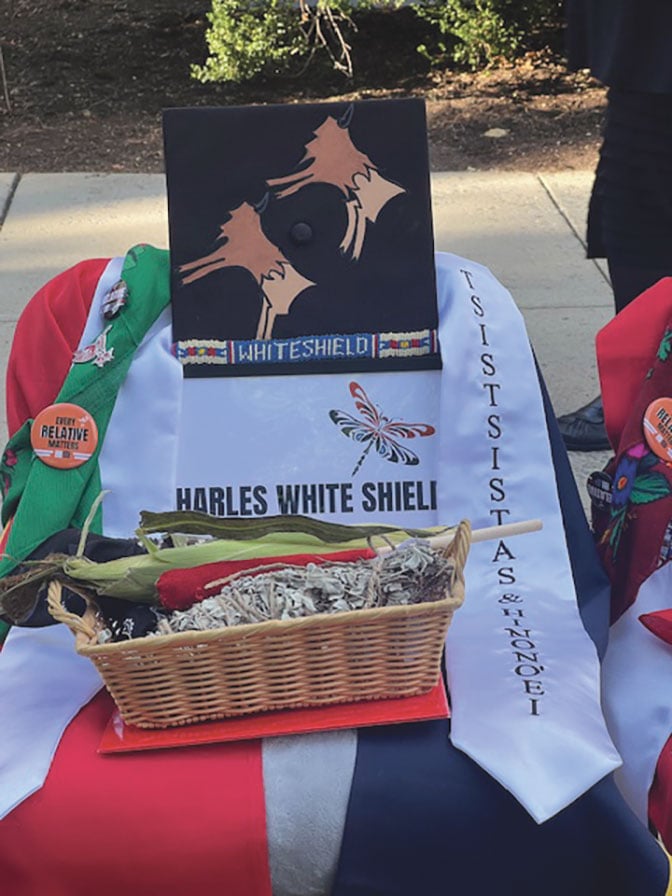
Keeth and Grant learned that among the 16 children whose remains were returned to the tribes last October, two Arapaho and five Cheyenne youths had been sent to Carlisle by Quaker Indian Agent J.D. Miles. The Arapaho youths who were brought home were Leah Roadtraveller and Wah-she-he. The Cheyenne youths were Giles Hands, Motavito Horse, Lou Thunder, Dora Morning, and Charles White Shield. They ranged in age from 12 to 18 at the time of their deaths. The cause of death was rarely recorded.

Paula Keeth feels close to this story because of the research she conducted. Paula Palmer has an additional connection. In 2016, she co-founded a local organization called Right Relationship Boulder (RRB). Its mission is to build relationships with the Native Peoples who were forcibly removed from the Boulder Valley—the Arapaho and Cheyenne—and welcome them back to their Boulder Valley homeland. She visited the Oklahoma tribes in 2017, and personal friendships have grown through nearly a decade of collaborative projects and activities. Boulder Friends give annual financial contributions to support some of these efforts. Through her friendship with Arapaho and Cheyenne tribal officers Fred Mosqueda and Chester Whiteman, Palmer felt she could ask whether a Quaker presence during the October “Carlisle Homecoming” ceremonies would be welcomed. They assured her it would be. Fred Mosqueda told her, “Before we received your reports, we had only seen the children’s names on the censuses, and then they disappeared. We didn’t know what happened to them. You helped us find our children and bring them home. Thank you for coming.”
The Southern Arapaho (Hinono’ei in their language) and Southern Cheyenne (Tsistsistas) are separate tribal nations under one governance structure that was recognized by the federal government in 1937: the Cheyenne and Arapaho Tribes of Oklahoma, headquartered in Concho, Oklahoma.
We two Paulas drove together from Dallas, Texas, to Concho on October 5. In the late afternoon, we found the Cheyenne and Arapaho tipis that stood downhill from a fenced-in burial site. Chester Whiteman, who serves as headman of the Cheyenne Dog Soldiers and the Bowstring Societies, invited us to enter the Cheyenne tipi. We did so reverently, pausing at each blanket-covered box to acknowledge the familiar names of the children. At the Arapaho tipi, Fred Mosqueda, who with his wife, Mary, call themselves “praying people,” invited us to enter the tipi and meditate for a while. It was good to be with the children in the stillness.
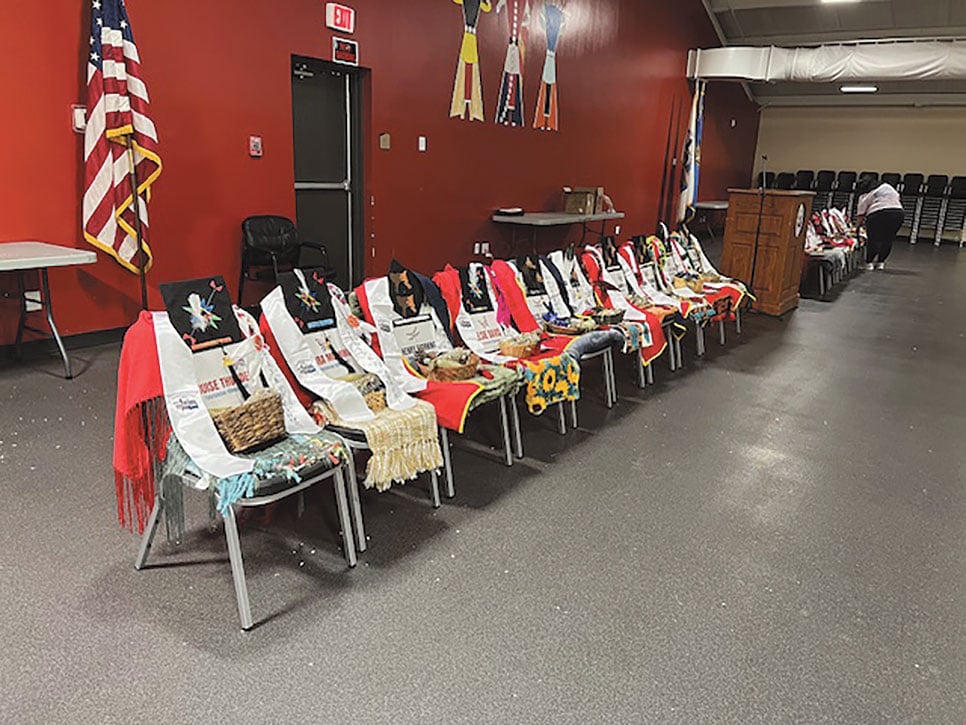
At 6 o’clock that evening, we accompanied Arapaho Chief Elvin Kenrick and his wife, Susan, to the wake. In the large assembly room, 16 chairs faced the audience, each decorated in memory of the 16 returned youths. A row of speakers sat behind these chairs, and we were surprised to be ushered to sit with them. We had been told that it would be good for us to speak at the wake: to tell the families why Quakers are part of this story, but we hadn’t realized we would be listed on the program as speakers. The wake opened with a prayer, followed by Cheyenne and Arapaho memorial songs, Cheyenne and Arapaho Christian hymns, and words from governor Reggie Wassana; Lieutenant Governor Hershel Gorham; and Larenda Morgan, chair for Missing and Murdered Indigenous Peoples. Amanda Cheromiah (Laguna Pueblo) spoke on behalf of the Center for the Futures of Native Peoples at Dickinson College, which hosted the Arapaho and Cheyenne families on their visits to Carlisle.
When we were called to speak, we read from a letter we had sent in advance to Arapaho and Cheyenne families and tribal officers. In part, it read:
We grieve the deaths of these children, knowing that the actions of our Quaker forebears are at least in part responsible. We are deeply sorry for the harms and losses the Arapaho and Cheyenne people have suffered. Feeling this remorse, we humbly hope to build new relationships with the tribes, based on truth, respect, justice, and our shared humanity. In this spirit, we are with you here today.
Then, with many tears and hugs, family members of each child eulogized their deceased relative and read obituaries. Among the many very moving statements, we remember these:
“It’s so heartbreaking to know how frightened and lonely these children must have been, so far away from home. It’s hard knowing how they were mistreated. But they had each other.”
“We weep not only because of the suffering of the children, but also remembering the pain of their parents, siblings, and grandparents, as the children were taken from them. They couldn’t know what was happening to the children. There was no way they could comfort them. No way they could help. How could they have endured that pain?”
“I have heard it said that each person dies twice. First is the death of the body. The second is the last time the person’s name is spoken. I think these children will live a long time.”
“These children never should have been taken from us, stolen from us. It hurts me; it angers me. Who might these children have become? Their loss is a loss for the tribe as a whole. We are still suffering the consequences.”
“Our children are home now. They are at home! It was an arduous journey. Thank you to everyone who helped bring them home to rest.”
Some of the youths did not have family members present at the wake, so others read the obituaries for them. Although they were not family members in the usual sense, they spoke with deep emotion, embracing the youths as family. The wake ended with a closing prayer.
The next morning, along with hundreds of mourners, we followed Chester Whiteman and the Cheyenne military society men, who, with drumming and singing, carried the 12 Cheyenne children up the hill to the fenced burial site. Before the boxes were lowered into the graves, family members put gifts on them to accompany the children on their final journey. We laid our gifts on the boxes too: T-shirts for each child with a design of Rocky Mountain flowers, reminiscent of their Colorado homeland. When the boxes were lowered, we filed by, adding a handful of red earth to each grave. Chester Whiteman reflected on the ceremony, “What a joyous moment, after so many years, for our ancestors to finally come home to rest.”
The Arapaho ceremonial men then carried the Arapaho children from the tipi to the burial site, drumming and singing the Arapaho Eagle Song. As we placed gifts on the four Arapaho boxes, they sang an Arapaho Memorial Song, and Fred Mosqueda and his son sang an Arapaho Traveling Song that is only sung at funerals. The final song was an Arapaho Chief’s Memorial Song because, Mosqueda said, all four Arapaho children descended from chiefs.
“More children will come home to us,” Mosqueda told us. “We are looking for them, and we will care for them.” Another Arapaho child who died while attending a Quaker-operated Indian boarding school in West Branch, Iowa, remains in a cemetery there after Fred and Mary Mosqueda visited and prayed at the gravesite in 2024. “She will be safe there,” Mosqueda said. QIBS researchers are sending information about children who died at other Quaker schools to their tribes and to the National Native American Boarding School Healing Coalition.

Personal Reflections
Paula Keeth: It was such a great honor for us to witness these rematriations. We were not only non-Native but Quakers whose spiritual ancestors were involved in every aspect of assimilating boarding schools. I was honored to speak with family members and ask, “Who was your ancestor?” A relative of Elsie Davis shared what she had learned about her growing up and shared family pictures with me. I obtained contact information for several family members and promised I would send them additional information. They were all eager to know more.
Paula Palmer: We were wearing dresses out of respect, although dresses are unusual attire for both of us. Maybe that made it easier for me to feel present there as a nineteenth-century Friend and also as myself at this moment in time. It felt important to bridge the 155 years of shared history among the Arapaho, Cheyenne, and Quakers. Through our research, we have learned who Quakers were then, and how their actions have reverberated through centuries. Now we ask: Who are Quakers today? What actions are we taking now, and how will they reverberate into the future?
Fred Mosqueda and Chester Whiteman of the Cheyenne and Arapaho Tribes both expressed appreciation and gave their approval of this article.


We want to hear from you, not an AI! Please be thoughtful and use your own words. Comments on Friendsjournal.org may be used in the Forum of the print magazine and may be edited for length and clarity.