



“It’s your duty to go into the military, Son! Your brother got sent to Hawaii. You’ll be okay,” John’s father, Ernie, said.
John and I were arguing with his father over the Vietnam War in his parents’ apartment on Telegraph Hill in San Francisco. It was a gloomy, foggy, December afternoon in 1968. I was 24 and John 23. We’d been married less than a year. John had just gotten his draft notice. His graduate student deferral had been denied. He was classified “1A.” John was declared “healthy and fit for duty and ordered to report to the San Francisco draft office on June 1, 1969.”
My husband’s older brother, Bud, had joined the army as a medical doctor, rather than waiting to be drafted into the infantry. That previous summer, Bud had lucked out and was sent to Tripler Army Medical Center in Honolulu for a three-year stint. He had the sickening assignment of patching up soldiers whose bodies were torn apart by Viet Cong Russian-made AK-47s and homemade booby traps but was spared from joining thousands of soldiers who were sent to kill or die in Vietnam.
“I’m not a doctor,” John said. “I won’t end up in Hawaii; I’ll be issued a gun and told to kill the enemy. I don’t believe in the Vietnam War, Dad. It’s racist and unprovoked. I’m not going to be any part of our country’s war mongering.”
“Well,” Ernie said, “if you go to Canada to avoid the draft, you’ll never see your mother or me again.” With that, Ernie left the room, ending the conversation.
John and I stared at each other. He was pursuing a doctorate in philosophy at Northwestern University and would one day serve as the Porterfield Professor of Biomedical Ethics and Professor of Philosophy and Public Health Sciences at the University of Virginia. I was teaching fourth grade in Evanston, Illinois, and would one day become a Baptist minister pastoring a church for marginalized people in Virginia. But in 1969, we were just a frightened and lonely couple who didn’t want to alienate our families. Both our parents and many of our friends supported the anti-Communist war in Southeast Asia. Finally, after many sleepless nights and heated conversations, we decided that instead of going to Canada we would do alternative service in the Peace Corps.
Unfortunately, neither of our families was happy with this decision. “You won’t survive in the jungle,” my mom said. “No air conditioning, no clean water, no electricity. I read that Sierra Leone, where you’re being sent, is called ‘white man’s graveyard’ because so many foreigners die of malaria there.”
With no other options, we decided to risk it and go anyway. John and I left San Francisco with our parents’ doomsday predictions ringing in our ears. We would spend the first two months in Sierra Leone training in Freetown; then we would go to the city of Bo, where we’d learn the tribal language of Mende, as well as the skills we would need for our assignments. John, who had only grown zucchini and radishes in his backyard when he was a child, was judged competent—according to his Peace Corps aptitude tests—to learn how to teach swamp rice cultivation to the nationals. Rice planted in bunds (shallow ditches) could be harvested three times a year rather, yielding more than the present practice of sowing a yearly crop of the traditional upland rice. I would use my experience as a teacher to demonstrate more effective educational methods than the rote memorization of facts and literary passages that was the norm for elementary students in this former British colony.
On our way to West Africa, we stopped in Philadelphia for a week of orientation and medical preparation. On the first day of orientation, the Peace Corp’s director, Sargent Shriver, spoke with us about the founding vision for the Corps. I will never forget his words, “We are dedicated to working with, living alongside, and celebrating cultures around the world. We partner with the nationals; we do not take control of the project but work with the people. We believe that through friendship, we will bring peace to our world.” Then Shriver interrupted his enthusiastic endorsement of the Corps and asked, “How many of you joined the Peace Corps to avoid the draft?”
Reluctantly, 90 percent of the men slowly raised their hands. “That’s fine with me,” said the assertive Shriver. “You may not have chosen the Corps for pure motives, but serving with the Peace Corps will change you forever. You will do more good for our country and for yourselves working with the poor overseas than you could ever do fighting Communism in Vietnam.”
Our whole group of 116 stood up and cheered. Here at last was a government official who was not touting the party line of the Domino Theory, the conviction that if Vietnam became Communist, the Chinese would take over the whole of East Asia. “Better dead than Red” was a popular slogan among U.S. politicians.
After two days of speeches and workshops on racism and multiculturalism, we were turned over to the physicians and dentists. Some of our group were “deselected” because of high blood pressure, and others were forced to have all their wisdom teeth immediately removed. Our orientation leaders told us, “There will be no doctors or dentists in your bush villages, so possible health problems have to be addressed before you get on the airplane for Sierra Leone.”
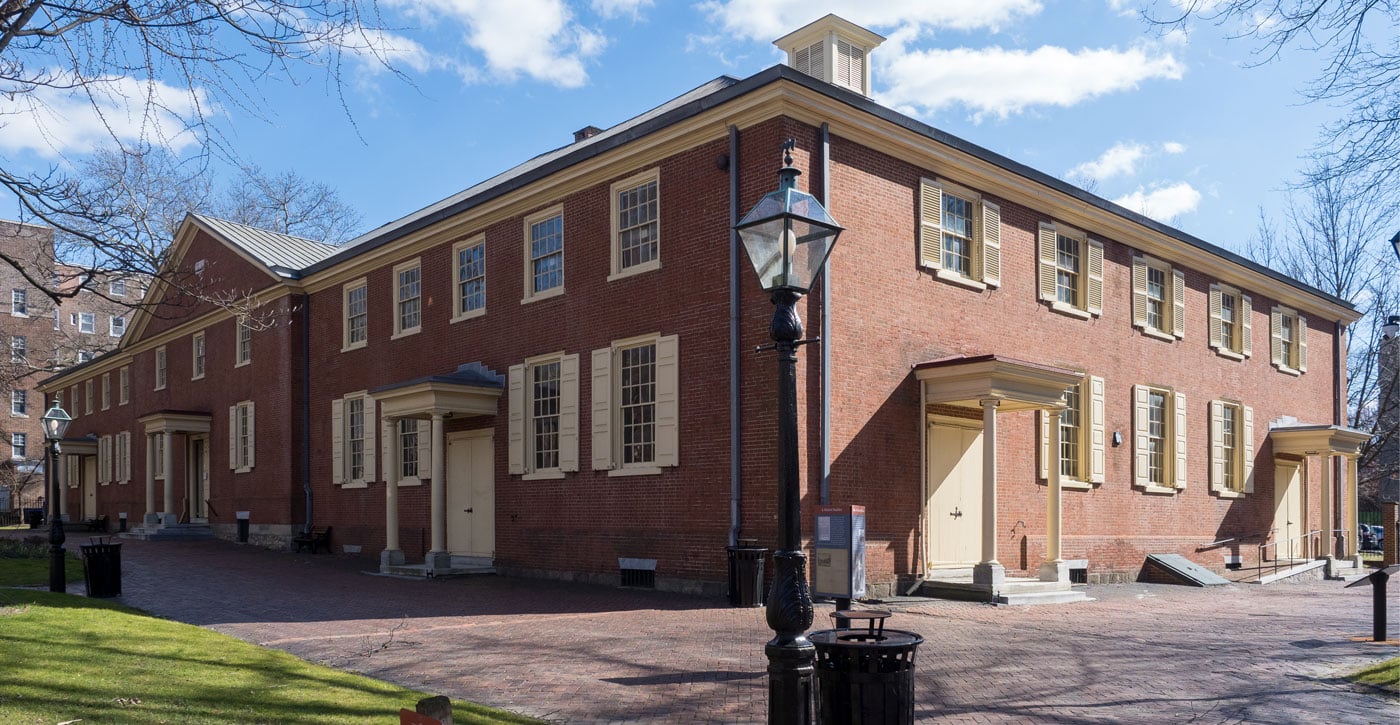
Luckily, John and I passed the health screening. We bypassed the dentists, both of us having had our wisdom teeth removed when we were teenagers. After running the medical and dental gauntlet, we were finally given our freedom for our last day in the United States. John and I decided to go to Independence Hall, which is in the center of Philadelphia. As we followed our map, we saw a two-storied brick, wood-framed building with a large cream-colored door and matching shutters. The sign in front read “Arch Street Meeting House.”
As we began to walk past this imposing building, a slim older woman dressed in a light-yellow suit, complete with stockings and black-patent leather high heels, beckoned to us from the gate. “Please come in and join our service,” she said. “We’re just about to start.”
John and I looked at each other and grinned. “Why not?,” we said. We walked through the black wrought-iron gate down a long, red-brick pathway where a well-dressed elderly gentleman stood at the entrance to the meetinghouse. He greeted us, shook our hands, and invited us to “sit down and join our silence until the Spirit moves someone to share their inner light.”
Although John and I had both been raised Catholic, where the churches were crowded with statues, candles, and altars, we felt immediately at ease in this sparsely furnished, bare-walled Quaker meetinghouse. We sat quietly on the dark, highly polished pews for a half-hour before someone began to speak. Ending our silence, a young woman cleared her throat and stood up. “Please hold in the light the medical supplies we sent to North Vietnam,” she said. “May the penicillin be used to save lives. May no one be arrested for ‘aiding the enemy’ since the government wouldn’t give us permission to send $25,000 worth of antibiotics to the Viet Cong.”
My heart fluttered. Here at last was a congregation that was against this senseless war, unlike many churches where the leaders were blessing bombs, praying for an American victory, and declaring “my country right or wrong!”
I felt that I’d found in the Religious Society of Friends the source of Sargent Shriver’s vision of “peace through friendship.” A burning sensation filled my chest; I squeezed John’s hand. Hesitatingly, I stood up, and with a quivering voice said, “Thank you for opposing this war. We’re going into the Peace Corps to avoid being part of this bloodbath. May God bless you.”
I sat down to an affirming silence. After the service, many of the Quakers gathered around and prayed for us. Their kindness and affirmation comforted and strengthened us as we got on the plane for the 18-hour flight to Sierra Leone. We kept recalling their prayers for us during our whole term of service in Moyamba, Sierra Leone, and afterwards, when we returned to the United States.
After coming home to San Francisco, we marched and protested with our Quaker friends against the Vietnam War for the next four years. In 1975, our country finally admitted defeat after 970,000 to three million Vietnamese, 275,000–310,000 Cambodians, 20,000–62,000 Laotians, and 58,220 U.S. service members died in vain.
The Vietnam War is history now. We lost, but all of East Asia didn’t become Communist; the dominoes didn’t fall. However, our country never seems to learn from the Quakers or the Peace Corps about “peace through friendship,” not force. We continue to wage one war after another: from the Gulf War to Afghanistan. If we are not fighting in other countries, we are sending bombs and missiles so that other nations can wage wars against each other. John and I have joined with the Quakers protesting one war after another as the Light within us guides us. Martin Luther King Jr. spoke for all of us who espouse nonviolence. “Darkness cannot drive out darkness; only light can do that. Hate cannot drive out hate; only love can do that,” he said.
Remembering that June day in 1969, I visit the Charlottesville (Va.) Meeting whenever I need comfort and assurances that nonviolence is the only path to peace. It is God’s healing way for all of us.
I think it’s worth remembering that those who supported the war believed, wrongly as it turned out, that it was similar to the Korean War. Our ally had been invaded in the earlier war. It lasted three years and ended in a negotiated peace that has endured two generations so far. Our ally eventually grew into affluent and vibrant society. Millions of people saw similarities that didn’t exist including my parents.