



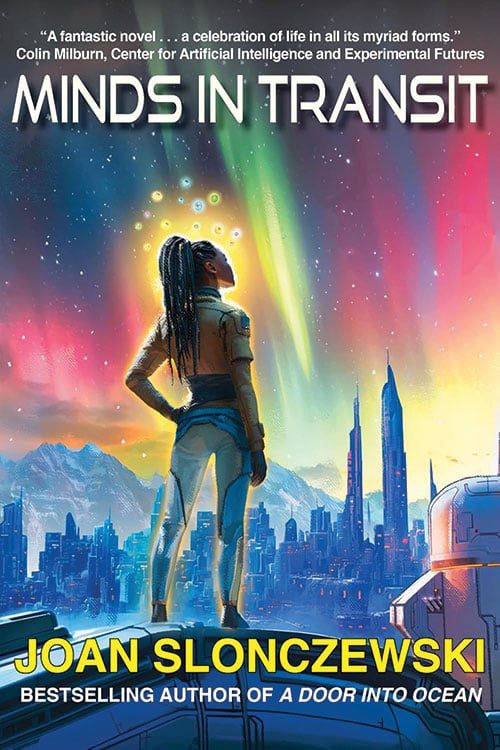
Minds in Transit
Reviewed by Rob Pierson
August 1, 2026
By Joan Slonczewski. Caezik SF & Fantasy, 2025. 300 pages. $24.99/paperback; $9.99/eBook.
Microbes are on Joan Slonczewski’s mind. That’s not surprising. As a Quaker microbiology professor at Kenyon College, they have written not just a textbook on the topic but also four decades of science fiction novels where they get to leave their lab and design alternate biologies on the microbic and planetary scales.
In their latest novel, Minds in Transit, Slonczewski takes us back to the worlds of their Elysium series, which began in 1986 with the award-winning A Door Into Ocean and which we last visited in their 2000 novel, Brain Plague. That latter novel introduced the protagonist, Chrysoberyl (Chrys), and the complex jumble of characters who live around and within her—in particular the million or so sentient microbes that populate the lining of her brain.
These talkative microbes (their internal chatter takes up part of every chapter) live thousands of times faster than their human host. To the microbes, Chrys is a god on whose mercy they depend and in whom—to use the apostle Paul’s words—“[they] live and move and have [their] being” (Acts 17:28). The society of a million microbe minds inspire Chrys’s controversial art; design buildings that grow on land and sea; and, in their spare time, solve problems in quantum networking. Thanks to the microbes, Chrys has risen, literally, from life in the underworld beneath her city to the skylit wealth, influence, and troubles of a ruling class that has political and social challenges on interplanetary scales.
This latest novel picks up where Brain Plague left off but piles on new complexities—everything from underground “cancers” infesting the roots of the city to an intelligent transit system fixated on Robert’s Rules of Order. A multi-planetary, multicultural stew of species from earlier novels reappear along with a bewildering array of sentient machines serving as everything from houses to doctors or roaming the underworld in gangs that, along with bad microbes, are up to no good.
The novel raises questions about what it means to be a person. Chrys’s self-configuring house not only manages Chrys’s artistic accounts but takes pride in cooking gourmet meals for residents and the unhoused. Is it a person? (And, one wonders, does it share that of God?) What about all those microbes building neighborhoods across Chrys’s brain? What about the disembodied planetary communication network that suddenly shows signs of “unhappiness”?
(Unhappiness indicates advanced sentience, say the microbes. And, ironically, happiness is the one thing the microbes can’t give their god/host because tampering with pleasure centers in the brain leads to the god’s addiction, enslavement, and demise!)
Interplanetary communication networks jammed full of so many sentient persons/things compound the challenge of being “online” with everything everywhere at all times. Even Slonczewski’s first book, the Quakers-in-space novel Still Forms on Foxfield, written in 1980 before the advent of the Internet, foresaw these issues. And their latest novels present a dizzying array of “retinal windows” vying for attention, literally in the eye of the beholder, right at the optic nerve.
Slonczewski’s novels seem to say: if you think things are complex now, just wait! While their early novels highlighted nontraditional, often lesbian, relationships, this latest novel propels us into societies where humans (the rich at least) choose their bodies and genders at will and where loving relationships may arise among all genders, species, and sentient machines. (Would we marry a sentient machine under care of our meeting?) In addition to navigating personal relationships, Chrys faces crises and moral choices both outside and within herself as she deals with inequity in the city and the politics of the “Fold” of connected planets, all while attempting to be a merciful god to the often troublesome microbes within her own body.
So, who should read Minds in Transit? Multiple Friends who started to read with me gave up trying to unravel the tangle of characters and threads. Others loved the questions raised. I’d note that this is less a novel with a simple story arc than a window on a moving train that looks out onto worlds in progress.
This book is for you if you are a Slonczewski fan who enjoyed their prior Elysium series, especially Brain Plague. If you are new to this author’s work but intrigued by the microbial themes, try Brain Plague first. Or, for an even easier less microbial entry, start way back with A Door Into Ocean.
Yes, Joan Slonczewski has microbes on their mind. And they’re willing to share them with you! Slonczewski’s four decades of science fiction open doors to worlds where technology and ecology merge and where sentient microscopic beings might just be the death of us, or our salvation.
Rob Pierson is a member of Albuquerque (N.M.) Meeting, a graduate of Earlham School of Religion, and a fan of science fiction. Sadly, he lacks intelligent microbes, but he has done his best without them as an aerospace systems engineer.
We want to hear from you, not an AI! Please be thoughtful and use your own words. Comments on Friendsjournal.org may be used in the Forum of the print magazine and may be edited for length and clarity.