



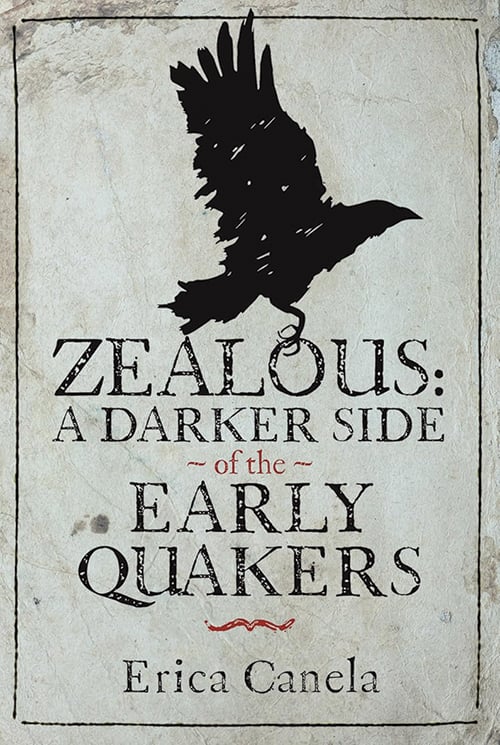
Zealous: A Darker Side of the Early Quakers
Reviewed by Max L. Carter
March 1, 2026
By Erica Canela. Pen & Sword History, 2025. 228 pages. $34.95/hardcover; $16.99/eBook.
With the subtitle A Darker Side of the Early Quakers, this book by social historian Erica Canela might lead one to expect some titillating stories of Quaker indiscretions. There is, indeed, brief mention of activities that might fall into that category (one tryst and “going naked as a sign,” for example), but the “darker side” Canela examines is far more interesting—and pertinent.
Canela focuses on events in the Midlands counties of Herefordshire and Worcestershire in the mid-1600s during the English Civil War, the rise of Quakerism, the Interregnum, the Restoration, and the “calming down” of Quaker activity toward the end of the century. The “darker side” is more about the dark forces in society, in human nature, and in persecution than in a few human peccadillos. So much of it was in evidence in those two counties where major fighting of the Civil War took place.
Zealous begins with an examination of issues leading up to the English Civil War period of 1642 to 1651. King Charles had solidified power and dissolved Parliament while archbishop of the Church of England, William Laud, supported the king with his ecclesiastical power. Conflict erupted in struggles between Charles I and Parliament, between the Church of England and Puritans, and among those controlling social systems and those demanding the rights of “the common folks” of society. Diggers, Levellers, Fifth Monarchists, Seekers, Ranters, and Quakers emerged out of the destruction and chaos. In personal correspondence outside of the book, the author has commented that she sees similarities between the current state of U.S. politics and that period of upheaval in England. In that period, however, Parliament was attempting to fight back against tyranny. The legislative branch of government in the United States isn’t there yet.
With the chaos, destruction, and uncertainty of the 1640s, a period that saw the execution of Archbishop Laud in 1645 and Charles I in 1649, many expected the End Times and the Second Coming of Christ. Canela writes that Quakers tapped into that and spread their message of direct access to a Christ already immanent as a Light in all people and shared that message with zeal, prolific writing, and traveling. Using primary sources from Quaker writings and anti-Quaker tracts, Canela describes a world “turned upside down,” to copy historian Christopher Hill’s phrase about the English Civil War.
A consistent accusation against Quakers in that topsy-turvy world was that they were guilty of disrupting the social order. A chapter in the book focuses on one Quaker in particular, Humphrey Smith, whose disregard of normative social behavior landed him in prison, where he died. Mention is also made of James Nayler’s 1656 ride into Bristol, which re-enacted Christ’s triumphal entry into Jerusalem as symbolic of Christ’s entry into the human heart. Seen instead as blasphemy and heresy by the authorities, the action evoked tremendous animosity toward Quakers. Canela describes Nayler’s trial in Parliament and subsequent punishment and wryly notes that followers’ testimony of Nayler as Prince of Peace, perfect man, son of God, and even Jesus was “extremely unhelpful.”
Another Quaker Canela uses as an example of going beyond the norms is Susanna Pierson, who responded to the suicide of fellow Quaker William Pool by offering to raise him from the dead a few days later. Unsuccessful with the “miracle,” Pierson simply walked away without apology or explanation. In another book about Quakers in that same time period, The Light in Their Consciences, Rosemary Moore writes that it wasn’t that early Friends didn’t believe they could perform miracles, it’s just that they weren’t very good at it.
In spite of such behavior or perhaps even because of it, as Canela shows, there was a receptive audience waiting in the midst of chaos and destruction for confirmation that God was still present. Quakers were very effective in doing that.
Following the Nayler incident, however, Quaker leaders moved to control the Spirit-led movement with the organizing principles that led to queries; advices; books of discipline; meetings of elders and ministers; and monthly, quarterly, and yearly meeting structures. Eventually, through that work, the impact of the restoration of the crown with Charles II, anti-Quaker laws, and the devastating impacts of the Great Plague and the Great Fire of London in the 1660s, Quakers moved from zealous attempts at convincement of their truth to preservation, from “Quakering” the world to preserving a remnant group and attempting to change the world by small degrees.
In conclusion, Canela notes that Quakers survived while other religious movements of the 1600s failed, the result of organizing the movement and quelling the zealous. The question remains, as it does with the “preservation” of the Religious Society of Friends in the South and Midwest after the American Civil War with revivalism: what was gained, and what was lost?
A further question, pertinent to the similarities Erica Canela sees between the time period of the rise of Quakerism and the current situation in the United States, is what role might Friends play? Is there a receptive audience now waiting in the midst of chaos and uncertainty for confirmation that God is still present, leading, guiding, and directing? What would that look like? And what would the modern means be of expressing it and sharing it with the wider world?
Max L. Carter is the emeritus William R. Rogers Director of Friends Center and Quaker Studies at Guilford College. He is a member of New Garden Meeting in Greensboro, N.C.

2 thoughts on “Zealous: A Darker Side of the Early Quakers”
Leave a Reply
We want to hear from you, not an AI! Please be thoughtful and use your own words. Comments on Friendsjournal.org may be used in the Forum of the print magazine and may be edited for length and clarity.
We need, each in our own way, time and space, to share that we believe in “that of god” in all living /human beings. They therefore should be treated as such. No ICe, no war, etc. Jane Taylot
I really appreciate the questions for Quakers with which Max Carter ends his book review of Zealous: “Is there a receptive audience now waiting in the midst of chaos and uncertainty for confirmation that God is still present, leading, guiding, and directing? What would that look like? And what would the modern means be of expressing it and sharing it with the wider world?”