



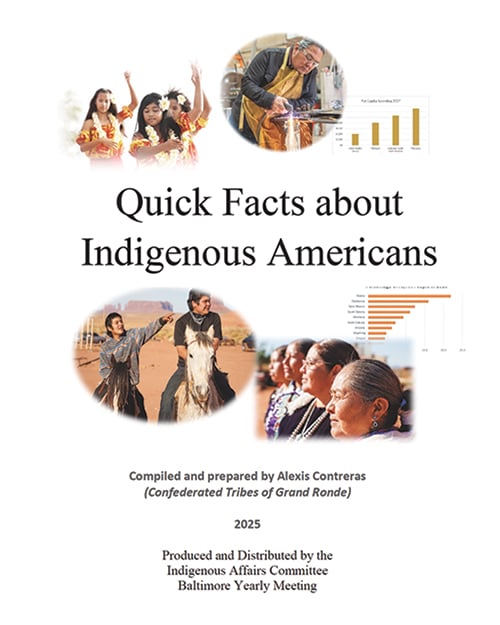
IN BRIEF: Quick Facts About Indigenous Americans
Reviewed by Addi Schwieterman
April 1, 2026
Compiled by Alexis Contreras. Indigenous Affairs Committee of Baltimore Yearly Meeting, 2025. 64 pages. Free PDF download at bym-rsf.org.
This useful resource document was compiled and prepared by Alexis Contreras (Confederated Tribes of Grand Ronde) in partnership with the Indigenous Affairs Committee of Baltimore Yearly Meeting (BYM). Contreras is an independent contractor, trainer, and facilitator who previously spent nearly 12 years contributing to research for the National Indian Child Welfare Association.
BYM’s Indigenous Affairs Committee was originally inspired by a similar yet now outdated resource from 2008 titled Snapshot of Native Americans at the Start of the 21st Century, which was issued by Friends Committee on National Legislation to assist policymakers and answer frequently asked questions about this population. Such a resource is clearly needed today, as Indigenous Americans continue to face challenges in all areas of life in the United States.
The data is organized into eight different categories, including demographics; poverty, income, and employment; health; and religion. Within the categories, key stats and concepts are highlighted in green outlined boxes, and each section concludes with a list of references.
In the employment section, for example, the report states that American Indians and Alaska Natives (AI/ANs) along with African Americans are “the most economically marginalized groups in the United States in terms of employment and unemployment.” The unemployment rate for AI/ANs in 2022 was 6.2 percent, nearly double the rate for white individuals (3.2 percent). As Contreras reflects, “Traditionally, Indigenous economies were diverse and adapted to their environments, but colonization and systemic barriers have disrupted traditional livelihoods and continue to have long-lasting effects.”
Quick Facts About Indigenous Americans is an efficient and valuable resource for anyone interested in the facts of how Indigenous Americans are doing today. In addition to those working in policy and advocacy, I believe it would be just as useful for the average Friend. As Quakers work toward right relationship with Indigenous people, we should seek to better understand their current realities.
Addi Schwieterman is Quaker Voluntary Service Fellow (2025–2026) atFriends Journal
We want to hear from you, not an AI! Please be thoughtful and use your own words. Comments on Friendsjournal.org may be used in the Forum of the print magazine and may be edited for length and clarity.