



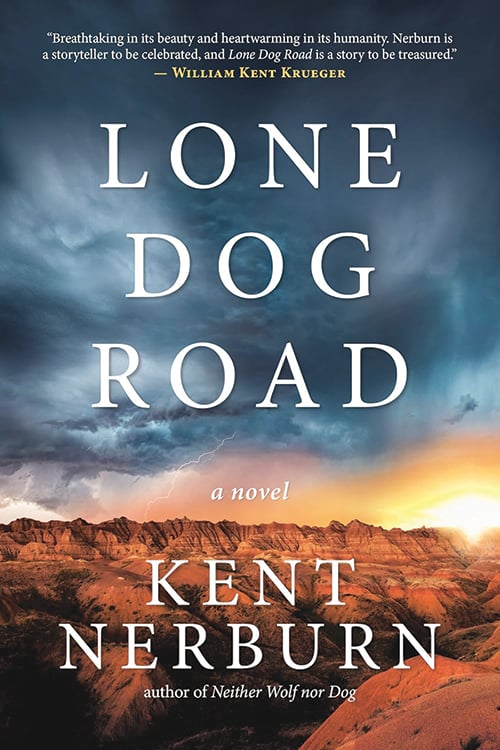
Lone Dog Road: A Novel
Reviewed by Margaret Crompton
April 1, 2026
By Kent Nerburn. New World Library, 2025. 504 pages. $21.95/paperback; $14.99/eBook.
In South Dakota in July 1950, Levi (11) and Reuben (6) are on a train. Their journey has two purposes. First, Levi is to protect his young brother from forced removal to the government boarding school, where he would be harmed. Earlier in the story, at their home on Lone Dog Road in Lakota territory, two government men, one mixed-blood and one white, showed up to take Reuben away. The mother and grandfather refused, and in the tense exchange that followed, the angry mixed-blood agent, who everyone calls Two Finger, broke their great-grandfather’s sacred čhaŋnúŋpa (red stone pipe). So in addition to outrunning the agents, the boys’ second task is to obtain sacred red stone from the distant quarry in western Minnesota.
They are aided by companions (human, canine, supernatural, and a turtle) whom they meet on their hazardous journey. They reach the quarry and are given a chunk of the stone. However, now Levi must create the new pipe, and then travel home. They are befriended by Danton, the now-former boarding school agent, who is seeking them: not to capture but to protect. He enables Levi to learn skills to work the stone. Then the road runs into the landscape depicted on the dramatic front cover of the book: dry, red rocks under a lowering black cloud. The companions are marooned. This climax is a crucial turning point for not only the people but also the land itself.
In a quest story, seekers must leave home in search of a boon which will benefit or even save the community. They encounter privation, danger, sacrifice, and loss, but they also discover unexpected abilities and strengths. Challenges are balanced by periods of recovery and rest. Everyone has a story, and everyone is changed.
In this story, the new pipe is made from the same source of stone as that which was broken. The new part, the bowl, is meticulously joined to the unbroken stem. Thus the pipe represents the companions who become more themselves, once they are freed from distorting damage. Levi, for example, matures greatly over the course of the story, discovering for himself the sacrifice required for a Lakota “to become a man.” Danton, as witness to this growth, observes: “Levi . . . looked at me from a place I could never understand or reach. In the moment he seemed more the man and I the boy.”
As I read this novel, I was learning all the time, and I was changed. I had expected to learn about the boys and Native American spiritual beliefs and practices. However, I also learnt how to listen and be more present. The words of Amos Lone Dog, the original owner of the red stone pipe, often expressed deep sadness for all that’s been stolen from Native people: their land, culture, language, ways, and children. In one scene, Danton gives Lone Dog a ride home with the intention of convincing him to let them take Reuben to boarding school. Lone Dog explains the ways of “Indian remembering” to Danton in an attempt to convince him to quit his job and instead protect Reuben:
You are trying to stop us from our way of remembering. That is why you steal our children for your schools. You fill them with wašíču [white] words and beat them when they use their own words, because you think that words carry the way of remembering. Taking our words might stop our wašíču remembering but it will not stop our Indian remembering.
Lone Dog Road is a long, deep, challenging, engrossing, and rewarding journey. The traveler is aided by generous signposts, for Levi and his companions have distinctive voices as they narrate their experiences. Along with the name of the narrator, chapters are headed with such titles as “Dog Thoughts,” “Banana,” and “Choosing Just Right,” and they are grouped in sections with simple titles: “Runners,” “Storm,” and “Home.” There is also a helpful glossary of Lakota words, phrases, and pronunciation.
Kent Nerburn is a non-Native author of more than 15 books on spirituality, the power of land, and what’s been described as “the bridge between Native and non-Native cultures.” His Neither Wolf nor Dog (1994) was the first in a trilogy chronicling his real experiences traveling with a Lakota elder named Dan. Lone Dog Road is Nerburn’s first novel. It is a journey of the mind and spirit. I’m grateful to have read this fine book, which I recommend to Friends Journal readers.
Margaret Crompton, a member of Britain Yearly Meeting, has written and edited numerous publications about children, spirituality, and religion, including the Pendle Hill pamphlet Nurturing Children’s Spiritual Well-Being (2012). Recent publications include poems and short stories, and she has written and directed plays for Script-in-Hand Theatre.

We want to hear from you, not an AI! Please be thoughtful and use your own words. Comments on Friendsjournal.org may be used in the Forum of the print magazine and may be edited for length and clarity.