



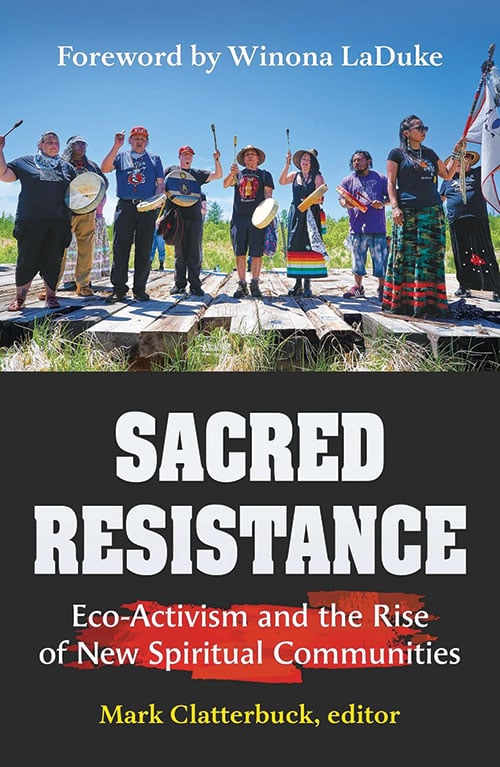
Sacred Resistance: Eco-Activism and the Rise of New Spiritual Communities
Reviewed by Pamela Haines
February 1, 2026
Edited by Mark Clatterbuck. Orbis Books, 2025. 272 pages. $34/paperback; $27.50/eBook.
Sacred Resistance brings us the stories of five environmental campaigns, told through the lens of the spiritual traditions that anchored them and in the words of those who provided spiritual leadership, most of whom are women.
The book starts with Indigenous women in northern Minnesota in 2021 taking part in the campaign against Enbridge’s Line 3 pipeline. Some Anishinaabe women built sacred lodges along the proposed pathway to offer prayers of protection. I sensed the weight of carrying a spiritual tradition that was deep in their bones but had been for centuries the target of hateful attempts at erasure. These women were grateful for kindred spirits from the Catholic Worker community, and they were surprised and glad for unexpected support from a female judge who ultimately dismissed charges brought against three water protectors.
The second story—also a pipeline struggle—takes place in rural Pennsylvania in 2017 with two nodes of resistance: an order of Catholic nuns through whose cornfields the pipeline was planned and an environmental activist group centered in the nearby city of Lancaster. The nuns brought a serene, unshakable faith. The activists, strongly influenced by Mennonite tradition, were able to follow wholeheartedly, and the little chapel created in the cornfield became a focal point of celebration and shared resistance.
The third story, from 2019, is about opposition to yet another telescope site on a mountain sacred to Native Hawaiians; their opposition was rooted in Indigenous cosmology. The leaders seemed eager for this opportunity to share their ancient but little-known worldview with anyone and everyone who wanted to join in. An introduction to their practices and beliefs was central to everything that happened at this encampment. Running through their witness was a confidence in standing publicly for their sacred beliefs and a joy of sharing them with others.
The fourth story is about resisting a pipeline in Appalachian Virginia that was eventually canceled in 2020. It tells of an unexpected partnership between yogis connected with an ashram near the pipeline’s path and a Black Baptist church in a nearby community that had been targeted for a pipeline compressor station. Both were stretched and enriched by this unlikely pairing, which led them far outside their traditions and understandings to find common ground and deep connection in a shared struggle for environmental and social justice.
The book ends with stories from Earth Quaker Action Team (EQAT) in southeastern Pennsylvania. While the other groups came together around a particular threat, EQAT has a longer history of creating environmental campaigns that are grounded in the Quaker tradition of bold, faith-based nonviolent action. Bringing deeply centered meetings for worship to bank lobbies, board meetings, and corporate headquarters, and focusing on the money behind the damage, their campaigns have attracted a host of young activists.
There is much to be learned from these stories. I am reminded of the image of a great wheel with many spokes all going from the rim to the center: faithful action brings us closer to the center, where we can join and be joined by others who are doing the same. Embodying our faith and values releases power. Public acts of faithfulness offer compelling contrast to the forces of greed and domination and attract others who are struggling in the face of those forces and reaching for lives of meaning. They may have no current spiritual home or professed beliefs, or—like some of the churchgoers in Lancaster—they may never have experienced the kind of gathered community that was palpable in that bare-bones chapel in the cornfields.
None of us can live full-time in encampments, of course. There is a great range of ways to be faithful in all parts of our lives, and we need them all. The common themes the editor lifts from each of these stories of boldness, discipline, and joy are applicable everywhere. The larger question then becomes how to do the work of building that vitality, that embodied and infectious faithfulness, into the fabric of our religious communities.
Some of the campaigns described in this book succeeded. Others faced odds that were just too great. Yet they all had impact, and who knows where those ripples might end? These are times that call for building our capacities to dig deep and stand firm, to celebrate community and right relationship, and to grieve great losses and share great joy. Sacred Resistance offers the taste and the feel of some journeys taken along that path. I would recommend it to anybody who cares about the earth, who would explore the potential of interfaith cooperation, and who would be immersed in stories of faithfulness.
Pamela Haines, a member of Central Philadelphia (Pa.) Meeting, is passionate about the earth, relationships, integrity, paying attention, and repair of all kinds. Author of Money and Soul, three Pendle Hill pamphlets, and three volumes each of essays and poetry, her blog and podcast can be found at pamelahaines.substack.com.
1 thought on “Sacred Resistance: Eco-Activism and the Rise of New Spiritual Communities”
Leave a Reply
We want to hear from you, not an AI! Please be thoughtful and use your own words. Comments on Friendsjournal.org may be used in the Forum of the print magazine and may be edited for length and clarity.
Dear Pamela, thank you for taking the time to review this work & to lift up these voices of spirited resistance. I especially loved reading your words: “There is a great range of ways to be faithful in all parts of our lives, and we need them all. The common themes the editor lifts from each of these stories of boldness, discipline, and joy are applicable everywhere. The larger question then becomes how to do the work of building that vitality, that embodied and infectious faithfulness, into the fabric of our religious communities.” I felt deeply honored to share in each of these inspired movements while working on the project, and I’m truly grateful for your careful review. — Mark Clatterbuck