



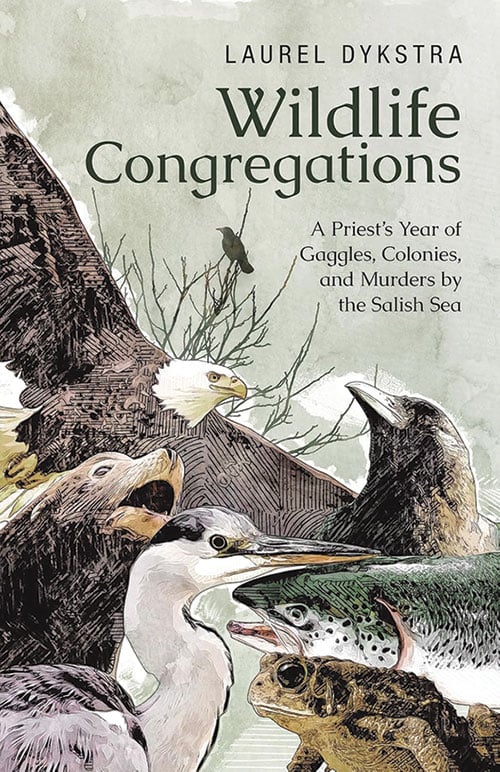
Wildlife Congregations: A Priest’s Year of Gaggles, Colonies, and Murders by the Salish Sea
Reviewed by Brian Drayton
February 1, 2026
By Laurel Dykstra. Hancock House Publishers, 2024. 232 pages. $24.95/paperback.
Laurel Dykstra is an Anglican priest whose congregation, Salal + Cedar, is located in the Coast Salish area of British Columbia. Named for two local plant species, the congregation—which often worships outside—is strongly oriented toward eco-justice and describes itself as a Watershed Discipleship community. This movement emphasizes the importance of place: reverence for and cooperation with the land, the creatures, and the Indigenous Peoples in the area where the church is located. Consequently, the congregation’s teaching and liturgy is interwoven with the land and its life.
Dykstra’s Wildlife Congregations exemplifies the attentiveness and wonder of this interweaving; Salal + Cedar “gathers to break bread and say ancient prayers outdoors—under 100-year-old Western Red Cedars, beside salmon streams, on urban beaches, or along the proposed route of a pipeline to transport tar sands bitumen to the coast.” And every week, together they “go out on the land, listening for the Divine word, in scripture and in nature.”
Dykstra, who uses they/them pronouns, is aware that the existence of common species (think grasshoppers, mice, and caribou) is an important and necessary element of biological diversity. This is a fact that is often overlooked in our concern for the rare and threatened species. Dykstra became interested in congregations of animals (in the context of Watershed Discipleship, the word congregation has an intentional double meaning). This interest resulted in a project in which they visited such a congregation and then gathered information from many sources (including scientific and Indigenous knowledge) about the creatures and their lives. Dykstra’s experiences and learning are infused with their spirituality, and the result is a series of essays that Friends will find enjoyable and enriching.
Dykstra shares their encounters with insects, fish, mammals, birds, and amphibians, and names each congregation with its own proper “term of venery” by drawing upon and sometimes adding to the ancient words that English offers us to tell of wild things gathered in their life activities: a haul out of Sea Lions, a murder of Crows, a siege of Herons, a colony of Bats, an eclipse of Moths, a knot of Toads, a run of Salmon, a gaggle of Geese, a convocation of Eagles, a raft of Ducks, and a shoal of Anchovies. Each of these general species’ names Dykstra conscientiously capitalizes, as one does the name of a nation or people.
As you will know if you have been near a large gathering of creatures, the sensory impacts (sound, smell, and sight) and the emotional responses (awe, confusion, delight, and sometimes anxiety) are powerful and direct. Dykstra writes effectively about these impacts, so that insofar as words can evoke these responses, they bring us into their experience. Out of such experience, questions come, and with questions come inquiry and learning; so the chapters unfold.
After watching a colony of perhaps 3,000 Yuma and Little Brown Bats emerge from a farmhouse at dusk, Dykstra provides a quick introduction to bat biology and conservation. About a quarter of all mammal species are bats, so there is a lot of diversity in their ways of life and their interactions with humans. But the bat story leads to reflections on prayer that are helpful and also make visible to the reader the entwining of Dykstra’s spiritual practice and life as a created being among created beings. Out of this experience of “wonder,” Dykstra identifies “seemingly contradictory truths” that “comprise most of what [they] know about prayer”:
The first is that you can prime yourself for wonder. . . . A lifetime of curiosity, learning, and fact-hoarding amplified my experience so that each vague silhouette sparked a thrill of recognition and unfolding back-story. . . . The second insight is that spiritual practice is often unspectacular . . . my spiritual life is not a different life that happens when I put on special clothes or perform certain actions; it is my same old, ordinary life, seen or held with a different kind of attention or reverence.
Exactly so, and this kind of reflection is why this book is like going on a retreat that really nourishes: It brings you into someplace beautiful. It involves you in wordless experience, and it supports you as you turn the messages from silence and contemplation into language; knowledge; and increased capacity for action and gratitude, worship, and work that is rooted in reverence.
Brian Drayton is a plant ecologist, science educator, and acknowledged Friends minister in New England Yearly Meeting. His most recent book, The Gospel in the Anthropocene: Letters from a Quaker Naturalist, is forthcoming from Inner Light Books in 2026.
We want to hear from you, not an AI! Please be thoughtful and use your own words. Comments on Friendsjournal.org may be used in the Forum of the print magazine and may be edited for length and clarity.