



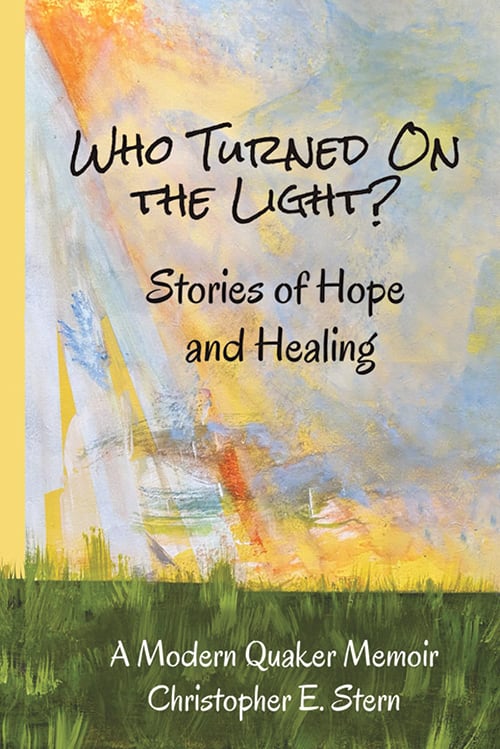
Who Turned On the Light? Stories of Hope and Healing
Reviewed by John Andrew Gallery
January 1, 2026
By Christopher E. Stern. Self-published, 2024. 189 pages. $12.95/paperback; $4.99/eBook.
I’ve known Chris Stern in a casual way for many years as a result of attending, and being inspired by, his presentations at Philadelphia Yearly Meeting (PYM) annual sessions. Consequently, when I learned he had written a memoir, I was eager to read it. When I did—much to my surprise—I discovered that behind his mild-mannered, unassuming Quaker exterior was a remarkable man who had been able to combine the call to travel in the ministry with being a special education teacher, a husband, a parent, a musician, and a writer of serious essays (many published in Friends Journal) and humorous skits. What a wonderful revelation Who Turned On the Light? turned out to be!
Stern describes his story as being not about him but “about all the great things that God has done and continues to do every day in my life” and a story about “losing my own agenda so that God could rebuild my life.” It is also a story about how God went about doing that by sending angels disguised as fellow travelers to nudge him along unexpected and challenging paths of spiritual growth, which Stern had the courage to follow by making many leaps of faith.
He tells this story in 19 short chapters, many illustrated with photographs. An addendum contains three humorous skits commenting on the state of the Religious Society of Friends (“The Reluctant Patient”) that he and fellow members of his meeting’s men’s group have performed at PYM sessions and elsewhere. Also included are handwritten travel minute letters from the many places he has visited.
Stern was born in the 1950s to Quaker parents who were on the staff of Pendle Hill study center at the time. Soon after, the family moved to Nyack, N.Y., where Stern drifted through high school (and away from Quakers) into the hippie culture of the ’60s and ’70s, even attending the famous Woodstock music festival at age 14. His interest in music led him to learn the double bass, which eventually led him to Purchase College’s music school, where he fell in with a group of seekers he describes as Fundamentalist Christians. His alarmed parents introduced him to a Quaker friend Bill Stafford, who turned out to be the first of many angels in disguise. With Stafford, Stern read George Fox’s Journal, became interested in the writings of early Friends, and soon began attending Purchase (N.Y.) Meeting. “The time that I had been able to spend with Bill was life-changing for me,” Stern writes. So much so that when he graduated in 1982, Stern made the astounding decision to abandon his career in music and become a student at Pendle Hill, where he found his next angel, Lewis Benson.
Benson was so controversial at the time that Stern and other students had to travel to a meetinghouse in New Jersey to study with him. Benson’s ideas about Fox and early Quaker beliefs resonated strongly with Stern, and he became a close friend for the remainder of Benson’s life. Next came John Curtis, with whose family Stern lived for three years and who was instrumental in encouraging Stern to travel in the ministry. He began with meetings in Maine; then went to Indiana; then to other states; and eventually to Jamaica, Kenya, Uganda, and most recently, England. After visiting over 50 meetings in Pennsylvania, New Jersey, and Maryland, Stern found a nurturing home at Middletown Meeting in Lima, Pa., where he remains an active member.
Uncertain what to do to earn a living, Stern listened to his mother’s suggestion that he work with people who have special needs. In his first job, he met an African American woman who later became his wife and with whom he has raised two children. After retiring in 2023 from a long, challenging, and rewarding career as a special ed teacher, Stern returned to Pendle Hill as the Kenneth Carroll Scholar to write this “modern Quaker memoir.” While there, he met Matt Rosen, a young friend from England, who was at Pendle Hill doing research. They found that they shared similar spiritual beliefs and a similar interest in traveling in the ministry. It’s hard to know if Rosen is one of Stern’s angels or if Stern is one of his. Whatever the case, Stern joined him for travels among British Friends. “We started out as father and son and now we are like brothers.”
This is an inspiring memoir, written in such an easy style that it feels like Stern is beside you telling the intimate details of his life and God’s working in it. I think it would be especially meaningful to younger Friends because it demonstrates that it is possible to have a career, raise a family, have personal hobbies you enjoy, and still be able to follow God’s leadings—that is, if you have the courage, as Chris Stern did, to make a leap of faith and follow unexpected and challenging paths.
John Andrew Gallery lives in Philadelphia, Pa., where he attends Chestnut Hill Meeting with frequent attendance via Zoom at Middletown Meeting in Lima, Pa. He is a frequent contributor to Friends Journal, and the author of four Pendle Hill pamphlets and two self-published spiritual books. Website: johnandrewgallery.com.

We want to hear from you, not an AI! Please be thoughtful and use your own words. Comments on Friendsjournal.org may be used in the Forum of the print magazine and may be edited for length and clarity.