



A Story of Rematriation in Oneida Nation
In late 2023, I attended a conference titled “The Religious Roots of White Supremacy,” a collaboration between Syracuse University’s religion department and the nearby Onondaga Nation. Many of the sessions focused on the legacy of the Doctrine of Discovery, the fifteenth-century papal bull that used religion to justify the taking of Indigenous lands and lives. During one conference discussion, local bishops got defensive when asked to do more than acknowledge Indigenous people. An audience member mentioned that some religious people were returning land to Indigenous ownership, including a Quaker in upstate New York who had “rematriated” 30 acres to Oneida women. When I inquired about the story, I was introduced to Michelle Shenandoah, the Oneida woman who facilitated the land transfer.
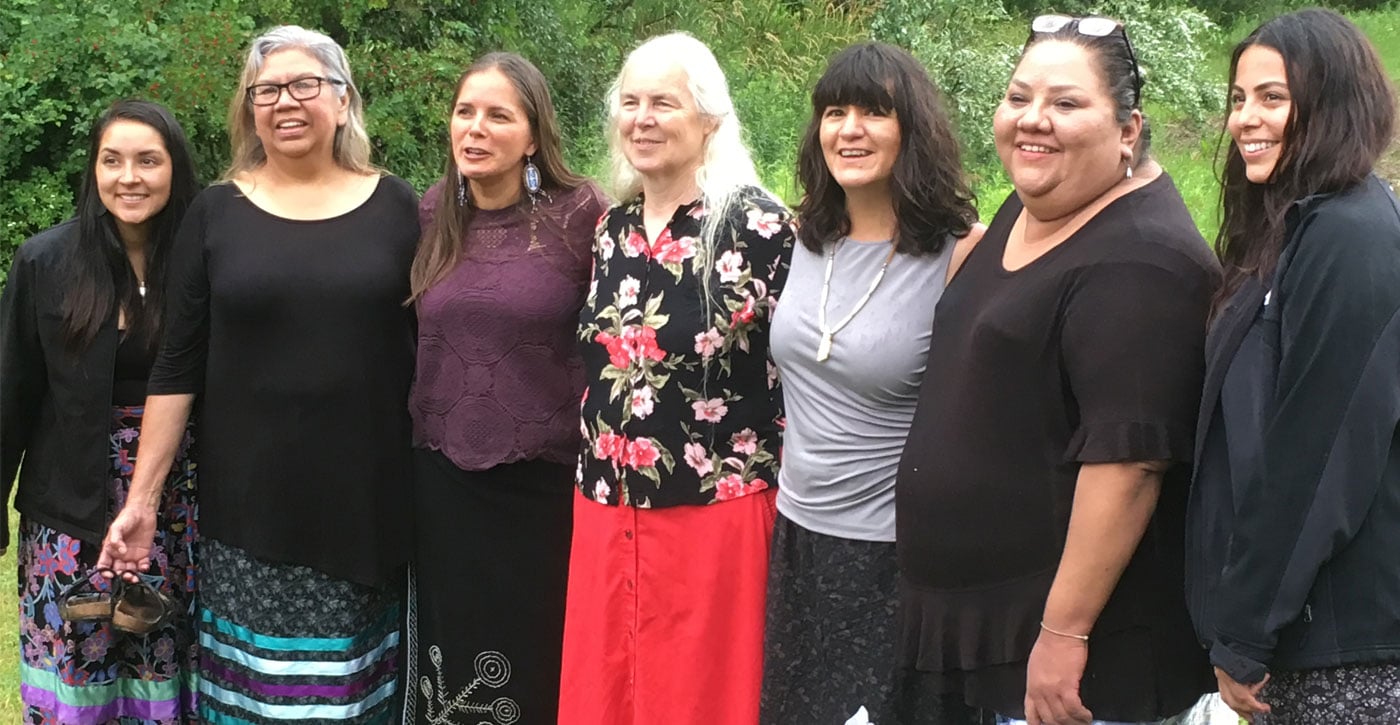
Michelle and Friend Liseli Haines shared their two sides of the story on a webinar for Catholic sisters and other property owners who were considering rematriating land. Michelle explained that the term originated with one of their clan mothers, who wanted to acknowledge the traditional authority of women in their culture, as well as women’s special connection to Mother Earth. Michelle worked with the clan mother to define “rematriation” as “the act or process of returning the sacred to the mother.” Michelle said the story of Quaker rematriation brought together many threads, the story of which could best be told by beginning with history.
“Our people were pushed out: through wars, through settlements, through illegal takings of our land, broken treaties,” said Michelle, who noted that the Oneida belonged to the Haudenosaunee Confederacy, whose territory once spanned New York State and included land in Canada. Today, the Haudenosaunee hold tiny, disconnected pockets of land, some as far away as Kansas and Wisconsin, where some of their relatives were forced to move. Although the Oneida were promised special protection because they helped George Washington during the Revolutionary War, the Oneida ended up having the greatest land loss of the six Haudenosaunee nations. Within about 80 years, their territory went from millions of acres to just 32. According to the Doctrine of Discovery, “We were just part of the flora and fauna,” Michelle explained. “Because the Indigenous people were deemed as really not human, that enabled them [White settlers and their governments] to do whatever they liked.”
Michelle was raised by female leaders who had long asserted their people’s land rights. Her great-grandmother wrote letters to the U.S. government and visited dispersed Oneida communities to keep that dream alive. After centuries without legal recourse, they were given in the 1940s a route to the U.S. Supreme Court through the creation of the Indian Claims Commission. Eventually the court recognized that New York State had illegally taken Oneida land, but the State dragged out negotiations and legal processes. The Oneida decided to buy back some of their traditional territory to add to their small reservation.
Indigenous nations don’t pay taxes on their sovereign territory, so on principle, the Oneida didn’t want to pay tax on the newly purchased land. Michelle said that in a spirit of goodwill, they offered a monetary gift to the town of Sherrill, comparable to the taxes they would have owed, but the town refused the gift and took them to court, insisting the Oneida should pay tax. After the Oneida won in two lower courts, the Supreme Court ruled against them in City of Sherrill v. Oneida Indian Nation of New York. The devastating 2005 decision was written by Justice Ruth Bader Ginsberg and based on the Doctrine of Discovery, which had been reaffirmed in nineteenth-century Supreme Court cases.
A lawyer by training, Michelle left practice, remembering her mother’s skepticism about U.S. laws ever helping their people. Still, she believed in her heart that something else would open up. Her work turned to uniting women across the Haudenosaunee Confederacy, including Oneida women from their three separate communities in Wisconsin, Ontario, and upstate New York. The women gathered for healing ceremonies, but they had no place of their own on traditional Oneida land, which some of their people had not set foot on in 200 years. “I believe that our spiritual umbilical cord ties us to the land where we’re from. So, for them, coming back to the land was really significant,” Michelle explained. Oneida women started taking up a collection to buy land where they could feel safe and unencumbered by the politics of their different nations.
When Michelle was invited to speak to a Quaker meeting in central New York in 2017, she felt intuitively that she needed to bring up her work in support of the Oneida women’s search for land. After the talk, a White Quaker approached her and said that she had land in Oneida territory that she wanted to give to the women. Michelle was amazed. The following day, Michelle felt her female ancestors to be very close to her, especially her grandmother and great-grandmother who worked hard to get their land returned. “I never even needed to go to law school,” she said with a smile.
Liseli Haines grew up in a Quaker family with ancestors from England and other parts of Europe. Since the 1960s, the family had owned land in central New York State amid rolling hills that were a patchwork of farm and returning forest. Liseli told me about the maple, beech, hickory, and birch trees. “We have some eagles that are coming back,” she said, and there are also songbirds, red-tailed hawks, snapping turtles, and gray fox, which Liseli feels especially drawn to. She shared that her spirituality has always been connected to the earth. She believes the land is inherently sacred and that life flows through everything, even the rocks and mountains. “The land has a life of its own, and a memory of the people who were here before,” she said.
In 2012, Liseli heard that plans were forming to reenact the four-hundredth anniversary of the Two-row Wampum, given by the Haudenosaunee to the Dutch in 1613, which represented their agreement to live together in peace for “as long as the grass is green, as long as the water flows downhill, and as long as the sun rises in the east and sets in the west.” She described the belt made of shell pieces: a field of white with two purple rows to represent the two peoples, “each with their own laws, languages, and cultures—traveling without steering each other’s vessels.” Liseli and her partner Buffy Curtis joined the planning of the commemoration, which was a collaboration of Haudenosaunee and their non-Indigenous neighbors.
In the summer of 2013, people from different Haudenosaunee nations canoed via New York’s many lakes and rivers to gather by the Hudson River. They were joined by other Indigenous people and allies, many speaking about their shared desire to protect the earth. “We paddled from Albany to New York City over 12 days,” Liseli recalled. In canoes and kayaks, Indigenous and non-Indigenous people journeyed in parallel lines, camping together along the way and forging friendships. “I learned an awful lot,” she said.
Like many White people, Liseli acknowledged that she hadn’t known much Indigenous history, but after the canoe trip she studied the genocide and land theft, and researched the oppressive boarding schools run by Quakers. Her thoughts about returning land were jump-started by a Tuscarora man named Neil Patterson, whom she met on the canoe trip and later heard speak on a panel in Syracuse. “He was the one who said, ‘If you have 40 acres, give it back,’” Liseli recalled. She discussed with Neil the possibility of donating her family’s land to a Haudenosaunee land trust, but that didn’t exist yet, so she waited. “I really love this land,” she said, getting choked up. “I’ve only lived here 46 years, and if it’s this important to me, what about people who lived here for thousands of years?”
When Liseli heard Michelle Schenandoah speak about the Oneida women looking for a place to perform ceremonies on the land of their ancestors—land that had not heard their songs for 200 years—she decided on the spot to give the land to this group, which included women from Oneida communities as far away as Wisconsin and Ontario. “It was so clear. There is no other choice really,” recalled Liseli. Her siblings easily backed her decision. I observed that it sounded like way opening.
After Michelle and Liseli met at the Quaker meeting, they started to get to know each other over lunches. Liseli said it took a while to build trust, with Michelle asking a few times if the land transfer was real. Knowing that the government of the Oneida Nation might want to build on the lush, green land in the name of economic development, they agreed to set up a nonprofit to receive and protect the land. The Oneida women called it Akwéku Ohshʌ’he Yukwayóte, which means “[w]e work together.” Knowing the intentions of the women and the history of White people trying to control Indigenous land, Liseli felt it was important that she not attach any strings to the gift. Michelle’s group took care of the legal details. “I just put my faith in the fact that this was the right thing to do,” she said.
The official dedication in 2019 was “really, really beautiful,” recalled Michelle. Gratitude was offered to the land, which she said is the core intent in their ceremonies. They invited community members and members of the Quaker meeting, which is right next door to the 30 acres, near the property where Liseli continues to live. There were tears and words of exchange with clan mothers, Liseli, and neighbors. Michelle recalled that the traditional Oneida dance they did was particularly meaningful. They put their feet on the earth and told the land they were there.
Michelle described it as threads coming together. I found the story a moving reminder that Quaker leadings are part of a larger tapestry. Our thread is needed, but it runs parallel to other threads, like the Two-row Wampum: a map of right relationship yet to be fulfilled.

We want to hear from you, not an AI! Please be thoughtful and use your own words. Comments on Friendsjournal.org may be used in the Forum of the print magazine and may be edited for length and clarity.