



Reflections from Friends in Indigenous-Majority Meetings
Indigenous-majority meetings and churches in the United States tend to be Christ-centered and pastoral. Founded by Quaker missionaries, some date as far back as the 1800s. Like other Christians, Friends participated in efforts to spread their faith to Indigenous people. In the nineteenth century, the term “cultural genocide” had not yet been coined, and Quakers believed they were helping Indigenous people by forcing them to assimilate into white European culture. The idea that destroying a group’s cultural artifacts, such as religion, language, and artistic creations, is a facet of genocide was argued by Polish lawyer Raphael Lemkin in the 1940s.
Many current believers do not see embracing Christ-centered Quakerism as a loss of culture. Some Native American Quakers point out similarities between Quakerism and traditional Indigenous religions. These Friends aim to preserve their cultures while embracing a decidedly Christian spiritual path.

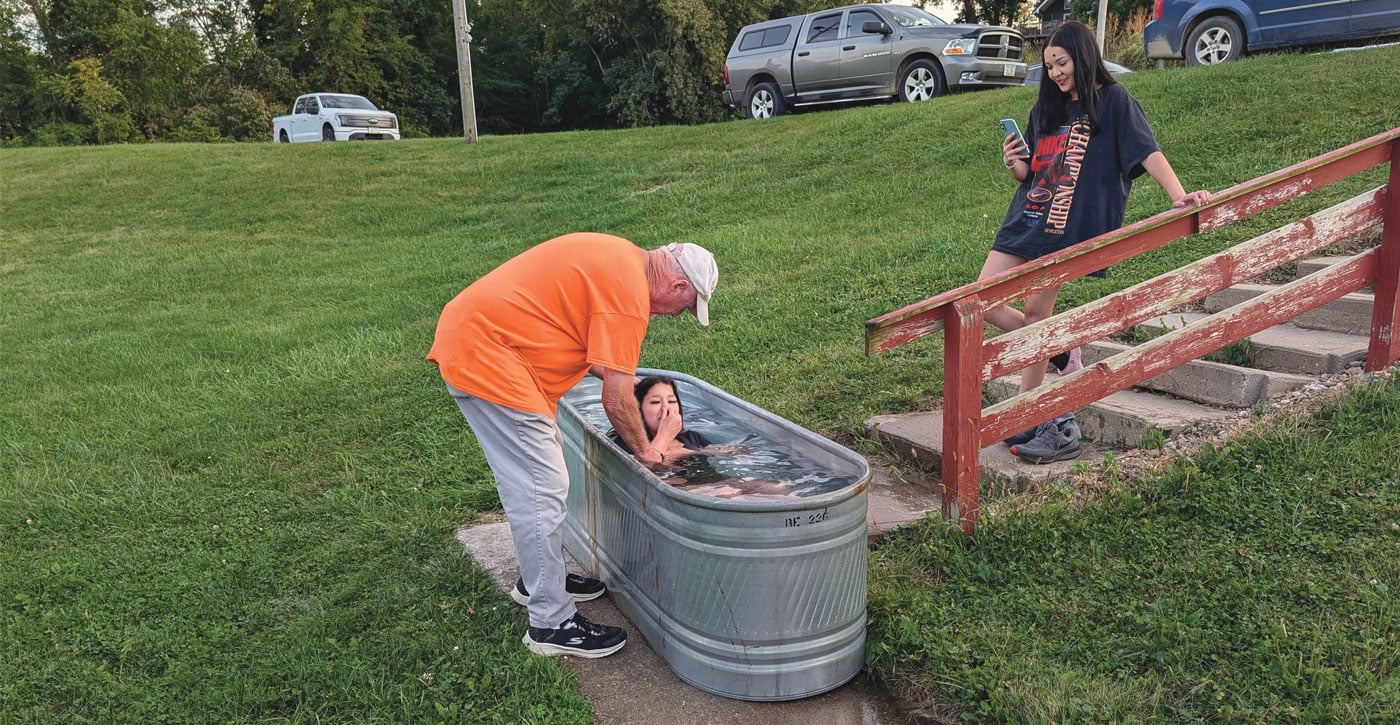
Sharon Mervin, a Meskwaki who worships at Mesquakie Friends Church in Tama, Iowa, believes she has always walked with God. When she was five years old, she and her best friend were walking on ice, and they fell through into the water. Her best friend drowned. Mervin felt someone grasp the back of her coat and pull her out of the frigid water to safety. She did not see anyone around, and she believes Jesus or an angel rescued her.
Mervin is a fully ordained pastor of the Assembly of God church, and she previously served as the lead pastor at Meskwaki Assembly of God Church. Her husband, Kenny Mervin, served as the associate pastor. The Assemblies of God has strict guidelines that prohibit retired pastors from attending churches where they used to serve, so when the Mervins retired, they searched for a different spiritual home and found Mesquakie Friends Church. When the Mervins attended service at the church the first Sunday in December 2024, they felt that God was calling them to be there.
Sharon believes that the deity Quakers and followers of traditional Meskwaki beliefs worship is the same being. “We all pray to the same God because there is only one God,” she said.
Sharon divorced the son of Eleanor, who was the grandmother of her children. Eleanor had begged Sharon’s daughter Tonya to renounce Jesus because Eleanor believed there was a separate afterlife for people who followed Meskwaki religious traditions and those who believed in Christ. Eleanor was facing her own death and did not want to be separated from her granddaughter for eternity, Kenny Mervin recalled. “She wanted Tonya to be with her in the Indian paradise. They had an Indian paradise and a white-man paradise,” said Kenny, who is not Meskwaki.
Sharon sat down with Eleanor and explained the commonalities between Christianity and Meskwaki religious beliefs, Kenny explained. He noted that a non-Meskwaki person could not have convinced Eleanor of the similarities of the two belief systems.
“Their beliefs are almost identical,” Sharon said. Eleanor asked Sharon to pray for her, and she replied that she would pray in the name of Jesus. “I was so happy when she asked me to pray for her. That said a lot,” said Sharon. The next time Tonya visited her grandmother, Eleanor asked Tonya to sing “Amazing Grace” in the Meskwaki language.

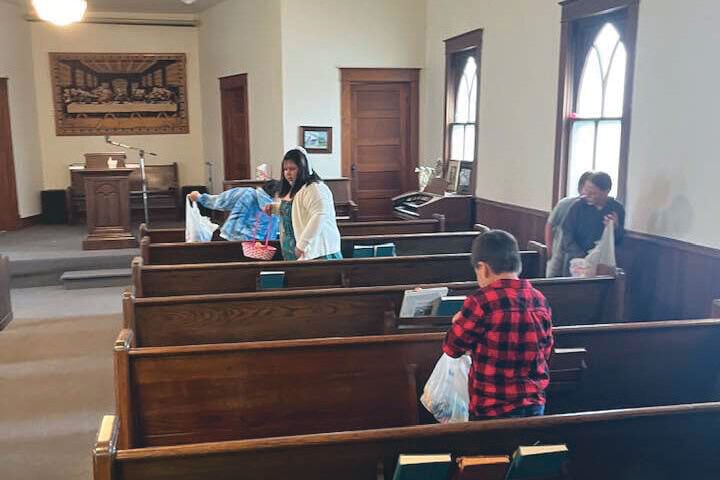
Exterior and interior of Hominy (Okla.) Meeting. Photos and the book cover Courtesy of David Nagle
Quaker missionaries involved in outreach to Native Americans believed that the Light of Christ was already at work in every person, regardless of culture or religious beliefs, according to Paul Anderson, professor of biblical and Quaker studies at George Fox University in Newberg, Oregon. Missionaries did not intend to destroy Native cultures, rather they wished to invite Indigenous people to relate with Christ, according to Anderson. Anderson opposes classifying Quaker missionaries who worked with Native Americans as racist. He noted that many Quaker missionaries moved West in the nineteenth century because they wanted to leave states that endorsed slavery. Quakers connected Christ with local mythology and folklore in Native American communities, according to Anderson. Quakers establishing rapport with Indigenous people would ask such questions as, “‘What’s your experience of God?” Anderson explained.
The majority of members of Hominy (Okla.) Meeting are Osage. Longtime attender Michael Kidder described the congregation as a tight-knit community. Kidder regularly participates in Osage ceremonial dances, and he works as the Osage Nation child support director. Commonalities between traditional Osage religion and Quakerism include belief in Jesus Christ, God, and heaven, he explained. He noted that the Osage think of heaven as a homecoming in which the departed are reunited with predeceased relatives, including those they never met in their mortal lives.
“Our church here in Hominy has adapted to Native people. It’s not like we walk into a different environment when we go to church,” Kidder said.
In addition to theological common ground, Quakerism shares moral values with traditional Osage culture. Aspects of Quakerism that Osage worshipers find most attractive include the following: “integrity, perseverance, respect for others and their traditions, compassion, honesty, seeking to be led by the Creator, importance of community, and broader concept of family,” said David Nagle, who is a recorded minister in Great Plains Yearly Meeting as well as a member of Hominy Meeting.
An argument could be made that some Quakers’ lack of creeds and other traditional Christian structures attract Native people who grew up with traditional Indigenous religions, according to Damon Akins, Lincoln Financial Professor of History at Guilford College. “Native religious practices are mostly non-dogmatic,” said Akins, who specializes in the Indigenous history of California. He is a coauthor of the book We Are the Land: A History of Native California.
Cultural destruction by settlers of European descent set the stage for the Osage to become Quakers. The traditional Osage religion relied on the clan system, but by the late-nineteenth century, many clans had been destroyed, so the religion stopped functioning, Nagle explained. Many Osage leaders renounced their traditional religion and adopted Christianity.
“Black Dog called together the elders of the Hominy district,” and they penned a letter asking Quaker Isaac Gibson to ask Friends to establish a mission in the area, Nagle said. Black Dog was an Osage chief, born into a line of chiefs who shared the same name. Gibson had previously worked with the Osage as their official Federal Indian agent in Kansas. The first mission workers came in 1908. The parsonage hosted all activities until the meetinghouse was built in the early 1920s.

The first Quaker missionaries came to Alaska in the late 1800s and did not understand Indigenous culture, customs, and language, according to Leon Kiana, pastor of Kotzebue Friends Church in Kotzebue, Alaska.
Kiana was ordained in the Moravian Church and served as a Moravian pastor for 11 years. He began his studies at Friends Bible Training School in Kotzebue in 2013. Three years later, he finished his degree and received his pastoral card. While studying, he lived in an apartment in the mission house. His grandmother had taken him to a Friends church when he was four years old, and becoming a Quaker brought him full circle. Kiana considers calling people to repentance to prepare for the return of Jesus the central purpose of his ministry. Alaska Natives maintained “direct contact with our God” before the missionaries arrived, Kiana said. One way they connected directly with God was through ceremonial dancing. “The first Quakers that came saw that as demon worship,” said Kiana. The Quaker missionaries forbade the Indigenous Alaskans to do traditional dances.
“There were a lot of people who relied on the Spirit,” Kiana said. According to him, this direct reliance changed when the missionaries came.
Many young Indigenous people went to boarding schools that aimed to assimilate them into European American culture. “We pretty much lost our Native culture, and we started to lose our native language,” said Kiana, whose native language is Inupiat.
Prior to European contact, the Alaska Natives had a subsistence lifestyle in which they survived by hunting and gathering. Their diet changed to include primarily store-bought foods, according to Kiana. The changes were gradual, beginning in the 1950s and 1960s.
Kiana attended two boarding schools. “The boarding school to me was beneficial but also negative in another way,” he said. In college, Kiana spoke Inupiat with an Indigenous classmate who was deployed to Vietnam in 1968, and he did not have anyone else to converse with for many years. He said, “It took me a while to start getting my language back.”

Before the current director came to Mesquakie Friends Church, worshipers participated in traditional Native practices such as sweat lodges and smudging, which involves burning sage to purify an area. A previous director of the congregation incorporated these practices into the church services, but the current leadership does not do so because the rituals are not Christian, according to director Kyle Chyma.
Members of Indigenous-majority meetings and churches can draw on their common strengths to preserve Native culture and advocate for Indigenous people’s rights. A summer camp for Indigenous people and an herbal medicine camp for Native youth are two of the activities planned for the church property, according to Chyma.
David Nagle describes how Osage members and non-Indigenous worshipers collaborate. Members of Hominy Meeting were involved in making Martin Scorsese’s anti-Western crime drama Killers of the Flower Moon, which focuses on a series of murders of Osage people in 1920s Oklahoma. Twelve-step groups meet at the meetinghouse. Before Indian Village had its own community center, the meetinghouse served as the town’s community center, according to Nagle. Osage language classes also take place at the meetinghouse.
Members made the meetinghouse available to an Osage-Cherokee filmmaker, Diane Fraher, who wrote, produced, and directed the movie The Heart Stays, a coming of age story about two Osage sisters.
Friends Committee on National Legislation (FCNL) had a volunteer Friend in Washington program that was coming to a close, and some worried that the Indian Health Care Improvement Act (IHCIA) might not pass without the efforts of advocates. Members of Hominy Meeting shared their concern, so Nagle wrote a letter to Friends across the country, which was signed by Frances Holding, the presiding clerk of the meeting at the time, who is an Osage of unmixed ancestry. Nationwide financial support from Quakers provided enough money to allow FCNL to continue advocating for IHCIA, which passed in 1976, as well as to permanently fund Indigenous advocacy.
Great Plains Yearly Meeting endows the Native American Legislative Intern Program at FCNL. Their endowment started as a $4,000 pledge for other yearly meetings to match. “Not only was our challenge matched but many times over, sufficient to endow the program for Native American concerns,” said Nagle.
Linguist Carolyn Quintero assisted with teaching a weekly Osage language class in the meeting’s fellowship hall. She wrote a book on Osage grammar, published by the University of Nebraska Press in 2005, as well as an Osage dictionary that was published by the University of Oklahoma Press in 2010. She intended to keep the price of the books below $50 so Osage learners could afford them.
“Just when the dictionary should have gone to print, the University of Oklahoma Press informed Carolyn that the project was more intensive than anticipated and that either the price of the book would have to be higher or she would have to come up with $10,000. Carolyn was devastated. She was ready to pull the project and to seek another publisher, such as Indiana University Press or a European publisher. I told her that doing so would only delay the book by years and that we could raise the additional funds,” Nagle said.
Hominy Meeting, Great Plains Yearly Meeting, and individual Quakers financially supported the endeavor. Nagle wrote a grant proposal to a fund of Philadelphia Yearly Meeting. “They quickly granted several thousand dollars, and this encouraged Carolyn to approach [another foundation] and very quickly she had the requisite funds in hand,” Nagle said.
When the Hominy Friends have hosted annual sessions of the yearly meeting, the gathering has featured Indigenous speakers, including a Skidi Pawnee spiritual leader and a Pawnee Baptist pastor. Twiss and Pratt suggested using “Native American cultures, languages, and histories to share the Christian message,” Nagle said.
One year, the late Gerald One Feather of Pine Ridge was the keynote speaker at annual sessions, and he spoke from a non-Christian vantage point. He was an employee of American Friends Service Committee. Nagle coordinated two conferences that promoted dialogue between Friends and Native Americans: Gerald One Feather and Chad Smith, who was a Cherokee chief. Chad Smith offered a presentation on the harms of Native American mascots.
Hominy Meeting is a member of the Hominy Ministerial Alliance, which offers financial assistance for paying utility bills. The alliance also runs the food pantry named “Christ’s Cupboard.”
“Many of us participate in Osage cultural events, such as dinners, handgames, dances, funerals, memorial dinners, and more,” Nagle said. A handgame is a Native American guessing game that involves concealing patterned bones or sticks in players’ hands.

In addition to advocating for Native culture and rights, members of Indigenous-majority meetings care for each other’s pastoral needs.
On the property of Mesquakie Friends Church is a garden for produce to be given away to people in need, church director Kyle Chyma noted. Chyma, who previously spent time in federal prison for conspiracy to deliver methamphetamine and cocaine, started chapters of recovery groups at the church, including Alcoholics Anonymous; Narcotics Anonymous; and a Christ-centered recovery group, Celebrate Recovery. Chyma has a bachelor’s degree in business management as well as a PhD in biblical studies. In addition to working as director of the church, he works as a building information modeling (BIM) specialist for ArchKey Solutions.
Some Indigenous-majority churches do not have the staff or members they need to adequately address pastoral concerns. Kotzebue Friends Church can seat 450 worshipers, according to pastor Leon Kiana. At a recent Sunday night service, 24 people attended. Some years ago, services used to attract 150 to 300 people. Friends churches in Alaska are hampered by untrained leaders as well as declining numbers of tithing congregants, according to Kiana.
The primary pastoral care needs at Hominy Meeting are the same as at any other Friends meeting in the United States, member and pastor David Nagle noted. They include counseling to help members deal with grief, illness, and marital problems. Nagle usually visits members who are hospitalized. The congregation periodically holds prayer meetings to uplift individual concerns. “Addressing pastoral care needs is not our strong suit,” Nagle said.

Friends who would like to know more about Hominy Friends Meeting or who might like to order a copy of our cookbook are invited to visit our website at http://www.hominyfriends.org. First-day meeting for worship is livestreamed on Facebook.Hominy