



Friends in Other U.S. Cities Prepare to Protect Their Immigrant Neighbors
An immigration enforcement surge in the Twin Cities of Minneapolis and St. Paul, Minnesota, will end in several days, PBS reported on February 12.
Quakers in the Twin Cities have responded to the deployment of more than 3,000 federal agents to the area as part of Operation Metro Surge. Immigration and Customs Enforcement (ICE) and Customs and Border Protection (CBP) began in December 2025 with the stated purpose of apprehending and deporting undocumented immigrants.
Federal agents fatally shot ICU nurse Alex Pretti, 37, a U.S. citizen, while officers restrained him on the ground on January 24, The New York Times reports. The shooting took place in Minneapolis after Pretti tried to help another demonstrator who federal agents had pushed to the ground. Jesus Ochoa, a border patrol agent, and Raymundo Gutierrez, a customs and border protection officer, fired shots on Pretti, according to ProPublica.
An ICE agent fatally shot Renée Good, a 37-year-old poet and mother of three, a U.S. citizen, on January 7 in Minneapolis. The ICE agent who killed her was Jonathan Ross, WBUR reported.
The Department of Homeland Security, which oversees ICE and CBP, did not reply to a request for comment for this article.


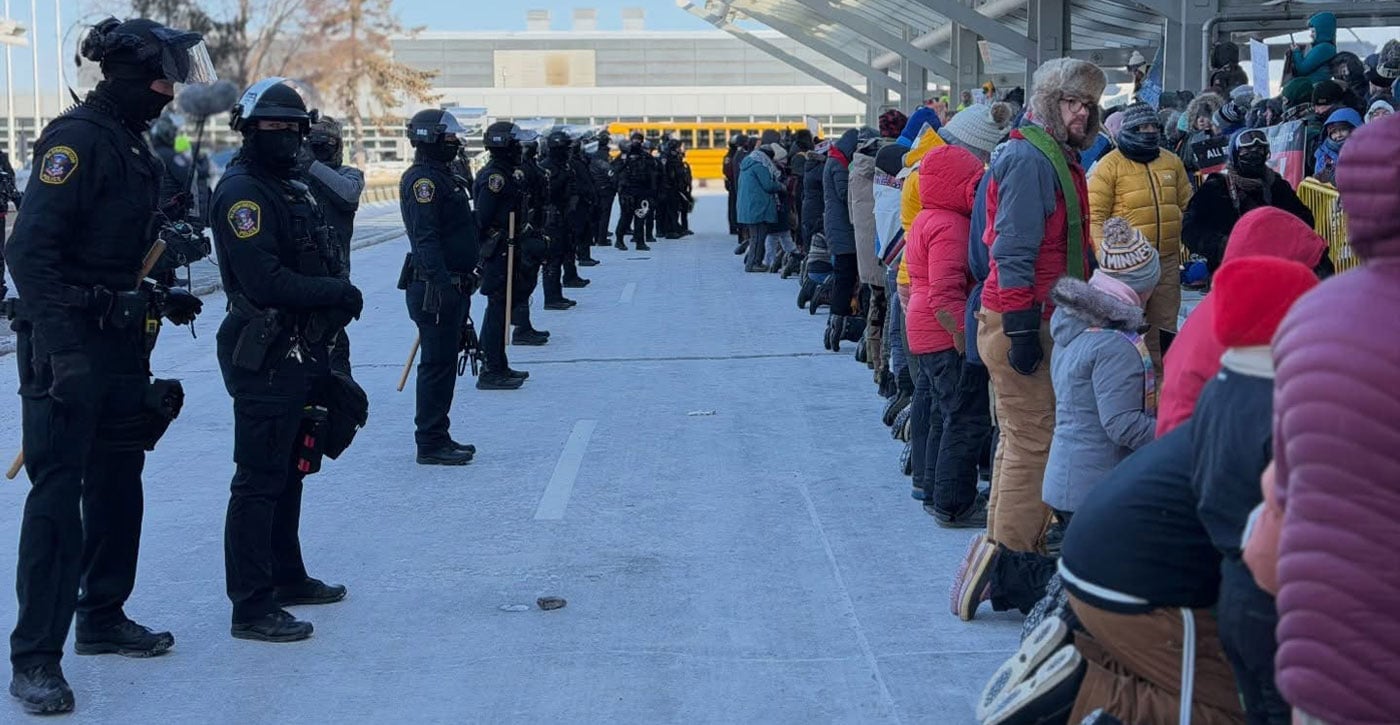
Left: Clergy members and activists form a picket line outside Minneapolis-St. Paul International Airport on January 23 to call on airlines to stop transporting detainees facing potential deportation. Right: Julie Doherty (right), a member of Twin Cities Meeting, with Pamela Twiss (left) at the airport protest, holding signs that read “We Are Minnesota, We Protect Our Neighbors.” Photos courtesy of Julie Doherty.
Friends in the Twin Cities have reacted to the shootings by partnering with other faith groups and community members to publicly protest, practically assist immigrants, serenade international neighbors who are afraid to leave their homes, whistle warnings of immigration enforcement officers in neighborhoods, educate the public about their legal rights, and video-document interactions between agents and immigrants.
Friends around the country are also responding to actual and potential ICE activities in their cities.
Julie Doherty and Laura Kressin, members of Twin Cities Meeting in St. Paul, were arrested as part of a January 23 protest at Minneapolis–St. Paul International Airport. The pair had prepared to be in jail over the weekend but were released after several hours after being charged with misdemeanors, Doherty explained. The officers who arrested them used zip ties on their wrists but took them off once the 98 arrestees were seated on the heated bus the authorities had prepared for them.
Protestors, many of them clergy, called on airlines to stop transporting detainees facing potential deportation. The demonstration took place on the same day as an anti-ICE general strike in Minnesota, Reuters reported.
Kressin, Doherty, and fellow meeting member Annika Fjelstad are involved in the interfaith activist group ISAIAH, which promotes immigrant rights and helped organize the airport protest. They plan to participate in a local event planned as part of a nationwide immigration justice protest called the Palm Sunday Path on March 29.
Laszlo Jentes is a Quaker Voluntary Service fellow at the QVS Minneapolis house, where he has been living since last fall. Last December, Jentes, who identifies as Quaker-adjacent, attended an interfaith convention hosted by ISAIAH. Many Quakers are involved with ISAIAH. Leaders from local Jewish, Muslim, and Buddhist communities, as well as members of Quaker groups, were among the approximately 4,000 people at the convention, which bolstered Jentes’s commitment to care for his immigrant neighbors.
Quakers and other Twin Cities neighbors are protecting immigrants by participating in school patrols, becoming local responders, and becoming Constitutional observers, Jentes explained. One local Quaker walks immigrant children to and from school. Constitutional observers watch to make sure federal agents are upholding the rights of immigrants being detained.
“We want our neighbors to be safe,” said Jentes.
Through QVS, Jentes works on the communications team at COPAL (Comunidades Organizando el Poder y la Acción Latina), where he produces resources explaining what help is available to immigrants. For example, the Immigrant Defense Network, a coalition of nonprofits, offers food assistance, hygiene products, diapers, infant formula, rent assistance, and legal support to hundreds of families seeking assistance. One of the network’s key goals is to help immigrants avoid eviction.
Friends in the Twin Cities have observed disturbing changes to their daily lives due to the surge of government agents. They have also noticed acts of solidarity with immigrants.
Quaker Minneapolis resident Greg Woods’s nine-year-old daughter goes to a school in which half of her classmates speak Spanish at home as a first language.
“I see ICE [while] going to take my daughter to school,” said Woods, who works as a consultant for Beacon Hill Friends House in Boston, Mass.
The students in Woods’s daughter’s school have been selling toys as well as knitted creations to raise money to pay the living expenses of classmates’ parents who cannot work due to ICE enforcement, Woods explained. In some cases, the parents’ workplaces are closed because the threat of ICE activity has led to a drop in business. In other cases, parents cannot go to work because they fear being arrested by ICE. As of late January the students had raised $150.
Everyone has something to contribute to supporting immigrant neighbors, according to Quaker and Minneapolis resident Katie Breslin. She noted that a woodworker created wooden whistles, which emergency response teams can use to alert immigrants that ICE officers are nearby.
Friends and others are supporting immigrants by patrolling neighborhoods and warning of ICE sightings, explained Ray Hommeyer, Minneapolis program coordinator of Quaker Voluntary Service. Quakers and other community members are keeping watch at mosques on Fridays so Muslims feel safer praying at weekly worship. Supporters are also patronizing immigrant-owned restaurants and grocery stores. The immigrant clientele of such businesses are afraid to eat and shop at them because they worry about being arrested by ICE.
Community members have also volunteered to serve as marshals at the Whipple Federal Building, from which ICE stages its operations in the city. ICE has pushed down and tear gassed the marshals. Friends have also been driving immigrant children to school and their parents to work. In addition, demonstrators went to the Whipple Building to pretend to turn themselves in to ICE as a form of protest.


Left: A protest crowd gathers outside Target Center in downtown Minneapolis as part of an “ICE OUT!” demonstration and general strike on January 23, 2026. Photo courtesy of Julie Doherty. Right: Protestors march at the anti-ICE demonstration in downtown Minneapolis, January 23, 2026. Photo by Katie Breslin.
Singing Resistance is a movement that involves vigiling and walking through neighborhoods where immigrants are hiding in their homes and singing to them, according to Hommeyer.
One hundred resistance singers also gathered to sing in the middle of a Target store in Minneapolis. Target is headquartered in the city.
After ICE detained two employees at a Minneapolis-area Target store, 300 employees circulated a letter of protest, the BBC reported.
One arrestee produced a U.S. passport but was still taken into custody, according to Doherty, who lives about three miles from the store. ICE dropped off one of the two 19-year-olds arrested several miles from his coat and car. Neighbors drove him back to Target to get his things. Activists are calling on Target to become a Fourth Amendment workplace, which would mean they would require all law enforcement agents to provide judicial warrants before entering the store.
Quaker and Minneapolis resident Katie Breslin recounted another ICE arrest.
“I responded to an alert. I heard a bunch of whistles, and I ran to this gas station that is in my neighborhood. And by the time we, a lot of us, got there, ICE was already leaving, and this woman had left her driver’s license and passport on the mirror. It’s not a targeted person. They saw a Latina woman, she had a white van, and they decided to mess with her, right?”
Quakers have long expected ICE to come to Minneapolis, according to Clara Fuehler, a QVS fellow at the Minneapolis house. When people have been sharing joys and sorrows at the end of meeting for worship, concerns for immigrant friends and neighbors have come up frequently.
Spiritual practices that help Fuehler continue supporting immigrants include listening and finding time for silence, she explained.
One key way that Twin Cities Meeting provides spiritual support and grounding is by elders offering wisdom about the work of activism drawn from their first-hand historical knowledge of such efforts as the Civil Rights Movement, Fuehler explained.
Fuehler led meeting for worship the weekend after a federal agent killed Renée Good.
“There are structures in place that are concerned with ‘How do we move in tragedy?’” Fuehler said.

Quakers in other parts of the country are mobilizing to support immigrants facing potential ICE arrests.
Sacramento (Calif.) Meeting member Chris Shipman-Mackey distributed 100 to 200 red cards with information about immigrants’ rights and resources printed on them.
“Given the last couple of weeks, those red cards have taken on a new meaning,” said Cindy Fowler, another member of Sacramento Meeting.
Individual Friends are accompanying immigrants to their immigration hearings, Fowler noted. The meeting is not organizing the accompaniment, but individual Quakers are participating as they feel led.
Know Your Rights trainings instruct participants in what they should say if stopped by ICE agents, according to Shipman-Mackey. If someone stopped is underage, they should give their name, age, and parents’ names and phone numbers then remain silent. They should not give law enforcement agents the passcode to their phone.
If the person stopped is an adult and a U.S. citizen, they should not say, write, or sign anything except to calmly repeat, “I’m a U.S. citizen. I want an attorney,” Shipman-Mackey explained.
Mountain View Meeting in Denver, Colorado, has volunteers who have agreed to greet ICE agents if they come to the meetinghouse and to tell them not to enter until after worship ends. Other volunteers would function as guest communicators to let immigrants in the worship meeting know that ICE is there. Additional volunteers would record videos of the ICE agents’ activities. Meeting attender John Lewis is the coordinator of the volunteers.
Previously, the meeting had immigrants living at the meetinghouse, but they have moved out, according to Lewis.
“The need really shifted away from housing and toward finding lawyers,” Lewis said.
Louisville (Ky.) Meeting clerk Cindi Goslee participates in Louisville Showing Up for Racial Justice’s Community Defense Network. Community defenders learn about the Constitutional rights of both endangered immigrants as well as those defending them. They also learn about the needs of the immigrant population in Louisville.
Recently community defenders provided accompaniment at a festival and a No Kings Day rally, according to Goslee. They also offer court accompaniment, Goslee noted.
Louisville Meeting financially supports immigrant advocacy organizations. When the meeting hosted their quarterly meeting, it included an education session about immigrant rights. The meeting also supports individuals who advocate for immigrants and includes relevant information in its newsletter and during announcements at the rise of meeting.
“This is a very small drop in the bucket, but it’s something. It’s a way that we can assist in the midst of this climate in which we are living,” Goslee said.

Quaker meetings can provide support and grounding for those acting in solidarity with their immigrant neighbors in the current climate. One such source of support is Friends’ long tradition of nonviolent resistance.
“It’s important to stay calm. I don’t think we’re going to win by saying ‘F–ICE,’” Twin Cities Meeting Friend Fjelstad said.
Older members who participated in the nonviolent resistance campaigns of the Civil Rights Movement can play an important role in shaping and supporting today’s activists, according to Fuehler, one of the QVS fellows in the Minneapolis house.
Quaker communities can support individuals as they lament loss of life and other immigration enforcement violence, Hommeyer noted. Lamentation exists alongside celebrations of community and wanting to be held by God, according to Hommeyer.
After the 2024 presidential election, which Trump won, Lewis and four other Colorado Friends started meeting each Monday night to discuss their feelings and identify actionable steps. The meetings are opportunities to “undrown yourself,” Lewis noted.
Lewis suggests that Friends concerned about immigration enforcement get together with other meeting members to express sadness and determine what they are called to do.
Remaining rooted in Quakerism can help Friends communicate with those who disagree with them on immigration enforcement.
When asked how he responds to people who say that ICE is making America safer, Lewis talks about individual experiences. “I think that I try to spoon feed people empathy,” Lewis said.
He often speaks of his friend whose father was a police officer in Venezuela and who also knew someone in a gang in the country. Lewis tells the person on the other side of the immigration issue how people have scraped by just to survive and what dangers immigrants face.
Asked how he would respond to someone who says ICE is making America safer, Jentes said, “It’s difficult for me to keep a level head with that.”
He described such a conversation as an opportunity to practice patience and forgiveness.
“They’re not really concerned with safety; they’re concerned with what someone has told them is safety,” Jentes said. “It’s not safer for me or for my neighbors.”
Thank you for writing this! Here next door to Minnesota in Madison, WI, the Mennonite Action Committee organized a Sing For Justice at the local Target store on Valentin’s Day. Many Quakers were among the 130 participants. Some employees were glad we were there. Our area newspaper printed a letter to the editor just before the sing. Many, many Quakers across the globe are sympathetic with and working for justice. The Friends Committee on National Legislation’s Advocacy Teams – 138 volunteer teams across all 50 states – are lobbying legislators in 2026 on Executive Overreach, in it’s many forms.
I appreciated the article about Friends’ responses to Operation Metro Surge. There were of course other quieter responses that occurred among Friends, mutual aid being one of them: Wage earners were too afraid to go to work; others were snatched from their homes and were detained or deported; and the family members who were left behind struggled to make rent on the severely reduced household income.
Quakers were among those who contributed to mutual aid. We also reached out beyond the Land of 10,000 Lakes to our out-of-state connections. Monthly meetings in the midwestern U.S. and countless Friends sent funds; still others made donations to trusted nonprofits like the Immigrant Law Center of Minnesota.
People who couldn’t give funds or do ICE patrols, or who couldn’t safely intervene when ICE was breaking down doors without proper warrants, instead made thousands of whistle kits to distribute; dispatched rapid responders; translated papers; did groceries and delivered diapers; drove neighbors to critical appointments; facilitated meetups to build community and to share how best to meet neighbors’ needs; repaired and secured the busted doors battery-rammed by ICE; jump-started cars during what was already a brutal winter; used their notary public credentials to sign the heart-breaking paperwork known as DOPAs that would delegate parental authority of children to a trusted adult if the parents were deported…
Not all of us were protesters but all of us were protectors of our neighbors. I’ll never know all the ways that we showed up for one another.
One more example: I wept as my Iowa-based monthly meeting invited the entire yearly meeting to a morning worship one First Day; my video screen was filled with Friends across the region who knew that Minnesota was hurting. They too were part of showing up.