




A Half Century of Ministry in Guatemala
My wife and I woke up early on that balmy morning in May of 1997. Excitement was in the air, for this would be a monumental day that we had dreamed of for over a quarter of a century. Today we would dedicate the translated New Testament for the Chortí people of eastern Guatemala. Thousands of people gathered in the plaza of our country town of Jocotán to celebrate this long-awaited event.
We had lived among the Chortí people since 1973, learning their language, creating the alphabet, getting it approved by the Guatemalan government, and then analyzing the grammar. This came about during the time that we lived in a rustic mountain village where no one spoke anything but Chortí. At first that was really hard, but I had learned a few words in town before moving there, so I was able to communicate on a basic level.
For example, arrangements had been made with a neighbor to bring water to our house from a creek several hundred yards away. But when I asked her to bring us water, speaking to her in Spanish, she had a blank look, obviously not understanding. Then I dug down deep in my memory and called up a couple of Chortí words that she would understand. “Aq’ueche ca e ja?” I asked her. (“Can you carry some water for us?”) And she agreed. For me that was really hard, but it worked, and she brought us water right away, carrying it in large clay jars, one on a tumpline and one balanced on her head. That was the beginning of our language-learning experience.
We were very pleased to see that we were being well-received by the people in the village. This was due in part to the love the people had for John and Joyce McNichols of the Friends Mission, who had lived among them for a number of years. Because the McNichols had such a good testimony, the Chortí people openly welcomed us. A group from this village had even been praying that God would send them another missionary family. When we arrived, we were given a huge welcome, since we were the answer to their prayers.
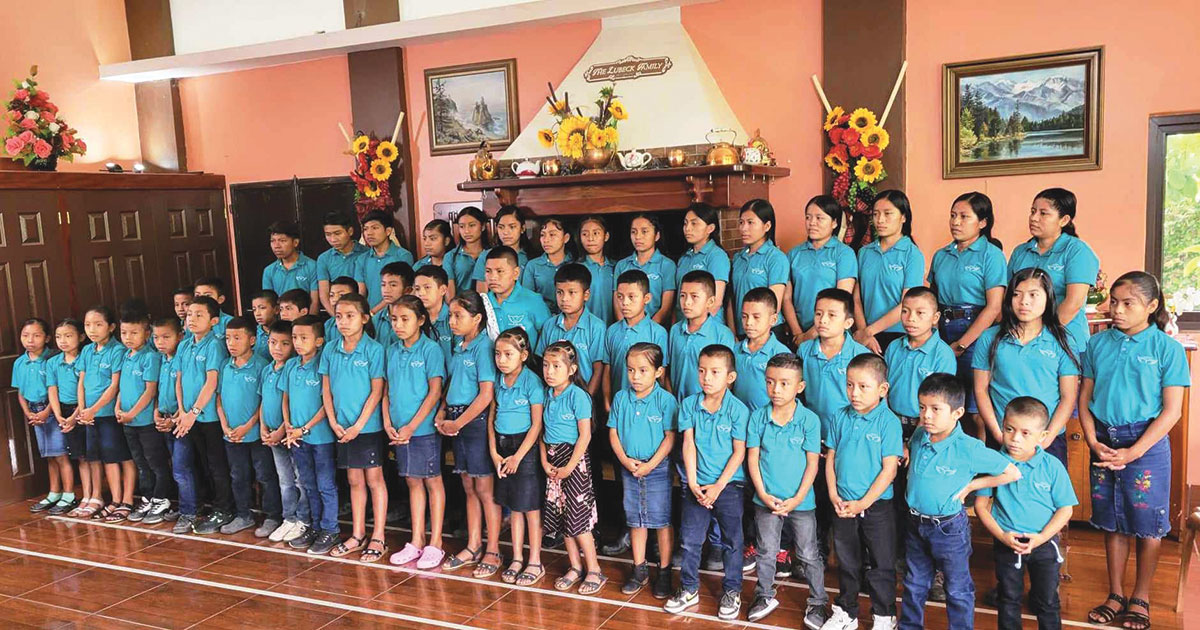
One of the main reasons for our living in a Chortí village was to be immersed in the language and the culture, and that was truly the case. Except for speaking English with my wife and children, the Chortí language was all that we heard or that was spoken in our hearing. This immersion resulted in my learning to speak the Chortí language in the four years that we lived there. And the fact that our whole family fit into the Chortí community was very satisfying. This time was very important and prepared me to get started on the translation of the New Testament.
I loved learning the language and was very motivated to get going as soon as we got to be with the Chortí people. I was quite persistent in asking people, “How do you say that?” and then writing it down in the little book I carried in my pocket. And in a few years, the sounds of the language and the grammar started making sense to me as I began speaking Chortí little by little.
But to help me learn to speak, I needed to choose a Chortí man to teach me. And so, Marcelino became my official language teacher and a good friend. Since there were no books to teach me Chortí, I had to learn it word by word. I was speaking Spanish to Marcelino, and he was telling me how to say things in Chortí. I wrote everything down phonetically, as I had been taught during the two years that I had studied linguistics at Summer Institute of Linguistics (SIL). And it was a lot of fun discovering all the sounds used to speak Chortí.
But there was one sound that escaped me for several months. There was a word I had solicited from Marcelino in which I couldn’t identify all the sounds. It was the word for “pitch pine,” which in Chortí is “ta_te’.” But I couldn’t identify the sound in the middle of the word. To me it sounded like two syllables with a silent space in the middle. But after a couple of months, I finally identified what it was; it was an “h” sound. It was completely different from anything I was familiar with in either English or Spanish. The first syllable was “tah” (with the “h” being pronounced) and then the second syllable, “te’” (meaning “wood”). So it was “tahte’.”
That opened up my thinking to that sound occurring at the end of a syllable or in the middle of a syllable. We had lots of words that have a consonant, then a vowel, then an “h,” and the syllable closed with another consonant. In linguistics, we write this: “CVhC.” It was a unique sound pattern that I had never encountered before. I learned to pronounce it exactly like Chortí speakers do. I was so happy that I was discovering the difficult-to-pronounce secrets of the Chortí language!
Even though we went to Guatemala as members of Wycliffe Bible Translators, we were supported by numerous Friends churches in California. We have had great fellowship and support from the American missionaries as well as Roman Catholic and Chortí Christians.
As we ended our time living in the village in 1980, SIL announced there would be a workshop in Guatemala City on the Gospel of Luke. So I gathered up a few men who had helped me learn the language and set off to attend the four-month-long workshop. When it was over, we had completed the whole book of Luke, including having it checked by a translation consultant to make sure we didn’t leave anything out or have any wrong meanings. Then, soon after this workshop was over, there was another one on the Book of Revelation, and we were able to complete that book as well, all in one year. It was so exciting! By then, I was beginning to be able to suggest how verses could be translated and was often correct. What a rewarding time!
But we ran into some problematic words in our efforts to translate these books. You see, as a Mayan language, Chortí is very different from European languages as far as translation goes. Doing a word-for-word translation is not possible: the goal being that the Chortí people would understand the meaning of the translation when it was finished. One of the problematic words was not complicated as such but was a problem because they used this word as an idiom that I did not understand. This comes from Matthew 15:17 where Jesus said, “Don’t you see that whatever enters the mouth goes into the stomach and then [passes] out of the body?” (New International Version). I worked and worked at explaining the word “passes” outside of the context of this verse to make sure I had the right word. But when we used it in this context, my translation helper burst out in laughter. I asked him why he was laughing, and he told me that in this context the word “pass” would mean that the person had diarrhea! So we had to find another way to say it. In Chortí, the translation came out like this (this is a back-translation from Chortí into English): “Because that which a man eats does not enter his heart, but just into his stomach, and then it goes out again from his body.”
Another difficult term to translate is found in Revelation 3:16: “So, because you are lukewarm—neither hot nor cold—I am about to spit you out of my mouth” (NIV). As I tried to explain this passage and attempted numerous possible translations, Chortí speakers would explain that lukewarm was the best. (That is also their cultural bent for drinking coffee and other hot drinks: they prefer that it not be hot.) I asked a few experienced translators from other Mayan languages how they handled this. They told me that I could not translate this metaphor using a liquid but would have to substitute it with another metaphor to get the meaning right: that God didn’t want them to be halfhearted in their obedience to Him but to be wholehearted. That would be an easy substitute in English, but in Chortí, we had to find a different metaphor that made sense to them. The older translators suggested I use firewood that is waterlogged as the metaphor. There is a word for that in Chortí, and by using that metaphor I was able to get the idea across. In Chortí the verse came out like this: “But since you are like waterlogged firewood which won’t light and will not burn or make heat, but will just smoke, I will throw you away.” When we changed the metaphor like this, Marcelino and another brother smiled big and agreed that we got the meaning right.
It was a blessing to us that I, as a recorded Friends minister, was assigned to work on a Friends mission field. And even though we went to Guatemala as members of Wycliffe Bible Translators, we were supported by numerous Friends churches in California. In Guatemala, we have ministered in the Friends churches in Jocotán, and in all of Chiquimula and Chortí villages. Throughout our time living in Guatemala we have had great fellowship and support from the American missionaries as well as Roman Catholic and Chortí Christians.
What does a person have to do to become a Bible translator? In my case, I went to a Bible-based college and seminary where I was taught how to use the Bible’s original languages—Greek in the New Testament and Hebrew in the Old Testament—to interpret the Bible correctly. Then I studied linguistics at Summer Institute of Linguistics (SIL) at Wycliffe Bible Translators (WBT) for two years to learn how to make an alphabet for an unwritten language. The instructors taught phonetics so we could learn how to hear, say, and write all the sounds of any given language, in preparation for doing a translation. I also learned how to analyze the grammar of any language. This was great preparation for the work we had before us.
It was a joy living among the Chortí people and meeting for church services in their little thatched-roof houses. But right away, they wanted us to translate the hymns and choruses they were singing in Spanish. Since my wife, Diana, is a gifted musician, she was a great help in producing a small hymnal our first year there. We later added more hymns and choruses that we knew from our great years at Yorba Linda (Calif.) Friends Church where I had accepted the Lord in 1961. We now have a Chortí children’s choir that sings all of these beautiful hymns and choruses in a mix of Chortí, Spanish, and English!
It was not all roses living in that rustic village. For the first year or two, we seemed to have a time limit of about three weeks before we had to take a break and leave for a few days. You see—like it or not—culture shock gets to everyone sooner or later in this kind of environment. One of the shocking things that happened in our house was that there were scorpions hatching in the walls that crawled out every day. Extreme caution was needed when putting on our boots or shoes to make sure there weren’t any scorpions in them. And when using a towel, we had to check to see that there weren’t any scorpions hiding in its folds. Having a dirt floor in our little mud-wattle house with its thatched roof also contributed to our stress levels.
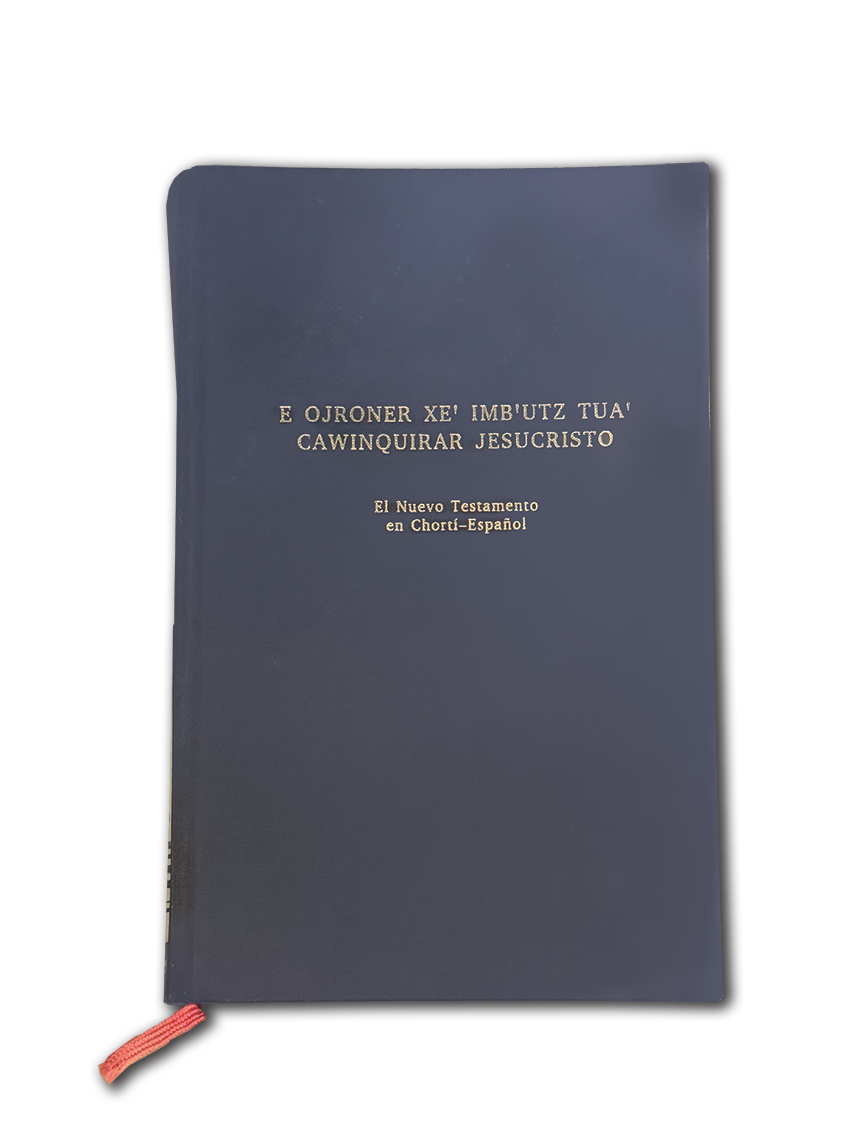
I began this article by sharing the great excitement of dedicating the New Testament in Chortí. But I would like to go back and explain how we decided to go to the Chortí to do Bible translation in the first place. In early 1973 Diana and I were just finishing up WBT’s six-month jungle training camp in Chiapas, Mexico, when we heard from Paul Enyart, the director of the Friends mission in Guatemala. He sent a letter to WBT in Guatemala inviting them to send a couple out to do the translation of the Bible for the Chortí. When we heard about it, both Diana and I were deeply moved by the Holy Spirit. We had known about the Chortí for many years, attending Yorba Linda Friends Church, so we were very interested to hear of this invitation.
We were right on the cusp of being assigned by WBT to the place where we would do a translation of the Bible. We decided to fast and pray and find out what the Lord’s will was for us. We were in a remote location in the mountains of northern Guatemala, and we went up on a deserted hilltop to pray and seek the Lord. My decision was that we would fast and pray until the Lord spoke to us. Well, that first morning as we were praying and reading the Bible, I was reading Psalm 2 and got to verse 8, which says: “Ask me, and I will make the nations your inheritance” (NIV). As I read that verse, the Lord spoke to me in my heart and said, “John, do you want the Chortí as your inheritance?” I paused for a minute to think about it, and then said, “Yes, I want the Chortí for my inheritance.” Now, nearly 53 years later, we are still here loving the Chortí people and encouraging them to follow the Lord and make Jesus their Lord and Savior. Diana and I are not sorry for saying yes to the Lord, and we continue to rejoice in the privilege of staying in Guatemala into our old age, loving Jesus and letting our lights shine for Him.
We want to hear from you, not an AI! Please be thoughtful and use your own words. Comments on Friendsjournal.org may be used in the Forum of the print magazine and may be edited for length and clarity.