



The Marvelous Mystery of Worship-Fluid Meetings
“We consider singing to be serious worship, Friend.”
Twenty years ago, the convenor of Lopez Island Worship Group in northwest Washington State thus spoke to me (a recently transplanted mainlander Quaker) in response to my request that, maybe this month, we skip Singing Sunday, as I had several “deeply unprogrammed” Friends visiting that weekend who would be expecting more “serious worship.”
Now many years later, that eldering remains a strong memory: a strong “Yikes, was I that full of my Quaker self?” It was my introduction to—and now a deeply held understanding—that, yes, singing can be serious and powerful ministry, even as a part of a traditional, unprogrammed approach to Quaker worship.
A bit of background and explanation:
I spent my Quaker youth (my 30s) at San Francisco (Calif.) Meeting, lovingly referred to by some as “SF Conservative.” San Francisco Meeting had, and I believe still has, a steadfast devotion to unprogrammed worship and a commitment to grounding silence and thoughtful vocal ministry. At the time, it had periodic three-hour “extended” meetings for worship, and it was there I practiced settling into the silence and listening for that still, small voice; sought the sensitivity to discern if I was to share a message in meeting; and looked for the grace to deliver it clearly and succinctly.
While my Quaker rookie self was often lacking in discernment and vocal ministry fluency, I did not lack in desire. Through trial and error and friendly eldering, I developed my own deep commitment to unprogrammed worship and a conviction that this was the correct and holy way of doing Quakerism!
In 2006, my life was upturned when I reconnected at a reunion with a college choirmate; fell in love; and left my beloved San Francisco to be with my new partner and her children on Lopez Island, 45 minutes by ferry off the northwest mainland of Washington. I shared with my San Francisco friends that I was moving from a city with 3,000 restaurants to an island with 3,000 inhabitants but, luckily, an island with the largest Quaker contingent anywhere in the San Juan Archipelago.
There in my new home, it quickly became clear I was no longer at San Francisco Conservative. I had stepped into Lopez Island “we do things a bit differently” Worship Group: different in that we met in members’ homes; different in that one Sunday each month, instead of holy unprogrammed silent expectant worship, the meeting held Worship Sharing Sunday where predetermined queries were offered to guide our worship. And the group was majorly different in that once a month we met for meeting for worship for singing, aka “Singing Sunday.”
After a few months, I realized I was now attending what some of my San Francisco Quaker friends had derisively referred to as a “semi-programmed” meeting. Oh my goodness! Was I now in a meeting on the slippery slope to program-ageddon! It was out of that fear and anxiety that my request to skip Singing Sunday had arisen, and yet it had been dismissed (and now I realize, thankfully had been dismissed) in such an iconically polite yet pulverizing Quakerly manner: “We consider singing to be serious worship . . . Friend.”
Fast-forward 20 years to the present, and much has changed in our meeting, as well as in my own Quaker heart and experience. After working through preparative meeting purgatory ten years ago Lopez Island became a monthly meeting with two neighboring island worship groups under our care. In keeping with the theme of “a bit different” and with the wonderful opportunity to set up a monthly meeting from scratch, we chose new names for our committees. We preferred “Spiritual Life Committee” in place of the more ominous-sounding Ministry and Oversight and the “Gifts and Talents Committee” instead of the (no one really wants to be on) Nominating Committee. In all seriousness, those names seemed more to the point of actual committee tasks as well as more friendly in all senses of the word.
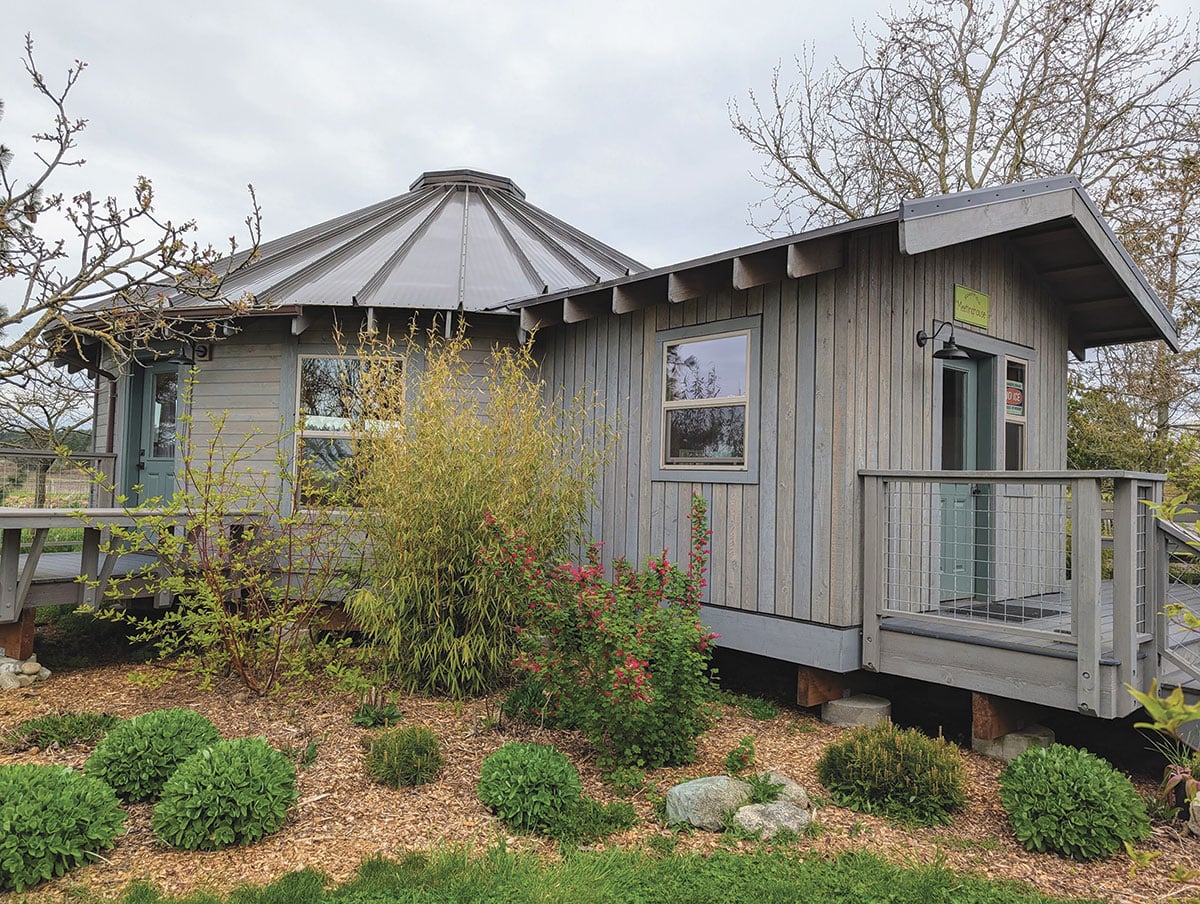
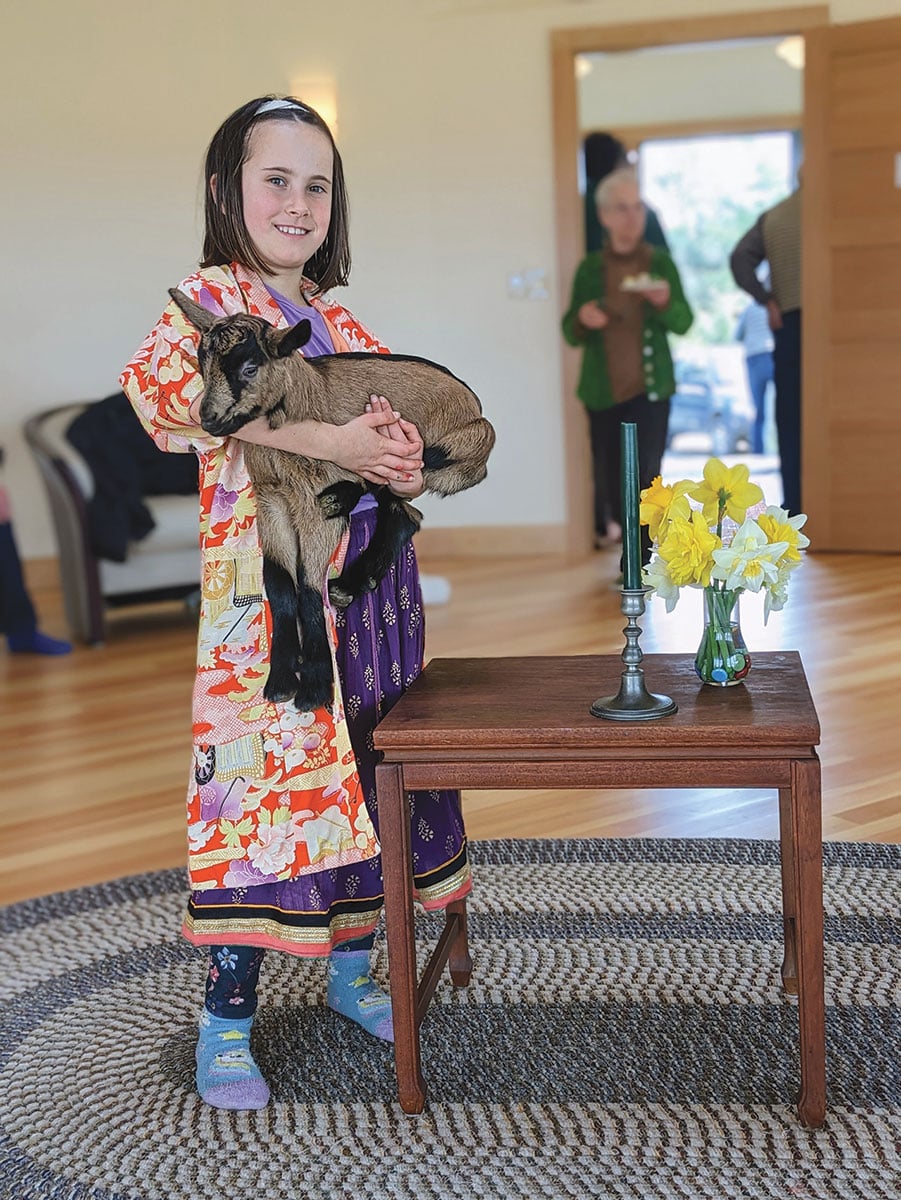
Our meeting now has a permanent home in a 30-foot diameter wooden yurt—why have a square meeting room when Friends gather in a circle? We built the yurt from a kit, primarily with our own hands, as island life breeds resourcefulness. The building, named Sunnyfield Meetinghouse, is located at Sunnyfield Farm, a small, family-run goat dairy. One member wryly refers to our new meetinghouse as “The Yurt of the Holy Goats.”
And we are growing. Attendance at worship sometimes reaches more than 30 and is regularly 20 to 25, including our child members: all this in an island community of around 3,000 full-time inhabitants—more if you include the goats, sheep, deer, and other of God’s critters. We are blessed, as how many other meetings have one percent of their area’s population on their mailing list?
And in the spirit of continuing revelation, we continue to experiment! Recently we were led to combine our regularly scheduled Singing Sunday with worship for letter writing regarding immigration enforcement concerns. We started our letters out of the silence, and as friends completed their personal letters to our representatives in Washington, D.C., they transitioned into worshipful singing. So far the reaction to this latest experiment has been positive, and we were able to deliver 51 handwritten letters to our congressperson and senators!
Through all these experiences in my Quaker island home, I have become convinced of the power of guided worship working in partnership with the more traditional form of open worship. Our guided worship feels well-covered by Spirit, with palpable energy and community, and it seems even to be—dare I say—popular.
So friendly reader, if you’re interested, here’s what we’ve learned, what we do, and how I have come to experience these benefits to our meeting and to our faithfulness. All are offered with the hope that it may be food for thought and practice in your Quaker community.
First, some explanation of the alternative Quaker nomenclature that I am using, offered for your consideration and possible use as well.
We use the term “open worship” in place of “unprogrammed worship.” Unprogrammed sounds like a trip your friends take you on to a nearby motel for an intervention. Moreover, unprogrammed describes our practice in the negative. In contrast, “open worship” is a positive statement of what we are doing: worship open to Spirit, open to all voices, and open to instruction and faithfulness.
We speak of “guided worship” rather than “programmed.” Programmed sounds like something humans used to do and now AI does. “Guided worship,” such as worship sharing and worshipful singing, seems more to the point. And in my experience, deep and spontaneous messages can and do rise out of these guided sessions.
“Worship-fluid” is our choice for “semi-programmed.” Keeping with the wisdom of the times, maybe we can let go of “worship duality” and accept that there are many different ways and combinations of worship that can serve as pathways to the Divine.
At Lopez Island Meeting, we always start with open worship. On Worship Sharing Sunday, we begin with 15 to 20 minutes of open worship; followed by five minutes introducing queries; and another 60-plus minutes of worship sharing, for a total of 90 minutes together in worship. (Who knew God was okay with more than an hour of meeting? Well, of course, George Fox knew that, albeit he did not seem as clear on the singing thing.) Singing Sunday also starts with a period of open worship and then transitions to worshipful singing where we sing out of the silence until the rise of meeting.
We’ve learned that singing or worship sharing is powerful and welcoming worship. As such, we devote a real portion of our serious worship time to these practices and incorporate them into our regular meeting for worship schedule, so more people can experience and be inspired by them. Currently, our first Sunday of the month is devoted to worship sharing and the fourth Sunday to worshipful singing.
We have found worship-fluid meetings greatly benefit from keeping things “serious.” Creating, sharing, and enforcing (okay, eldering) guidelines for all forms of worship is a key. Friends are likely familiar with guidelines for worship sharing, and we recite them at each Worship Sharing Sunday. (One of my favorites is, worship sharing works best paired with worship listening.)
These different forms of guided worship have brought a new and more diverse set of people into our meetinghouse. In our experience, guided worship creates a wider door to welcome seekers and newcomers. It offers different forms of worship that welcome more voices and provide different pathways for connection to the Divine.
Moreover, I find guided worship can serve, in part, as a training ground for ministry. In particular, worship sharing with well-crafted queries explicitly invites individuals to speak and allows them to focus on their own spiritual and life experiences.
Overall, this tends to set a less-threatening bar to clear for one to speak in worship. It’s an opportunity to share in meeting without the whole “God spoke to me and told me to share our conversation with y’all!” requirement. This, in turn, seems to encourage different and new voices to be heard, and provides those souls an opportunity to develop their ministerial voice and sense of Spirit. In that way, worship sharing can help strengthen the quality and depth of vocal ministry across the full spectrum of worship formats, including our traditional open worship form.
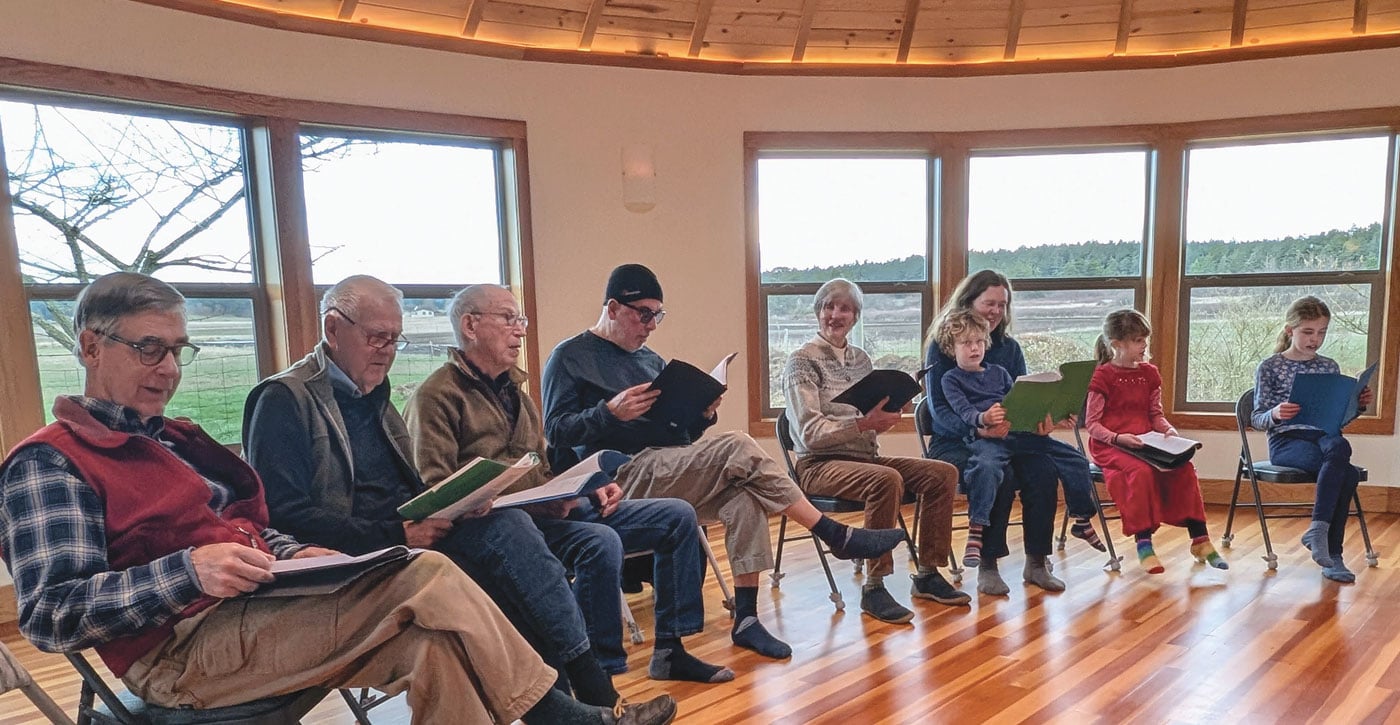
Singing Sunday, too, brings in a wider range of voices and is at the heart of our monthly intergenerational meeting. Kids like to sing—especially kids’ songs. Our own loosely collated songbook includes songs for, and suggested by, children in our community. They even wrote a new “Simple Gifts” verse for singing in meeting.
In our experience, our worship-fluid meeting has welcomed a wider diversity of souls to Quaker worship and given them a broader set of ways to practice our Quaker faith and connect with Spirit and faithfulness. Breaking out of worship duality has brought more engagement and joy into our meetinghouse to the benefit of all. It is much in keeping with the Rumi lyrics to one of our favorite Singing Sunday songs and rounds:
Come, come, whoever you are!
Wanderers, worshipers, lovers of leaving.
Ours is no caravan of despair.
Come, yet again, come.

Dear Friends, I’ve had requests to share the guidelines we use for Singing Sunday. Here they are, sing on!
Lopez Island Friends Meeting
Singing Sunday Guidelines
Welcome to Singing Sunday!
“When friends rejoice both far and near, how can I keep from singing?”
Here are some reminders of how we sing Singing Sunday:
We start with a period of open worship, center ourselves, and then the host will transition us to worshipful singing.
Singing Sunday is joyously intergenerational! However, if a child needs to head out of meeting to ‘sing their own song’ someone will be available to accompany them elsewhere.
We encourage ourselves in “worshipful singing” in which, out of silence individual friends are encouraged to select songs that “speak to them.” (Friends born in the last decade or so are particularly encouraged to, and supported in, picking songs!)
As led, a friend putting forth a song pick might before or after the song is sung, might share why it came to their heart. Others might share as well how the song touched them.
We strive to keep the space between the songs ‘worshipful’ — reverent and focused on the singing and the spiritual energy of the selections.
And of course worshipful can include having a joyous time, or laughter, sharing of smiles, reveling in the joy of making music together, harmonies, rounds, and when present instruments to accompany us.
At around the hour mark, the meeting host will discern when to have a final song, and then they will lead us in the close of our worship time together.
“Sing and rejoice, you children of the day and of the Light ….” George Fox
I love your new terminology… the relaxing of forms that were fitting in their time… but we are in a NEW TIME… a softening of healing hard edges… a time of deeper listening to newly found common ground… hidden beneath habits that hurt. And, of course, singing and humming are so good for the health… connecting the brain through the vagus nerve to all the organs for energy flow and vitality. Group singing is especially good… intergenerational even better.
I loved reading this message on singing worship. I find that the Spirit moves me to sing and this article lets me know that there’s nothing wrong with this. Music touches my soul in a way words alone might not. Thank you for sharing this story.
Michelek
So much gratitude for this joyful article! So much depth of Spirit in music and song – are we inclusive or exclusive in our time together in worship?
Love this quote from George: “Sing and rejoice, you children of the day and of the Light ….” George Fox
I am hopeful all are familiar with the singer/songwriter Paulette Meier. She sets words of Quaker inspiration to song and this George Fox quote is one of my favorites to play over and over…
thank you Friends. Nancy