



Revisiting Joan Slonczewski’s Quaker Science Fiction Novel
Merwen reached over the boat rail, but her hand froze above the weathered pier. To be sure, spring morning breathed peace through Chrysoport harbor, and the sea rippled without a crest. Still . . . a shore. Across the sky where Merwen was born, none but the dead ever sank to touch the world’s floor. —Joan Slonczewski, A Door Into Ocean
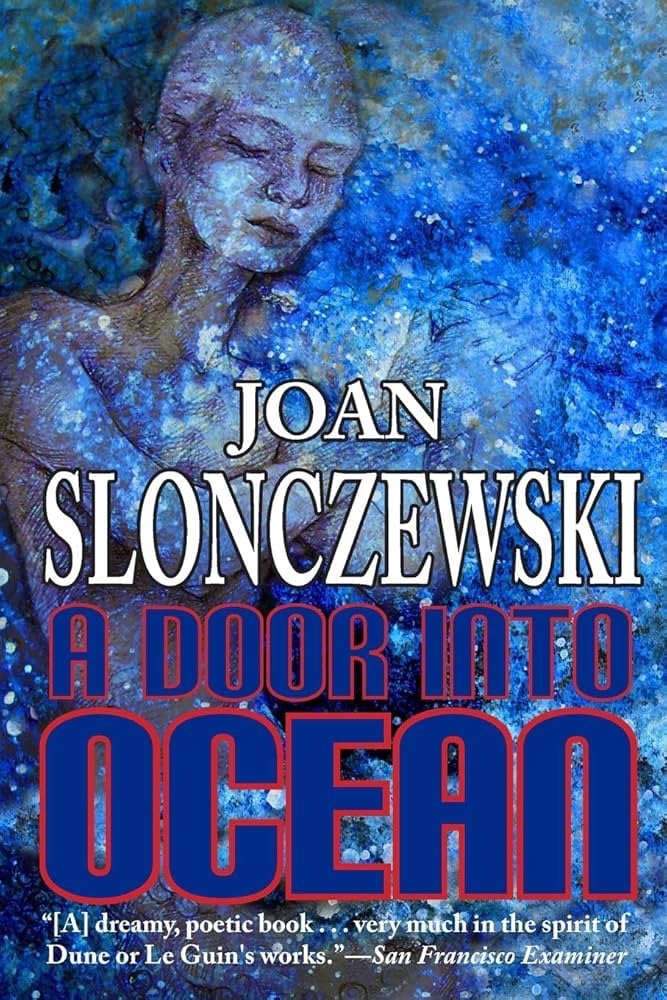
So begins Joan Slonczewski’s celebrated science fiction (sci-fi) novel A Door Into Ocean, published in 1986 and marking its fortieth anniversary this year. Ocean, written in response to the challenges and possibilities of the early 1980s, would bring Slonczewski the first of two Joseph W. Campbell Awards, a Prometheus nomination, and a place on numerous “best of” lists.
Ocean tells the story of the meeting of two divergent cultures. The organic world of Shora, existing on a moon entirely covered by water and inhabited by a race of communitarian, female bio-scientists called “Sharers,” circles the mechanized, militaristic world of Valedon. The novel opens at a point where the Valans have been progressively developing a trading presence on Shora, being met with varying degrees of enthusiasm from the Sharer community.
What perhaps clearly marks this work as significant is the way in which it knits together creativity with Quaker values and practices, political concerns, and a deep scientific expertise. As the sci-fi author Gregory Benford enthused in his review, “If you want a completely built world, and science fiction done with the science right, this is it.”
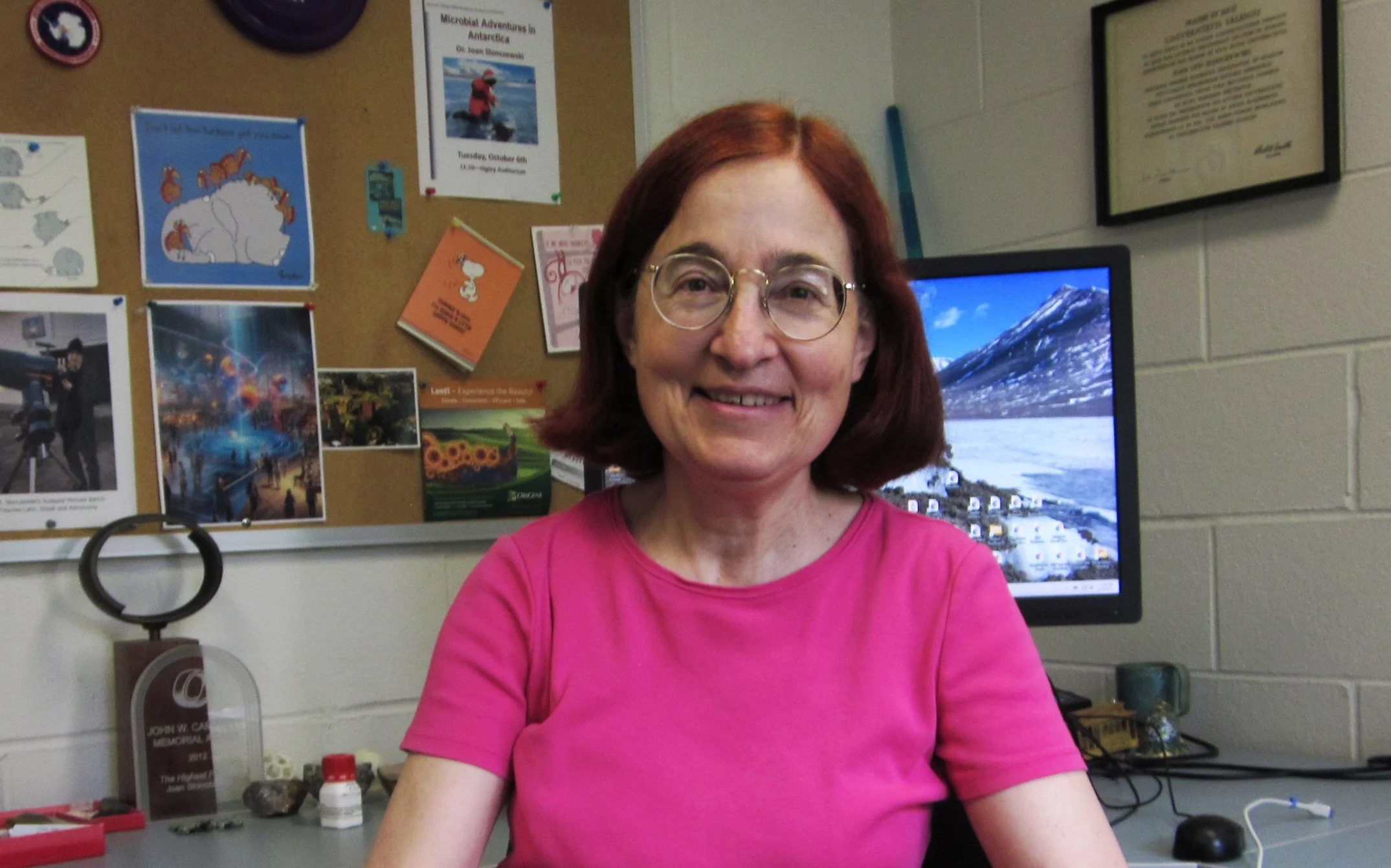
After graduating with honors from Bryn Mawr College in 1977, Slonczewski completed a Yale PhD in microbiology and post-doctoral research at the University of Pennsylvania. Since 1984 they have taught at Kenyon College in Ohio, where they are now a professor of biology and science fiction writing. Their interlinking of art and science began in a childhood where their parents were “completely encouraging” of their scientific ambitions:
My father was a physicist and wrote the Britannica article on magnetism. . . . My mother was the leading children’s violin teacher in Westchester County [New York]. . . . She came from a New Jersey Italian background and was a great storyteller. My interest in the arts and storytelling came from my mother. . . . I wish I had a book of all the Italian American immigrant stories that she used to tell.
Slonczewski describes their parents as “extreme intellectuals,” explaining that growing up they (Joan) did not receive much explicit religious input, but that they were always interested in religion, history, and the Bible. “I used to read the Bible on my own, although as a scientist, I had a real tension with religion.” Exposure to Quakerism came through higher education:
I knew absolutely nothing about Quakers, but Bryn Mawr had an association with Haverford College. . . . I met my future husband there. . . . When we decided to get married at the end of college, neither of us had a church. . . . Haverford Friends Meeting had a tradition that they would conduct weddings for any Bryn Mawr–Haverford couple.
The association continued from there. “After that, we so much appreciated the Quakers for conducting our wedding that we thought we really ought to attend Friends meeting for a while.” Slonczewski’s new experience of Quaker practices fit harmoniously with their scientific instincts: “What I found interesting about the Quakers was that they described their religion as ‘experiments with truth.’ I thought that the idea of Quakers experimenting with truth, that experimenting is the way to find truth, that was consistent with my science experience.”
Slonczewski was soon involved in activism, including participating in many actions with American Friends Service Committee. These included challenging the launch of Trident nuclear submarines and organizing the 1982 nuclear freeze march in New York City attended by one million people. At another action in Washington, D.C., Slonczewski saw families in attendance and witnessed a mother get arrested in front of her son, who watched from behind the police line. “He was telling everyone, ‘My mom’s getting arrested for me today.’” Slonczewski recalls. “Those experiences really made an impression on me and worked their way into my writing.”
Slonczewski had always read and loved sci-fi, and against the backdrop of the 1970s—with economic, political, and military threats sweeping the world—writing offered itself as a positive response to what was happening.
As a biologist, I was very much aware of dangers to the planet from human technology. . . . Climate change awareness was there, but also the threat of nuclear war was imminent, and as a scientist, it was very, very depressing to me. I started writing [science fiction] with the idea of writing about worlds that got beyond that, that had succeeded, had not been destroyed. Writing was very much a therapeutic thing for me.
By this time, through their involvement with Quakers and peace activism, Slonczewski had been exposed to the writing and ideas of Mohandas Gandhi and of peace activist and thinker Gene Sharp and was attempting to put these influences into practice. “I thought one thing I could do would be to write a book about self-defense by the means of Gandhi, Sharp, and the Quakers to show how that would work. I thought that could be a useful thing that people would learn from and might help save the world.”
We can see these elements being worked through in Ocean. The Sharers send representatives to Valedon to identify someone who might be interested in joining their community and learning their ways. They meet Spinel, a young Valan struggling to make his way in an aggressive, acquisitive society; it is through him that the reader experience the fluid, holistic ways of the Sharers. Insofar as it is possible, the Sharers are at one with their environment, and from an outsider’s perspective could be dismissed as practicing New Age hocus pocus. In actual fact, they have evolved into a highly sophisticated society founded on deep science, which includes marine ecology as well as high-level genetics that allow Sharers to propagate in spite of being an entirely female community until Spinel’s arrival.
One of the many affecting narrative strands in the book deals with Spinel’s blossoming relationship with the forthright Lystra, revealing that while it initially appears that the Sharers are lesbian, they are in fact pansexual. Slonczewski spoke about including LGBTQ characters in their writing:
When I wrote [my first book] Still Forms on Foxfield, I included one gay male character, just because I thought that’s part of life, and to be accurate to life, I would include that. Then after the book was published . . . gay readers wanted to put it in gay and lesbian bookstores because it had one gay character. At that time, books could disappear. So I thought, “Well, the one way I’ll always have my books in print is if I have gay characters!” So that was another factor in my choice to write A Door Into Ocean with an all-female society. Much later than that, I looked back and thought, “Why do I always write about these characters?” Actually, it relates to myself. I consider myself agender or both genders, and looking back, that’s really what the Sharers were: gender was irrelevant to them.
Following their capitalist–colonialist logic, the Valans decide to expand their authority over Shora, setting the scene for clashing cultural and ethical perspectives. We witness the creeping environmental devastation of Shora caused by capitalist exploitation—and now echoed in our world today by melting icebergs, withering forests, and ever more ferocious weather systems. Sharer decision making is modeled closely on Quaker business meetings, where sharply divergent views are held in an open attempt to reconcile them. Various forms of direct and nondirect action are considered, leading to conflict both among the Sharers as they wrestle with the right way forward and between the Sharers and Valans, who employ increasingly aggressive economic and military tactics to get their own way. These include spreading a pathogen to kill off the “seaswallowers,” which cleanse the oceans, as well as arresting, torturing, and executing the Sharers who oppose them.
Sharer scientists succeed in isolating an antidote to the Valan pathogen, which in turn leads to the return of the seaswallowers and the Valan military bases being inundated, forcing their retreat. The book’s conclusion sees a travel ban coming into effect between the two worlds, with various characters needing to decide where they will remain. Spinel, desiring to spread the Sharers’ message of nonviolent resistance, wishes to return to Valedon, but ultimately love wins out when he realizes that he cannot live without Lystra.
Part of the appeal of Ocean—besides its skillful plaiting of hard science with Quaker spirituality and political activism—is the honest acceptance of moral ambiguity. While there are general characteristics displayed by the communities that are in conflict in the story, certain individuals confound expectations, with some Sharers not following the values of their people: Rilwen, Lystra’s first “lovesharer” becomes “stonesick,” addicted to the semi-precious, meaningless stones brought by Valan traders, causing their relationship to founder, while Virien realizes even darker corruption: indulging psychopathic bloodlust that results in her murdering other Sharers before losing her own life. On the other hand, several Valans refuse Valedon’s cruel cupidity. Spinel passes from fearful incomprehension to fully embrace Sharer values. Siderite, a scientist tasked with learning as much as he can about Sharer bio-science, is enthralled and humbled by the delicate, organic genius of the Sharer’s genetic systems, coming to the realization that if it is absorbed by Valan knowledge, it will be besmirched. These characters, as in life, are aware of the moral complexity of so many situations, all of them lacking any easy answers.
That integrated approach to art and life also informs Slonczewski’s approach to writing, which they see as “something that just happens all the time. I’ll get little ideas or have an experience and write something down. It’s kind of like a patchwork quilt. You get experiences and bits and pieces from different places and fit them together in a creative way.”
This happened in many ways with Ocean, for instance in Slonczewski’s decision to have every Sharer meeting chaired by a nursing mother, a choice inspired by once witnessing a woman nursing a baby while clerking a Philadelphia Friends Peace Committee meeting. Slonczewski’s biology experiments informed more technical aspects of the narrative.
When I was [studying for a PhD], one time I had the student next to me working on bacteria that have a purple pigment that captures light. He had managed to purify this pigment, and it was an amazing molecule, so he grabbed me and said, “Hey, look at this.” He had this test tube of purple pigment and when he shone light on it, it bleached, then transmitted the energy to the bacteria. So that idea of this purple pigment that would bleach really stuck in my head. I was inventing the Sharers of Shora. What would they look like? I thought their skin could have symbiotic purple bacteria that bleaches white. Then I changed it: they don’t bleach white because of light but when they give up oxygen, when they’re under stress. It’s a stress response [“whitetrance”].
Ocean’s message, hopeful yet challenging, was not universally embraced when Slonczewski attempted to get the novel published:
My publisher [of Still Forms on Foxfield] sent it back and said, “Oh, that’s a fairy tale. That’s no good.” Then several publishers rejected it, and people told me, “Well, you see, it’s impossible. Nobody will believe that.” But finally, I did find a good publisher, David Hartwell, and he took it on.
Slonczewski’s faith in their message and writing was finally rewarded:
The year after my book came out you had the Golden Revolutions beginning in Europe. The Soviet Union collapsed and Czechoslovakia and East Germany . . . all these countries became free by nonviolent action. When that happened, it was a shock because America had this view that Communism never gives up and that armed resistance is required . . . so they said, “Which authors foresaw this?” Isaac Asimov in a piece he did for MacNeil/Lehrer NewsHour said, “Here are the science fiction novels that got it right and are the ones that people should read.” He flashed several novels, and my book was one of them.
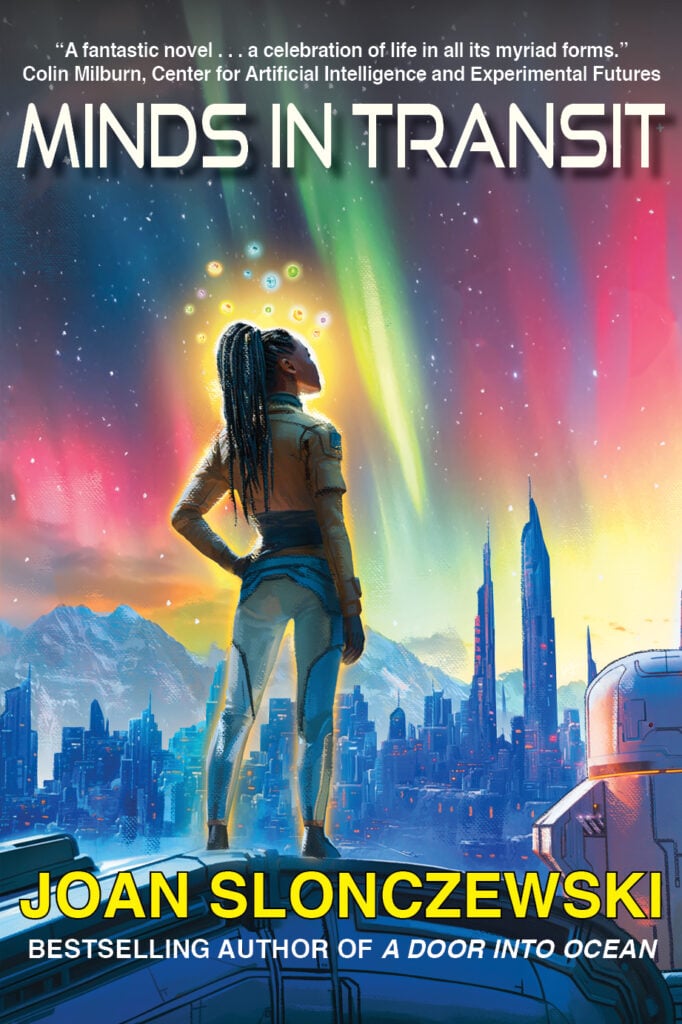
Since Ocean, Slonczewski has written on an array of scientific themes, including developing the Valedon universe in a similar way to Ursula K. Le Guin’s Hainish Cycle stories, to space exploration, to the nature of microbes, and to the future development of AI. Their new book, Minds in Transit, imagines a situation where microbes have evolved to the point of developing discernible personalities, communicating with their human hosts, and even lobbying for the right to vote. Alongside this, there are also sentient artificial minds that behave like humans:
Transit in the book is an entire transportation network that became self-aware not with the intention of its creators. It runs the whole transit network and it’s kind of temperamental so that if it dislikes the design of the new city that you’re building, it will just shut down and the entire transit network gets paralyzed. . . . It deals with very serious questions, but it’s a fun way of thinking about complex questions.
Blessed with a constantly roving mind, Slonczewski is already at work on their new project, provisionally entitled Forevertree, which deals with deep space exploration, terraforming, and “humans that colonize a distant planet where the terraforming went so bad that there are 1,000 years of lawsuits on it.”
But they got it to work with this continent that’s a wetland full of trees. If you can imagine a vast sequoia tree wetland, where . . . the people who inhabit this forest have both sets of reproductive organs and don’t care about gender, but they work with sentient machines who all insist on having gender because they consider it a sign of being human. So, all the machines are “she” or “he” and the humans are “they”! I deal with complex issues but always with a bit of fun in it.
At one point during our conversation, Slonczewski remarked, “The times we’re in now have a lot in common with the times that Ocean was published.” I have to agree with that assessment, but then there are always reasons to be hopeful. Humor and the unexpected are key aspects of Slonczewski’s writing; they look set to continue framing new experiments with truth, inspiring people to try to save the world.
We want to hear from you, not an AI! Please be thoughtful and use your own words. Comments on Friendsjournal.org may be used in the Forum of the print magazine and may be edited for length and clarity.