




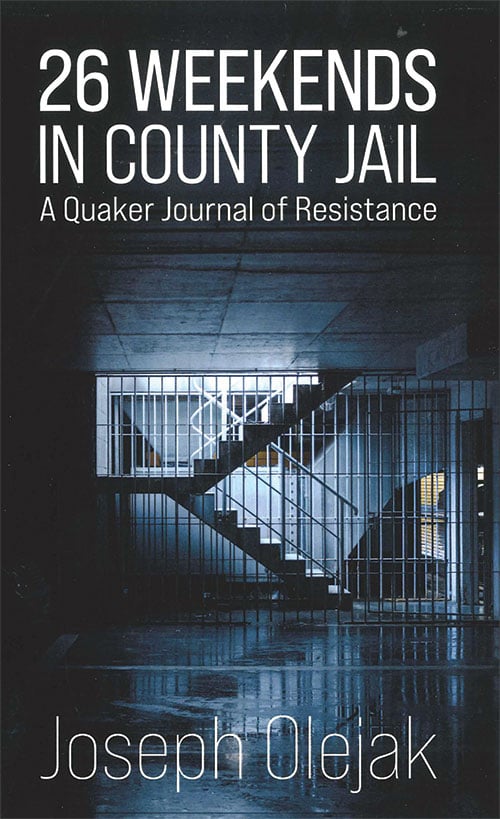
26 Weekends in County Jail: A Quaker Journal of Resistance
Reviewed by Michele Sands
September 1, 2026
By Joseph Olejak. Flare Books, 2026. 256 pages. $21.95/paperback; $14.95/eBook.
On November 22, 2013, Joseph Olejak entered the holding area of the Columbia County Jail in Upstate New York for not paying his taxes. This record of his next 26 weekends covers his musings, jail conditions, personal tribulations, and conversations with other inmates (population 140) and corrections officers, weekend by weekend. It is worth reading.
A chiropractor and father of two girls, Olejak decided in 1996 to stop paying his federal taxes in protest of U.S. involvement in wars in Iraq and Afghanistan. After years of threatening letters, the IRS raided Olejak’s office and home in 2009, and then in 2013, they summoned him to federal court and ordered him to county jail. In consultation with his lawyer, Olejak had decided to plead guilty in order to avoid lengthy time in court and federal prison time, as he likely would’ve received the maximum sentence of five years.
Olejak’s initial anger at being punished for doing something that he believed in lessened as he began to understand the circumstances that had led to the imprisonment of other inmates, as well as the prison–industrial complex that keeps pulling them back. The near intolerable jail environment included constant noise; extreme temperatures; metal beds inconducive to sleep; and non-nourishing foods that often lead to diabetes, heart disease, and general poor health. As a professional who was jailed for moral reasons, Olejak was considered an outsider by both inmates and the corrections officers. As they viewed him practicing yoga and natural health remedies, and saw his willingness to share his knowledge, they started calling him “Doc” and looked to him for advice and camaraderie.
Though he adjusted to most jail procedures, he drew the line at locking his own door at night. As punishment, a corrections officer took away his pillow: his one comfort for his neck and back when sleeping on a metal bed.
When he began his war tax resistance, Olejak was not a Quaker, but he later started attending Old Chatham (N.Y.) Meeting. He acknowledges the meeting’s profound support throughout his ordeal, both during the imprisonment and in publishing the book this year.
Quaker practice made Olejak good at listening. Most Columbia County inmates were convicted of drug or family court charges. His reports of these conversations—profanity included—bring to the reader an acute understanding of prisoners and their lives inside and outside, including their families and communities. A painful injury and a doctor-prescribed opioid leads to drug abuse; a traffic violation gets put off as other immediate bills are paid; a loss of a car leads to loss of a job; a layoff leads to lack of child support payments; all lead to the eventual destination of time behind bars. There but for fortune go I.
A well-read author, Olejak quotes from the Bible, Pope Francis, George Fox, Nelson Mandela, Martin Luther King, Malcolm Gladwell, and Rumi. As a war tax resister myself, I was most interested in his discussion of Mandela having “no choice but to become an outlaw,” a quote from Mandela’s autobiography, Long Walk to Freedom, which Olejak began reading during his tenth weekend in jail. Later in the same chapter, Olejak writes: “As the IRS tax deadline of April 15th approaches again [while in jail], I have to face the question of what I am willing to pay for. . . . I support food stamps, but find drone strikes horrific.” He makes a case for Peace Tax legislation, which would allow “persons of conscience to pay . . . a separate income tax that supports all the needs of the country except war.”
In many countries, it has been universally acknowledged for centuries that conscientious objection to war is an acceptable form of protest. It is enshrined in the laws of countries worldwide, including our own. Why shouldn’t we demand that our money must not be conscripted for war, as an acceptable form of conscientious objection?
One of only two war tax resisters to be imprisoned in recent history (to my knowledge), he is often asked, “Was it worth it?”
My response is that you can’t answer a moral question—a spiritual question—with a pros and cons calculation based on money, status, or comfort. The choice not to pay taxes and withdraw my money from the war system came from a spiritual place. Whether it was worth it didn’t really apply because it was a choice made beyond fear.
This very human book—about prison life, about spiritual life—is to be read and shared, and perhaps, acted upon. Alternatives to Violence Project supporters and other prison advocates need this in their libraries. Book groups and individuals will find grist for thought. More about Joseph Olejak can be found in a 2014 QuakerSpeak video, “Why I Stopped Paying Taxes,” and two Friends Journal articles published in 2015.
Michele Sands and her husband are war tax resisters. She still worships by Zoom with Upper Susquehanna Quarterly Meeting; currently living at Collington retirement community in Bowie, Md., she also worships with Friends on land populated by Potomac and Piscataway Conoy Peoples.

We want to hear from you, not an AI! Please be thoughtful and use your own words. Comments on Friendsjournal.org may be used in the Forum of the print magazine and may be edited for length and clarity.