



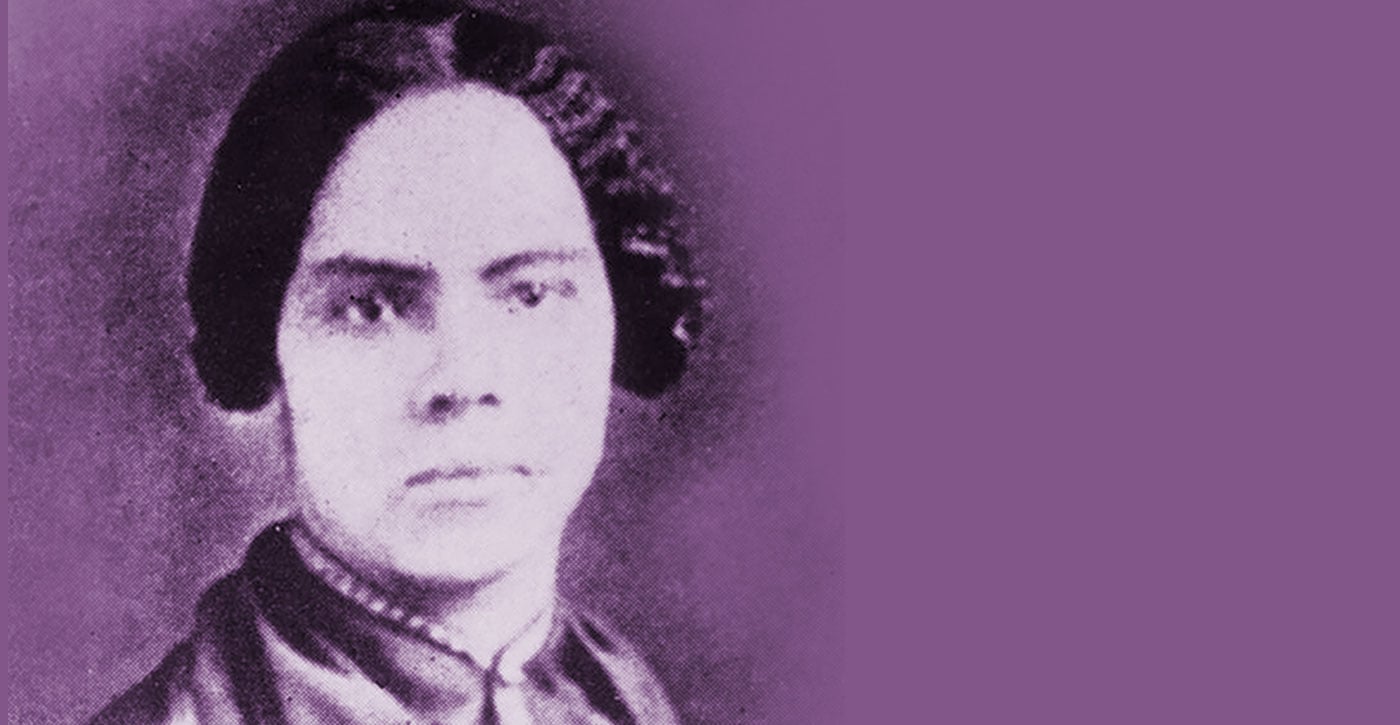
The Inner Light of Mary Ann Shadd Cary
In 1882, Williams Wells Brown—a former slave-turned-abolitionist, novelist, and historian—described teacher, editor, and lecturer Mary Shadd Cary as “tall and slim,” “resolute and determined” with an “intellectual countenance [and] bright, sharp eyes, that look right through you.” In his book The Rising Son he added that Shadd Cary was a skilled debater who forcibly took “advantage of the weak points of her opponent.” He even went so far to conclude that “had she been a man, she would probably have been with John Brown at Harpers Ferry.”
The 69-year life of Mary Shadd Cary (October 9, 1823–June 5, 1893) offers a master class in the values of self-reliance and humanitarianism that are associated with the grit and spirit of independence that are being celebrated during America250, the semiquincentennial of the founding of the United States.
Throughout her life, she revealed her self-evident truths with pen and voice when she advocated for abolition, temperance, self-determination, integration, and equal employment and pay regardless of gender.
The life of Mary Shadd Cary offers a master class in the values of self-reliance and humanitarianism that are associated with the grit and spirit of independence that are being celebrated during America250.
Her freeborn parents, Abraham and Harriet Shadd, were abolitionists who provided their children with the witness and testimony of their home being a safe house for those self-emancipating from the physical and mental shackles of the United States’ race-based slavery.
Modeling self-determination, Shadd Cary’s parents packed up and moved roughly 17 miles from Wilmington, Delaware, to West Chester, Pennsylvania. Their move was prompted by the state of Delaware, a slave state, which restricted public funds for education to white children in 1829 with the Free-School Act. Black parents were forced to rely on private or church-run schools.
In West Chester, under the guidance of Quaker Penelope Darlington, Shadd Cary thrived as she trained in Latin, literature, and math and deepened her insights of the Light Within. The Quaker understanding of the Light Within encouraged her to prioritize her individual conscience over restrictive social and religious rules and to believe in universal equality regardless of race and gender. Witnessing the abolition activities of her parents and having the moral fortitude to mind the Light Within despite external pressure, 16-year-old Mary Ann Shadd, after six years of Quaker education, began her long teaching career. Throughout the 1840s, she taught in West Chester and Norristown, Pennsylvania, with some stints in Trenton, New Jersey, and in Wilmington, Delaware.
A determined Shadd convinced a Black educator to start a school in Canada, and she moved there in 1851 after the Fugitive Slave Act of 1850 deputized whites to surveil Black people and actions, stripped suspected Blacks of their voice in court, and financially incentivized finding Blacks to be guilty of being slaves. The act extended the legal reach and power of the slaveholders of the South, increased the vulnerability of self-emancipated Blacks, and jeopardized the liberty of free Blacks.
To combat this assault on Black life, Shadd Cary wrote a 52-page pamphlet entitled “A Plea for Emigration, Or, Notes of Canada West,” that was published in 1852. She encouraged Blacks to join her in what is now Ontario. For her, Canada offered opportunities of integrated education and churches, quality land, and less-obstructed pathways to the “life, liberty, and the pursuit of happiness” proclaimed in the Declaration of Independence.
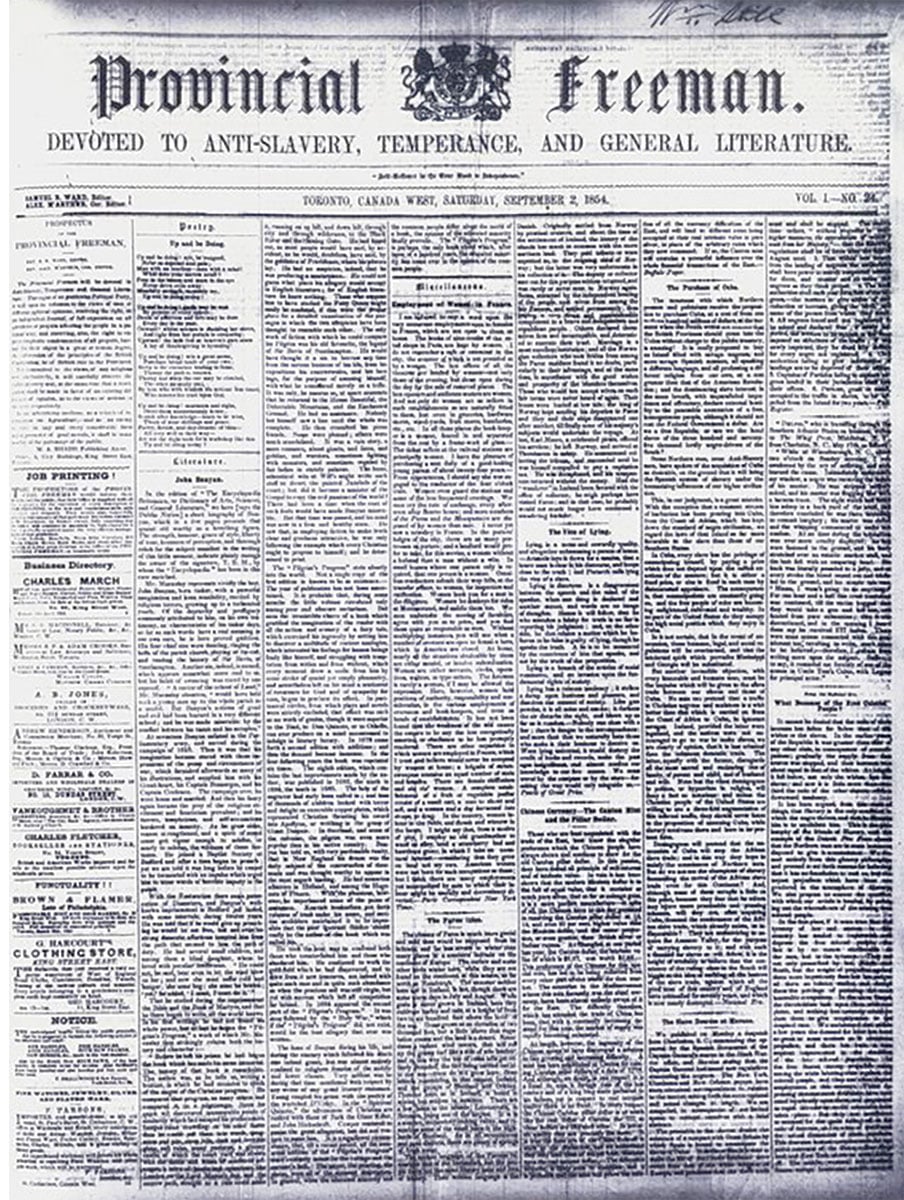
Capitalizing on the conversations generated about Canadian emigration, Shadd Cary, then age 29, launched the newspaper Provincial Freeman on March 24, 1853, in Windsor, Ontario. By doing so, she became the first Black woman editor and newspaper publisher in North America.
The official motto of her newspaper was “Self-Reliance is the True Road to Independence.” The motto demonstrates her rejection of segregation and the pseudoscience found in—what was called in the nineteenth century—“complexional distinctions,” which were used to justify color-based hierarchy. She firmly opposed the dependence of Blacks on white philanthropy and charity. Four years before, in the March 1849 edition of the newspaper North Star, 31-year-old editor Frederick Douglass published Shadd Cary’s full response to a query he had posed about how northern Blacks could improve themselves. At 25, she replied that they could “talk less and do more.” Her move to Canada models her response.
On January 3, 1856, at 32, she married Canadian barber Thomas F. Cary; she had her first child, Sarah, at 33. She was carrying a son, Linton, when Thomas died in 1860, which made her a widow and single mother at around 37. That same year, her fledgling newspaper, which after years of financial woes, ceased publication, although some accounts have the paper folding as early as 1857.
By 1863, she had returned to the United States, worked to recruit for the United States Colored Troops (USCT) in Indiana, and freelanced for newspapers before moving to Washington, D.C., to work as a teacher and principal.
In 1869, she joined the inaugural class of Howard Law School. Her delayed official graduation from Howard Law School in 1883 happened for these reasons. First, she was a single mother of two children without a support system. Second, the law school was temporarily shut down from 1873 to 1877 due to a severe national depression. Finally, the laws at the time prohibited women from being admitted to the bar.
During her interrupted studies of law, she worked as a teacher and principal, signed petitions calling for the franchise of women, and created an organization that was a forerunner of the Black women’s club movement in the 1890s.
In January 1874, along with the pioneering suffragists Elizabeth Cady Stanton and Quaker Susan B. Anthony, Shadd Cary testified in the U.S. House Judiciary Committee that “the strength and glory of a free nation [it] is not so much in the size and equipment of its armies as in the loyal hearts and willing hands of its men and women.” She linked the Fourteenth and Fifteenth Amendments to the necessity of Black women’s suffrage. Two years prior, in January 1872, before the House Judiciary Committee, she argued that she deserved to vote because she was a taxpayer, and stated that “the crowning glory of American citizenship is that it may be shared equally by people of every nationality, complexion, and sex.”
In 1880, she formed the short-lived Colored Women’s Progressive Franchise Association to center Black women’s voices in the conversation about the merits of self-reliance in financial uplift.
After being admitted into the bar in 1883, she worked as a lawyer until her death in June 1893.
The official motto of [Shadd Cary’s] newspaper was“Self-Reliance is the True Road to Independence.” The motto demonstrates her rejection of segregation and the pseudoscience found in—what was called in the nineteenth century—“complexional distinctions,” which were used to justify color-based hierarchy.
Interred initially at the Columbian Harmony Cemetery in D.C., Shadd Cary’s remains—along with 37,000 others—were dug up in the 1950s to make room for the current Rhode Island Avenue-Brentwood Metro station in Washington, D.C. While the new developer promised to move the bodies to what is now National Harmony Memorial Park in Landover, Maryland, the moving of the tombstones was not a part of the agreement, so they were sold, given away, or tossed in garbage heaps. Many of the tombstones disappeared, including that of Shadd Cary.
The story of what happened to the grave of Shadd Cary and other notable Blacks in the cemetery—such as dressmaker Elizabeth Keckley and Chester County native Osborne Perry Anderson, the only Black survivor of John Brown’s raid on Harpers Ferry—tells a physical story of erasure.
Her story is essential to the America250 commemoration because her views, pen, voice, and action chronicle liberty as an ongoing quest for “we the people” to create “a more perfect union.”
On June 6, 2018, 125 years after Shadd Cary’s death, the New York Times, posthumously featured an obituary to rectify its 167-year-old historical inequity of featuring mainly white men. On her 197th birthday in 2020, a Google Doodle that appeared in the United States, Canada, Latvia, and various African nations featured Shadd Cary.
Mary Ann Shadd Cary’s self-evident truths interrogated America and demanded her native country to live up to its highest ideals, so all can freely exercise their inalienable and legal rights. Her foundational Quaker education, combined with her commitment to justice, opened pathways for her to pursue, with intention, “life, liberty, and the pursuit of happiness” on her self-awareness terms.

We want to hear from you, not an AI! Please be thoughtful and use your own words. Comments on Friendsjournal.org may be used in the Forum of the print magazine and may be edited for length and clarity.