



One summer afternoon years ago I was reading an old Quaker journal. It was nothing too obscure. I believe it might even have been that of John Woolman, whose journal rivals that of Quaker founder George Fox in terms of lasting impact. Woolman was a small-town merchant in eighteenth-century New Jersey with a highly attuned sense of justice.
For a moment in my reading that day, I let myself feel a pang of jealousy. Woolman is most well-known for his strong advocacy against slavery, a cause that seems so very obvious to us today. It’s easy to think any of us would have been as clear-eyed as he and brave enough to confront slave holders face-to-face as he did. Our modern Quaker dilemmas feel so complicated in comparison. What does it mean to be a Friend? What must we believe or not believe? Are there practices that define us—things we must or mustn’t do to remain Friends?
I laughed out loud as I snapped out of this line of thought. Woolman didn’t have it easy at all, of course. The slaveholding Friends he was challenging came from the richest and most powerful Quaker families in colonial America. In a slightly different timeline, he could have been drummed out of Friends just as his fellow antislavery advocate Benjamin Lay had been a few decades earlier.
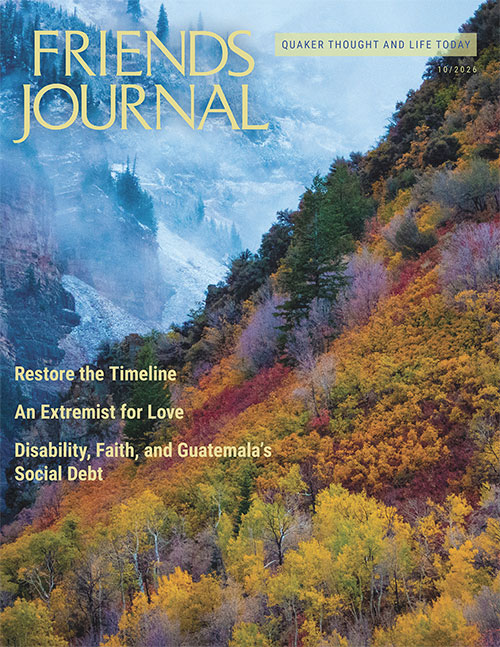
S.E.W. Smith starts this issue off with talk of timelines that I find compelling in a similar way. Modern science-fiction storytelling is full of what-if alternate history stories (a genre that’s personal catnip to me!), but a phrase that’s become popular on social meda is a call to “restore the timeline!” The implication is that somewhere along the way, humanity took a wrong turn. In its most superficial form, the turning point was a particular election or the mis-adoption of some technology. But as Smith points out, “Quaker faith has always been about restoration.” Wherever we are, we have a responsibility to do the hard work of imagining and co-creating a better kingdom of heaven here on earth.
Michelle Downey also looks to Woolman’s Journal as a guide, in her meeting’s case to work on immigration justice (I especially love how they paused to deliberate their own motivations in their discernment). Christopher E. Stern is back with a look at Jesus’s timeline restoration, what he describes as a “real call toward transformation of our hearts in the present moment and time.”
It’s a packed issue, and there are so many good stories of Friends stepping up to heal the world, including a disability rights story from Guatemala, a hospital chaplain in California, and an American Quaker in wartime Vietnam whose work has been rediscovered. Don’t miss the two features in the online edition: Quaker nerds will appreciate the interview of Michael J. Sheeran, whose 1973 outsider look at Liberal Friends in Philadelphia changed the way we looked at ourselves. And Jack Tripp’s questioning of what we mean by “Quaker values” feels smart and fresh in a similar generational way.
The troubles, opportunities, and challenges for us Friends today are not so dissimilar to those of earlier generations of Friends. May we all find the peace and inward wisdom to restore our parts of the timeline.
We want to hear from you, not an AI! Please be thoughtful and use your own words. Comments on Friendsjournal.org may be used in the Forum of the print magazine and may be edited for length and clarity.