



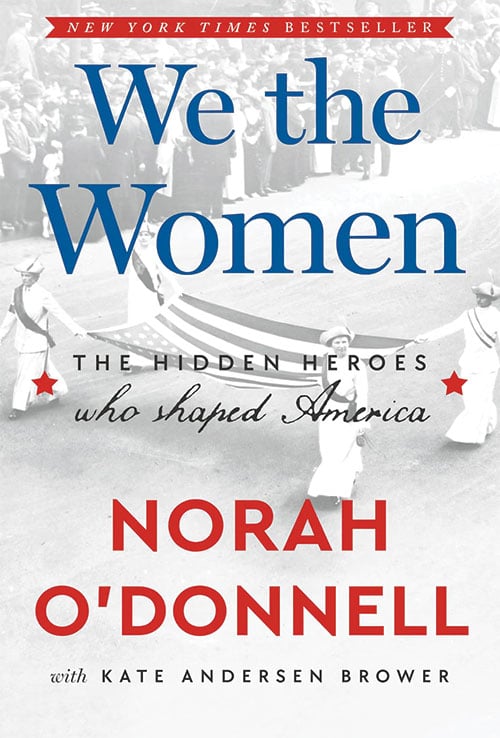
We the Women: The Hidden Heroes Who Shaped America
Reviewed by Alicia McBride
October 1, 2026
By Norah O’Donnell, with Kate Andersen Brower. Ballantine Books, 2026. 416 pages. $35/hardcover; $14.99/eBook.
In this book, journalist and former CBS Evening News anchor Norah O’Donnell sets out to celebrate the women who helped shape the United States over its 250-year history. She is especially interested in lifting up the contributions of women who are less well-known. I was previously unfamiliar with many of these women’s stories, including Mary Katherine Goddard (the first printer of the newly signed Declaration of Independence), Maggie Lena Walker (who in 1903 opened a bank to support Black economic opportunity), and Patsy Mink (the first Asian American woman to serve in Congress and a champion of legislating equal opportunities for women).
Written with support from author and fellow journalist Kate Andersen Brower, the book is divided into five sections that each cover 50 years of U.S. history. The first four parts include a high-level overview of historical and cultural shifts in the time period, followed by chapters that give biographical sketches of particular women. About two-thirds of the profiles feature White women, with the remaining third focused on Black, Native American, Latina, and Asian American subjects. In the final section, O’Donnell reflects at more length on the impact of women during her lifetime in areas such as medicine, law, business, sports, and education.
O’Donnell’s passion and personal drive to share these women’s stories comes through in her writing. She frames the book with stories of her Irish grandmother, who immigrated to the United States in 1930, and with her own discovery of how much was omitted from the history she learned in school. The individual narratives are peppered with asides about the research that led to the story’s inclusion in this volume.
This approach makes for accessible writing: no dry history here. The book is based in research and draws on primary source documents—more than 10 percent of the book is devoted to citations and references—but O’Donnell’s journalistic background is evident throughout in her desire to tell a compelling story. She is clear from the introduction that she does not want to write biographies but instead to “paint a picture of [women’s] grit and determination to be treated equally.”
As someone interested in the nuances, struggles, and contradictions of history, I was sometimes frustrated by the flattening of these women’s stories to support that goal. These women “don’t take no for an answer,” are “uniquely equipped for any challenge,” and “set the standard for women who followed.” The details of each woman’s story run together, as they all become tales of plucky perseverance and determination to overcome the obstacles in their path on the way to become role models for those who come after.
Still, I appreciate O’Donnell’s project to elevate women’s contributions, as the United States’ 250th birthday prompts renewed interest in this country’s history. Amid the heroic narratives of success against the odds, O’Donnell also highlights the ways that “a more perfect union is still a work in progress.” The impact of racial identity and class, along with gender, are undercurrents in these stories. Although framed in the language of individual achievement and patriotism, the book also recognizes the shortcomings of the American experiment’s first two-and-a-half centuries and the need for ongoing work.
The stories in We the Women can serve as a jumping-off point for Friends and others to delve more deeply into the experiences of people who have shaped the United States. Friends may be especially interested in exploring further the stories that touch on Quaker history. For example, the profile of the Native American writer Zitkala-Ša opens at Earlham College, where during her freshman year there in 1896 she gave a speech arguing for equal rights for Indigenous people.
In addition to the further learning these stories might invite, O’Donnell’s premise and motivating questions could prompt Friends to reflect on our own communities. When we tell our story, whose contributions might we be missing? What ideals are we still working to live up to? O’Donnell wonders about how learning this history at an earlier age might have affected her sense of possibility and courage; in our meetings, do we help children see themselves reflected in Quaker and community history? As a journalist, O’Donnell knows how to ask good questions. Along with the new information this book might offer to readers, it provides openings to consider how the stories we tell shape our understanding, not only of the past but also of future possibilities.
Alicia McBride is a member of Sandy Spring (Md.) Meeting in Baltimore Yearly Meeting and lives in Takoma Park, Md. She is the senior director for Quaker leadership at Friends Committee on National Legislation.
We want to hear from you, not an AI! Please be thoughtful and use your own words. Comments on Friendsjournal.org may be used in the Forum of the print magazine and may be edited for length and clarity.