



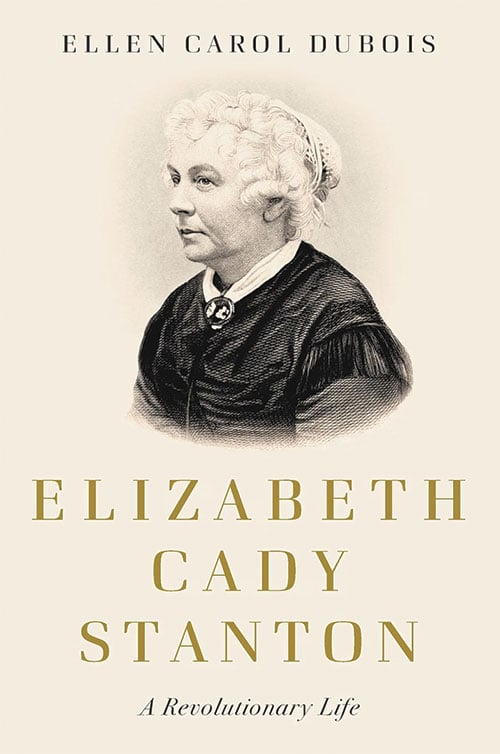
Elizabeth Cady Stanton: A Revolutionary Life
Reviewed by Abigail E. Adams
October 1, 2026
By Ellen Carol DuBois. Basic Books, 2026. 496 pages. $35/hardcover; $19.99/eBook.
Forty-five years ago in a Haverford College women’s studies course, I learned about Elizabeth Cady Stanton’s racism, anti-immigrant nativism, and commitment to eugenics. Up until then I idolized the women of the nineteenth-century women’s suffragist movement, many of them Friends: Lucretia Mott, Susan B. Anthony, the Grimké sisters, Martha Coffin Wright, and Alice Paul. I’ve since gained a more complex understanding of Quaker history and of the women’s movement, thanks to powerful scholarship such as historian Ellen Carol DuBois’s new biography, Elizabeth Cady Stanton: A Revolutionary Life. In its examination of the complicated Cady Stanton, the book addresses the difficult “balance between her most forward-looking and her most backward ideas.”
Friends will appreciate DuBois’s integrity, as well as her complex, contextualized narration of the (very complex) 1800s, made possible by “the sheer length of [Cady Stanton’s] career.” The 19 chapters unfold chronologically, exploring each stage of Cady Stanton’s life from her birth family and childhood to the years following her death. DuBois focuses on Cady Stanton’s relationships as well as their socio-historical settings, with close readings of her correspondence and other writings.
Friends do figure prominently in this biography, as they did in many nineteenth-century progressive movements and conflicts. Neither Quakers nor Cady Stanton avoided any of the frays: women’s participation in abolitionist leadership; Black men’s suffrage vs. universal and women’s suffrage; women’s full civil and marital rights vs. a singular campaign for women’s suffrage; the National Woman Suffrage Association vs. American Woman Suffrage Association; and support for Republican candidates vs. calling out the party’s repeated betrayal of women’s suffrage.
I hoped DuBois’s granular biography would reveal the influence of Quakerism on this pioneer of women’s rights. In addition to her husband, abolitionist Henry Brewster Stanton, Elizabeth’s most influential relationships were with Quaker women, notably Lucretia Mott; Susan B. Anthony; and Amelia Willard, the housekeeper and family’s seven children’s “second mother” who made possible Cady Stanton’s early achievements.
Cady Stanton first met her long-standing mentor Lucretia Mott while on her honeymoon with Henry to London to attend the 1840 World Anti-Slavery Convention, where women were barred from participating. Cady Stanton, Mott, and three other prominent Quaker women went on to organize the 1848 Seneca Falls Women’s Rights Convention. Three years later, Cady Stanton met her lifelong f/Friend Susan B. Anthony. The book is almost a dual biography of the two women, given how intertwined their histories and accomplishments were.
While DuBois documents these friendships in detail, I did not learn much about how their “Quakerliness”—their testimonies and practices—shaped Cady Stanton’s life, projects, and ideals. Instead, it seems that she was a like-minded fellow traveler of the century that itself shaped her and Friends. For example, her lifelong opposition to capital punishment arose from visiting the prisoners held in her father’s courthouse cells when she was an adolescent. Another example was her fierce championing of women’s marital equality, which played out in her own companionable, supportive, and egalitarian marriage to Henry and stood in contrast to unions endured by other suffragists.
The example of Quaker meeting and theology, however, did not soften Cady Stanton’s lifelong opposition to organized Christianity, which intensified in her later years when she created The Woman’s Bible, “her last as well as her loneliest and most frustrating battle.” She decried religious dogma as the root of women’s discrimination for teaching that “woman was an afterthought in creation, her sex a misfortune, marriage a condition of subordination . . . and maternity a curse.” And 1800s Quietist Quakers may have reinforced Cady Stanton’s aversion with their contradictory behavior. The majority of the leaders of the 1848 Seneca Falls conference were Quaker women, and yet Angelina Grimké was read out of meeting for marrying a non-Quaker, and Sarah Grimké was blocked from recognition of her ministry by male Quakers. Cady Stanton’s dear friend Susan B. Anthony moved from devout Quaker observance to humanist agnosticism.
And what of Friends influence on Cady Stanton’s very public eugenicist, racist, and anti-immigrant positions? We know from careful and revealing revisionist Quaker histories that many white Friends and meetings, perhaps more quietly, shared Cady Stanton’s white supremacist sense of superiority. Cady Stanton was enraged that “unworthy” men of the “lower orders” held power over her, “making laws for Lucretia Mott,” as she wrote in the multi-volume History of Woman Suffrage. Cady Stanton’s nativism lasted longer than her racist attacks and had more impact. DuBois observes aptly that while Cady Stanton vilified Black and immigrant men (excepting her longstanding friend Frederick Douglass, whom she considered a worthy opponent), the suffragist cause was really betrayed by men of her own class and race.
DuBois writes, in this her last book of her own “eighty years and more” (echoing Cady Stanton’s memoir title), “I have certainly grown less forgiving of her over time, but I am still in the category of those who do not find the lessons of her entire legacy tainted by her prejudices.” DuBois’s careful review of the difficult polarizing choices and alliances facing Cady Stanton and nineteenth-century activists helped me understand better how the 1800s informed the Friends testimonies I hold high and turn to in the twenty-first century.
Abigail E. Adams worships with New Haven (Conn.) Friends and serves on FCNL’s General Committee and Woolman Hill Retreat Center’s board. A recently retired anthropology professor, she continues work in urban forestry, in Central America, and on immigrant concerns. Although she was unexpectedly elected to town office, she dreams of serving as a Connecticut tree warden.

We want to hear from you, not an AI! Please be thoughtful and use your own words. Comments on Friendsjournal.org may be used in the Forum of the print magazine and may be edited for length and clarity.