




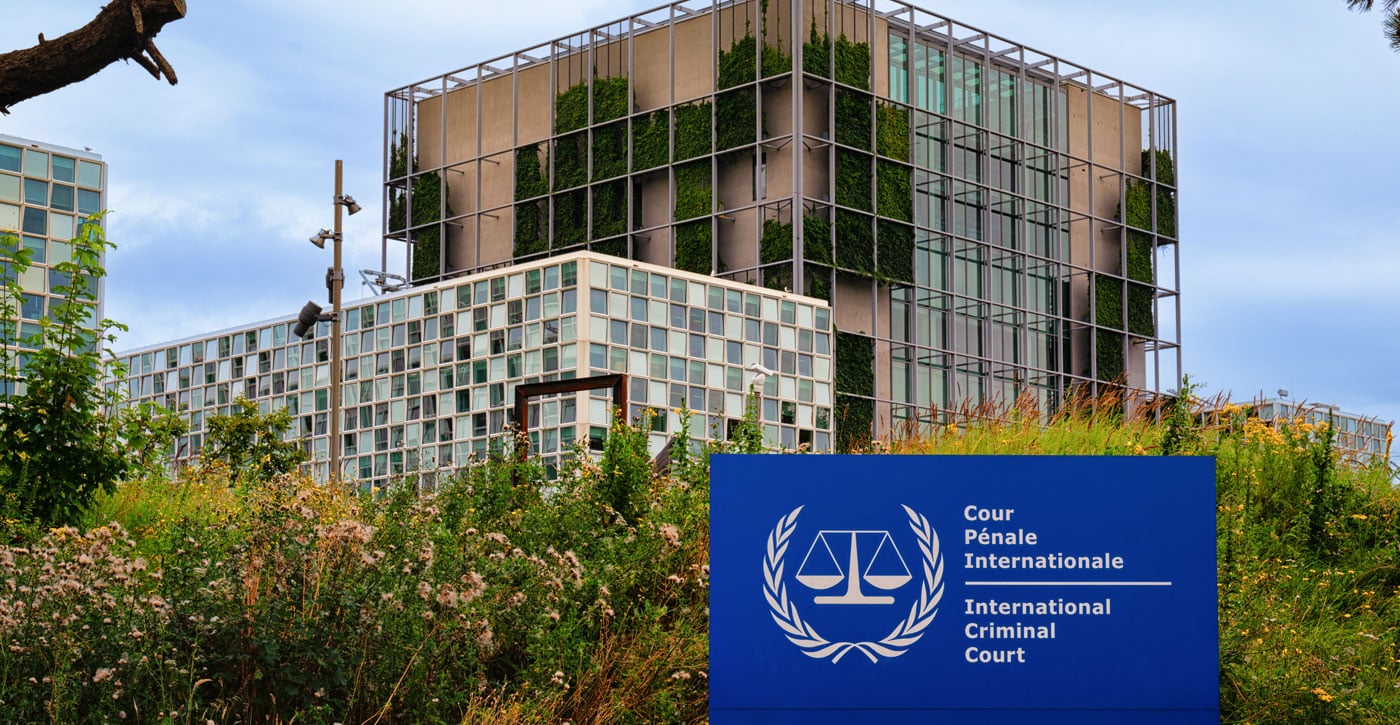
American Friends Service Committee (AFSC) and three other organizations are suing the Trump administration to oppose an executive order sanctioning International Criminal Court judges; ICC prosecutors; human rights groups; and Francesca Albanese, the UN special rapporteur on the situation of human rights in the Palestinian territory occupied since 1967.
“This is an unlawful abuse of power constituting a frontal attack on the rule of law, the independence of judges, prosecutors, and lawyers, basic precepts undergirding the international legal order, and the principle of equal access to justice. The effect is to cause grave damage to the ability to bring to justice the perpetrators of genocide, war crimes, and crimes against humanity,” the lawsuit states.
Attorneys for the Foley Hoag law firm filed the suit on August 11 in the U.S. District Court for the Southern District of New York. Other plaintiffs include Center for Constitutional Rights, Human Rights Watch, and Open Society Institute. President Donald Trump, Secretary of State Marco Rubio, and the U.S. State Department are among the defendants.
Any support—including education or advice—for sanctioned individuals or entities carries the threat of a 20-year prison sentence for U.S. citizens, the lawsuit explains. Non-U.S. nationals would face direct sanctions.
The administration has sanctioned three human rights organizations: Al-Haq: Law in the Service of Man; Al Mezan Center for Human Rights; and Palestinian Centre for Human Rights, according to the lawsuit.
AFSC has had long relationships with Al-Haq and Al Mezan. Representatives of Al-Haq and Al Mezan understand the conditions on the ground in Palestine, according to Joyce Ajlouny, general secretary of AFSC. “These are the organizations that are rooted there,” said Ajlouny.
AFSC has been in Gaza since 1948 and has developed relationships with several civil society organizations, according to Ajlouny. AFSC helped to establish a legal aid organization in Jerusalem in the 1980s. The United Nations asked AFSC to provide relief to refugees displaced in the Nakba (Arabic for “the catastrophe”), the removal of Palestinians from the territory that became Israel.
Accountability requires documentation; organizations must collaborate to document genocide and other war crimes, according to Ajlouny. Without documentation, people seeking justice have a much harder time making their cases.
Ajlouny pointed out that victims of genocide in Gaza have bereft relatives. “I think about parents who’ve lost children or husbands or wives. They want accountability, right?,” Ajlouny said.
The suit argues that the executive order violates the American Servicemembers’ Protection Act, the Administrative Procedure Act, the First Amendment, and the Religious Freedom Restoration Act.
“Plaintiffs have each been forced to stop, alter, or cease to consider engaging in speech and expressive conduct that they otherwise would have undertaken, either independently or jointly with others,” the lawsuit states.
AFSC enacts Quaker testimonies of peace, equality, community, integrity, and stewardship, according to the suit. The sanctions burden AFSC’s exercise of religion. The government cannot show a compelling state interest or prove that sanctions are the least restrictive way of furthering a state interest.
“Our programmatic work in Palestine is a direct expression of that belief that there’s that of the Divine in everyone,” Ajlouny said.
The sanctions have significantly confused staff of human rights organizations and civil society groups because it is unclear what is allowed; normal coordination has broken down, according to Liz Evenson, international justice director at Human Rights Watch. The sanctions intend to dismantle the International Criminal Court, which would set international law enforcement back several decades, Evenson explained.
“The International Criminal Court is really one of the most powerful tools that we have to protect human rights,” Evenson said.
The State Department did not reply to a request for comment on the lawsuit by deadline.
We want to hear from you, not an AI! Please be thoughtful and use your own words. Comments on Friendsjournal.org may be used in the Forum of the print magazine and may be edited for length and clarity.