




Part of being a Friend who speaks with the public is needing to explain what we’re not. No, we don’t make oatmeal; no, we’re not Amish; and no, we’re not Shakers either.
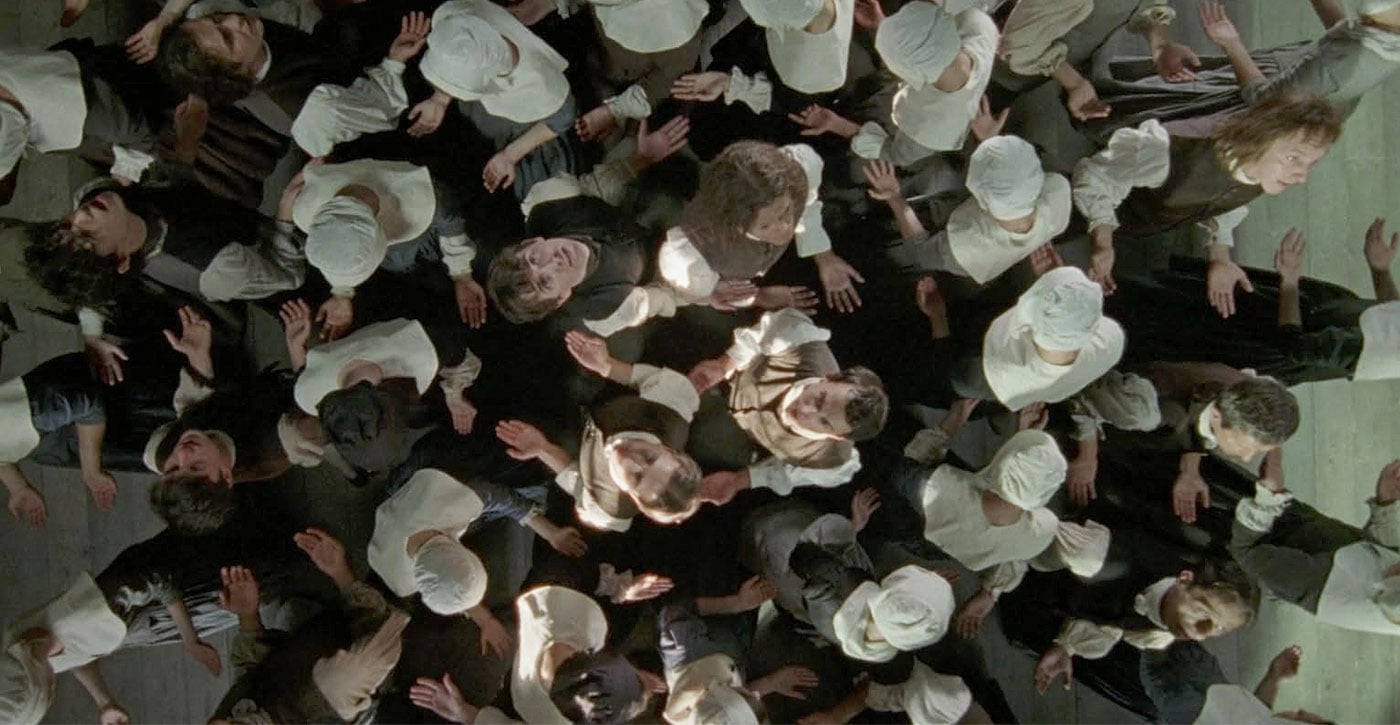
There are interesting stories attached to each of these misconceptions, but it’s the third one that has come to the fore recently; thanks to the recent movie The Testament of Ann Lee about the best-known leader of the Shaker movement. It’s a good film; I recommend it. The cinematic depictions of ecstatic worship and spiritual experience are immersive. (Both Ron Hogan’s Friends Journal review and Martin Kelley’s reservations about it on his blog are worth reading, too.)
Shakers, however, aren’t the same as Quakers—a misunderstanding that is apparently more common than I realized. Yes, we both have a commitment to peace, simplicity, and gender equality, but we Quakers don’t require abstinence from “fornication,” as Ann Lee calls it in the film. Quaker worship styles vary from place to place, but in sharp contrast to Shakers, Quakers in Britain (where the film begins) as well as in New York (where the film ends), for the most part, meet in serene, silent stillness.
Part of my job these last few weeks has been to correct various mix-ups in different parts of the media, including in the headlines of some well-known news brands. In my fact-finding though, I also found myself interrogating some of my own assumptions, including the idea that Ann Lee grew up as a Quaker. Through the film itself, as well as subsequent research, I discovered five pieces of evidence that point otherwise.
The first is that both Ann Lee and her brother were baptized as children with water in 1742, as recorded in the accounts of the Register of Baptisms of what is now Manchester Cathedral. This suggests that her parents were, at least nominally, Church of England.
The second fact is that she was also married in the Church of England (seemingly enforced by her parents), which would be an odd thing for Quaker parents to do.
The third is that Ann was illiterate. By the 1750s, the Quakers were a largely literate community, as well as close knit and well-resourced. For a Friend at that time to grow up without the ability to read is not impossible, but it is surprising.
The fourth fact is that although we know Ann’s mother was very devout, her name is lost to history, which would be very unusual among Friends who kept good records and didn’t skip over women’s names.
And the fifth is that while a number of contemporary websites assert it, I haven’t found any historical document to suggest that she ever was a member of the Religious Society of Friends. I’ve checked with Quaker scholar Ben Pink Dandelion, based in the north of England, who confirmed that the people he knows who have been through the records haven’t found her name either.
This all points to Ann Lee having grown up with parents who were, at least initially, Anglicans. This would put into context the scene in the film where Lee and others disrupt an Anglican service: she is sharing her new beliefs with her former worshiping community.
Despite all this evidence, why do several sources, including some Quaker sites and even a page of the Manchester Cathedral website, assert she was from a Quaker family?
I think the answer originates in the 1879 American Cyclopædia entry on Ann Lee, which says: “Her parents were members of a distinct branch of the society of Friends.” It seems that this distinct branch was, in fact, the Wardley Society, which is depicted in the film. It was also variously known as the Manchester Society; Bolton Society; Shaking Quakers; or, indeed, Shakers, whose founders Jane and James Wardley had broken with the Religious Society of Friends some years before but carried over many of the values, and even began some of their meetings in silence. An 1859 biography by Shaker leader Frederick William Evans confirms that her parents became members.
The Cyclopædia entry also says of Ann: “She became in 1758 a member of the Manchester society of Friends.” There are two clues here: first, the Religious Society of Friends in Manchester in those days was known as Hardshaw (as it was known in a slightly different form until recently), and second, there was a group called the Manchester Society (see above), formed in 1747, which was the Wardley group that was the original organization of the sect better known as Shakers.As a Friend who grew up in the Manchester area, I am slightly disappointed that Ann Lee was not originally “one of us,” but beliefs need to change as evidence arises. Now I hope someone will edit that Wikipedia article. . . .

Ann being a member of a group known as the “Shaking Quakers” that would seem to support the proposition that she was a member of a branch of the Quakers, as least as the relationship between the two groups was known at that time and viewed from the perspective of the Shaking Quakers. With just a slight change of direction, the Shaking Quakers might have been the antidote to the staid rule-following the main Quaker branch embraced.