




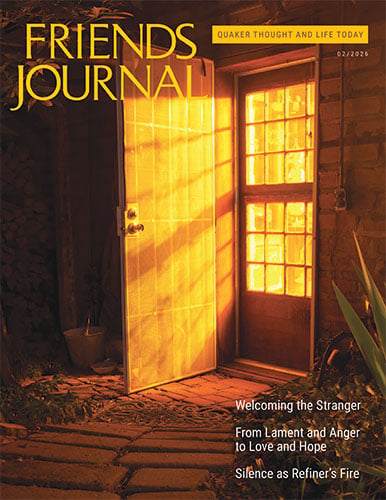
Merry Stanford’s ministry has graced the pages of Friends Journal and a wide swath of Quaker communities over a span of more than 30 years. And reading Merry’s words in this issue, “From Lament and Anger to Love and Hope,” I find myself again grateful for this Friend’s gentle guidance.
In my country, the United States, communities everywhere are under attack by the shock troops of a tyrannical government. In recent weeks, we’ve seen video of the state-sanctioned murders of Renée Good and Alex Pretti by federal agents in Minneapolis, Minn. Good and Pretti made themselves targets of state violence because they had the courage to stand up for their neighbors. Compassion is revolutionary in the face of a regime that thrives by sowing fear and division. And as Jesus made clear in Matthew 22:37, loving your neighbor as yourself goes hand-in-hand with loving God as the greatest of the commandments.
Taking Jesus’s words seriously these days can tend to lead me to a dark place. My heart breaks when the neighbors I love are threatened, kidnapped, hunted, and slaughtered. And this is where I find words like Merry Stanford’s so comforting. Who among us, Friends, does not find themselves dwelling in lament and anger in these dark days? Merry takes readers inside the powerful experience of a Quaker meeting for healing. This practice is predicated on some vital assumptions, among which are these: that we can start from exactly where we are, and in the providence of a loving God and a faith in the power of good to overcome the power of evil, we can arrive at the fruit of the Holy Spirit, a place that has transcended our brokenheartedness and despair.
Elsewhere in this issue, Lynnette Arnold shares stories of Central American Quakers assisting and advocating for their neighbors, people from all over the world who have been caught up in the inhumane and cruel machinery of U.S. immigration policy. Acts like those of Monteverde Friends, like Alex Pretti and Renée Good, like the hundreds of clergy who showed up in Minneapolis to place themselves between empire and neighbor: these are revolutionary. And if we are called to join in this revolution, we’ll need to lean on assumptions such as those Merry shares.
Another way of thinking about our calling in troubled times is present in my colleague Ron Hogan’s Bible Study column for this issue. As Ron has it, George Fox, animated by the spirit of the living Christ, was paying heed to John the Baptist’s cry to seize “the ax lying at the root of the trees” that bear evil fruit. Might compassion for our neighbors be the weapon against empire that we are called, as Friends, to wield? If so, let’s roll up our sleeves together.

We want to hear from you, not an AI! Please be thoughtful and use your own words. Comments on Friendsjournal.org may be used in the Forum of the print magazine and may be edited for length and clarity.