



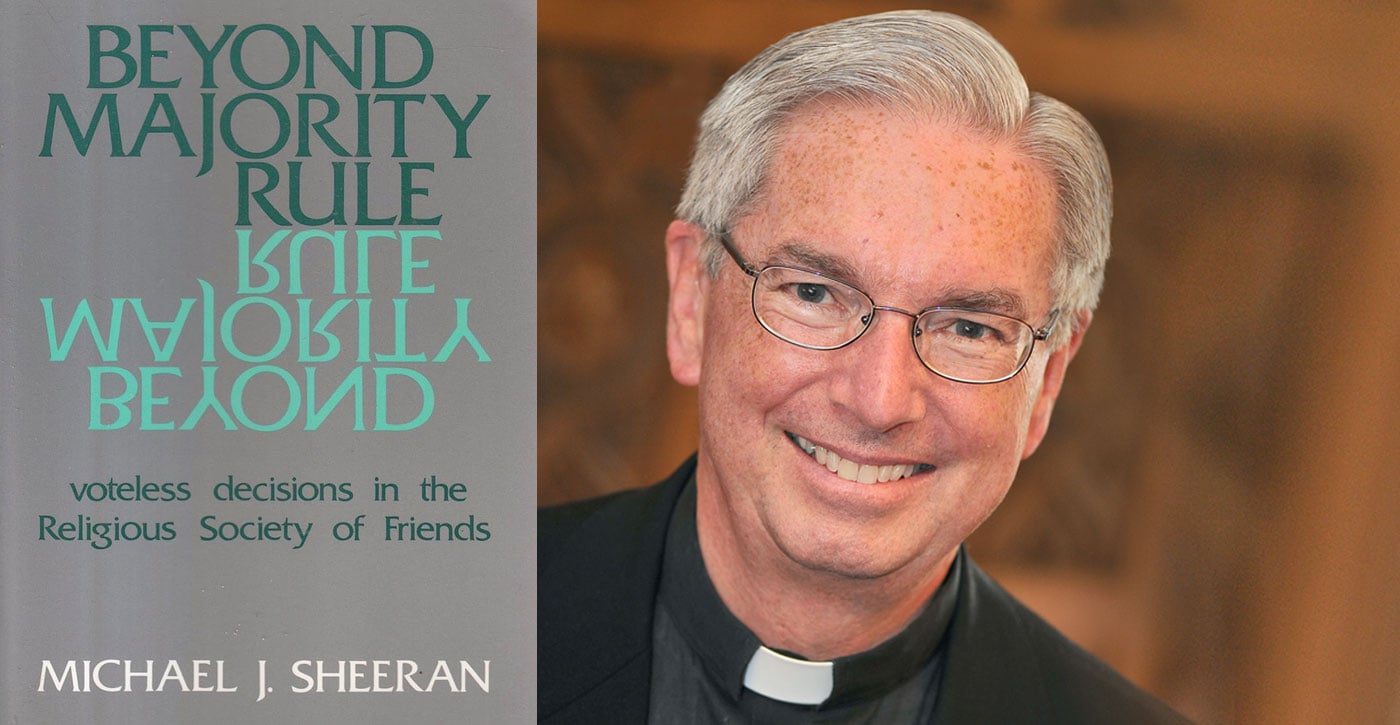
An Interview with Michael J. Sheeran
In 1983, a young Jesuit priest, Michael J. Sheeran, published a seminal study: Beyond Majority Rule: Voteless Decisions in the Religious Society of Friends. Based on his PhD research in the Politics Department of Princeton University in the mid-1970s, the book shed light on communal discernment and impacted a generation of Quakers on both sides of the Atlantic. He became president of both Regis University and the Association of Jesuit Colleges and Universities. Although his book remains in print through Pendle Hill, its importance has slipped from the awareness of many Friends. Might it now be ripe for rediscovery? Father Sheeran is now in his mid-eighties and recently semi-retired. Alastair McIntosh, a Scottish Friend of Glasgow Meeting and a writer on community and spirituality, caught up with him.
Alastair McIntosh: Father Sheeran, in the aftermath of the 1960s cultural revolution, what were the circumstances that led you, a young Jesuit priest, to carry out your research with the Quakers of Philadelphia Yearly Meeting?
Michael J. Sheeran: The Second Vatican Council (1962–1965) was a huge reformation within the Catholic Church. It drove my curiosity about the Quakers. In one of its decrees, the Council advised all religious orders to study whether any of the practices of their founders had been lost through the centuries.
When I started theological training in 1967, various Jesuit seminary teachers were surprised to find that St. Ignatius and his first nine companions spent Lent in 1539 meeting every evening to decide whether God was inviting them to apply to be a religious order marked by vows of poverty, chastity, and obedience. And a record had been kept of their daily process, a procedure which turned out to be suspiciously similar to the meeting for business which would surface when George Fox established Friends one hundred years later.
In short, the Jesuit Order had been founded through the use of what Catholics call communal discernment, but down through the centuries, it had lost its expertise with the practice.
AM: What caused that loss?
MS: I think it was the tensions between separation and togetherness. When Ignatius Loyola sent Francis Xavier to Japan in 1549 to preach the gospel, a letter took three years to travel one way. This hampered communal discernment. Key people couldn’t readily sit in the same room and share in each other’s inner experience. Accordingly, the superior general, not the scattered group of founders, became the prime decision maker. In contrast, Friends meetings for business were admittedly scattered but within, at most, a few days’ journey.
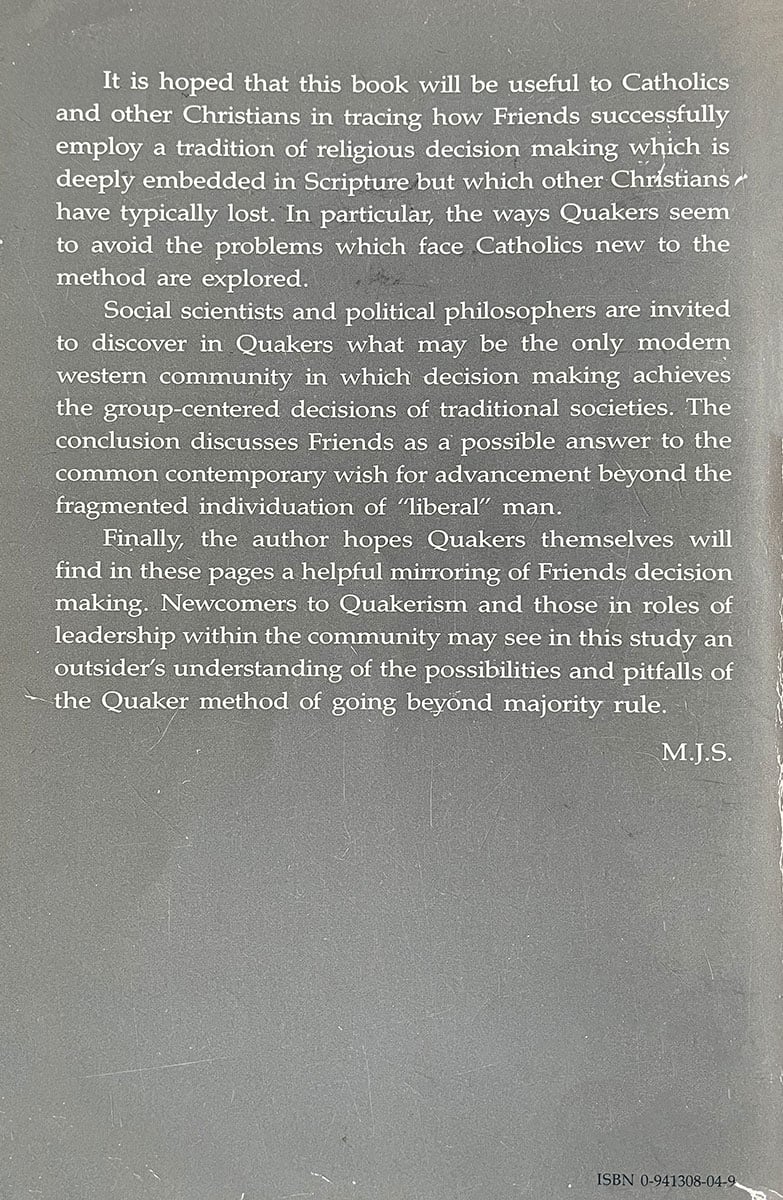
AM: In the preface to Beyond Majority Rule, you suggested that Quakers “may be the only modern Western community in which decision making achieves the group-centered decisions of traditional societies.” What led you to us?
MS: By a graced coincidence, just after Vatican II, Philadelphia Quakers were experiencing the talented assistance of Douglas and Dorothy Steere. This was to help the Friends in this yearly meeting to reflect, individually, on their inner experiences: a practice known as spiritual direction. The Steeres started nudging these individuals to spend time at Jesuit retreat houses. Some of the original ideals of discernment had carried over in these houses into what we call “the Ignatian Exercises”: seeking God’s invitations in one’s prayer and retreat experience.
I gather that my late Jesuit colleague Father Gerry Hughes—who was born in Ayrshire in Scotland in 1924—made a similar contribution in the UK with such popular books as God of Surprises.
In short, I ended up going to Quaker meetings to learn how communal discernment is done well (and badly). Meanwhile, a good number of Friends were returning the gesture by learning individual discernment from Jesuit retreat directors! It made for a moment of significant mutual openness, as each group realized they had only one of the two essential keys for discernment. Jesuits were skilled at reading one’s own internal movements, and Quakers brought the complementary expertise of being able to hear the harmonious chord found in the comments expressed by individual participants.
AM: In what ways did you find that the Quaker tradition shone fresh light on Ignatian spirituality?
MS: To start with some background, in our novitiate training, we learned that we should be alert to each other’s disparate reactions to a situation. We had each grown up in different social classes, parts of the country, educational settings, etc. But somehow, we shared a common sense of calling to serve God together, even calling ourselves brothers in Christ. So, from the novitiate forward, we were trained to listen for each other’s accents of speech, taste in food, and style of humor. We expected that our fellow novices would correct, enrich, and challenge each other, whether in prayerful group discussions, in competitive sports, in music, or whatever contributed to our life together.
This was theoretically important, but we had little if any real training in the practical skills of listening, reflecting, gently disagreeing, and gracefully valuing insights that perhaps we had initially dismissed. For me, my time of sitting in on Friends monthly meetings for worship for business, and especially representative meeting (akin to the original Meeting for Sufferings) was my first regular experience of how a committed group can reach real practical unity, and perhaps do so again and again.
AM: And that pattern and example restored the Society of Jesus, the Jesuits, to its roots? And just like that? I jest, of course!
MS: Hah! Not quite! You see, in retrospect, I blundered. I was so impressed with Quaker method that I presumed my Jesuit brethren would be delighted to explore and incorporate it. I thought that all I had to do was point the way by writing up the process.
In practice, my dissertation-turned-book seems to have helped Friends appreciate their process and protect it against abuse. But I didn’t get enough copies into the libraries of Jesuit universities, especially Jesuit universities with programs teaching Jesuit spirituality based on the Spiritual Exercises of St. Ignatius. I didn’t find effective ways to get the attention of the scholars in such fields. Unaware of the significance of what was lost from the communal discernment practiced by St. Ignatius and his colleagues in 1539, these scholars didn’t realize that something significant was missing in Jesuit practice today.
When my graduate work was complete, I moved into university administration. There I introduced Quaker decision making to help my staff reach and implement policy decisions. But only in 2013 when Francis, the first Jesuit pope, came along and started requiring the discussion-based listening called “synodality,” was there a new internal discovery that we Jesuits had a lot to learn about the communal discernment process. Our Jesuit superior general in Rome has helped. He has encouraged key meetings of groups like major superiors, secondary school heads, and university leaders to foster common collaboration. Slowly, we are learning to discern together.
AM: To you, what is discernment?
MS: For me, individual discernment is considering the choices in front of me, while alert to the peace and strength I feel in the presence of God. Personally, I favor both natural law philosophy and scriptural tradition, so I tend towards them both unless the nudge of God’s peace is quite strong in a contrary direction. So, discernment involves reasoning and all the modes of human knowing, but also, it looks for confirmation that springs from the peace of heart: from the sense of God’s presence that one finds in quiet prayer. Moreover, group discernment adds alertness as to whether the direction in which the community is being drawn might confirm my leaning or challenge my leaning.
AM: What makes a conviction to follow the leadings, promptings, calling, or movement of the Spirit of God so important to such a process?
MS: One learns to rely on the quiet Presence, much as one learns to ride a bike. The more one listens, the more reliable the nudges.
Quakers who feel drawn to the community’s conclusion, but who don’t recognize God within it, might be missing the authority of the call that they experience. It is God that gently reveals himself in those nudges! But the nudges have authority because it is God, not because it is comfortable to our community.
AM: Can you do it just as well without God? For example, in the secular settings of wider social movements and their organizations?
MS: Admittedly, there are lots of listening skills that can be learned in group workshops. There are lots of devices for keeping discussion focused but stress-free. But to reach confidence that this or that particular option is what the individual or group is called to, that is something that extends beyond good group process. It is important that we learn the skills that social science teaches us, but when we experience the invitation of a Presence which seems to hide in each of us . . . then we’re moved beyond mere social science.
AM: Pope Francis in his Catechesis on Discernment (2022) concluded: “Discernment is not a sort of oracle or fatalism, or something from a laboratory. [Rather] God works through unplannable events, and also through setbacks. [Therefore] discernment is the aid in recognizing the signals [by more deeply] learning to know our heart as it moves.” What does that fine statement say to you—not just about the individual but about the individual in the community; about us one with another; and in ways that can help us to move, as you put it, “beyond majority rule”?
MS: On this one, I think Friends and Catholics tend to have a difference of theological emphasis. When Jesus said, “If you will be my disciple, you will take up your cross daily and follow me” (paraphrased from Matt. 16:24 and Luke 9:23), he was promising his disciple a share in his suffering. That means that an individual or a community can follow God’s invitations and find that they lead through unplannable events and setbacks. In my experience, Friends also find themselves paying a high price when they say yes to such invitations. But Friends are not as blunt as Francis about the cross being part of the faithful person’s life.
AM: May I draw you out further on that point, that you have perhaps put diplomatically?
MS: My own experience of typical Christians—be they Protestant, Quaker, or Catholic—is that when the cross does enter our lives, we all start by unintentionally holding the same heresy. We complain: I have been doing my best to go to church, pray, and help the poor, so why is God letting me suffer this way? Jesus’s message that the Christian shares Jesus’s cross in his own life is not something we rise to readily! In their bluntness, Pope Francis’s words, like those of Matthew 16:24, go beyond our desire.
AM: How might Quakers, Jesuits, and others of goodwill communicate the charism (gift) of discernment methodology in our world today?
MS: There is significant value in learning from each other. Jesuits have become good at reading their own inner spiritual motions but have to work hard to pay attention to other people’s inner spiritual motions in a group setting. Quakers are perhaps more at home in listening to each other but can have more difficulty in being aware of their inner nudges and adjusting to them.
When members of both communities face a similar issue, added assurance may come from being alert to the other group’s typical way of making decisions. For example, suppose the issue is whether to change presidents at a school that my group sponsors. As a university administrator when in such a position, I have often asked myself whether there were any issues that a Quaker would be raising but that I might not have noticed.
On the other hand, conflicts of theological viewpoint that have not been faced, whether between Quakers and Jesuits or within either community, can frequently prevent emergence of the unity that is the mark of God’s invitation. I’m afraid it will almost always be slower progress towards the agreement that God points to, than the ease of agreement that we might long for.
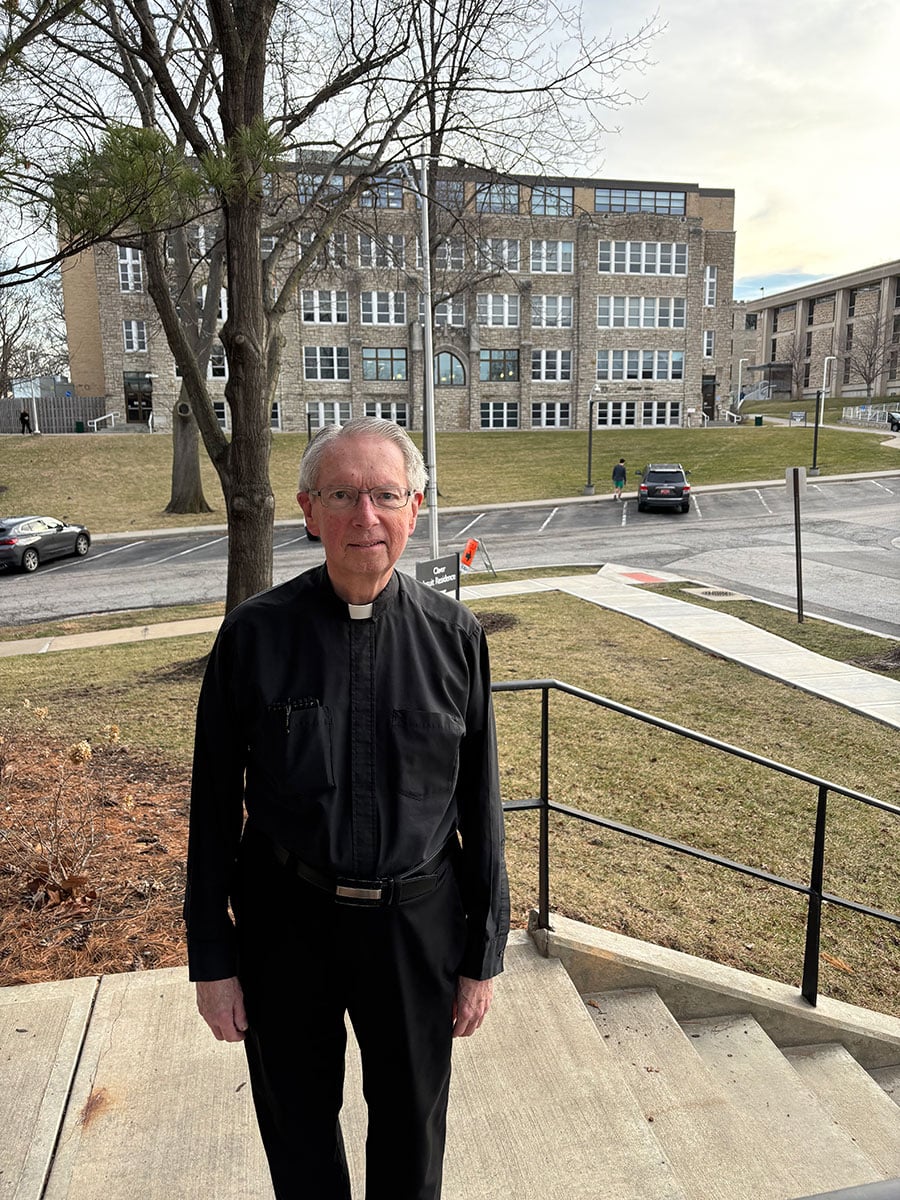
AM: In your mid-eighties, as you look back on a long, active, and discerned life, what words of encouragement can you offer to your old friends, the Quakers?
MS: Running beneath St. Ignatius’s Spiritual Exercises is the understanding that God made a good but not perfect world. Then, He trusted His human creatures each to bring their own part of that good world closer to perfection. In that sense, He invites each of us to be His co-creator.
A great blessing for me has been learning how Friends discern God’s nudges through the insights their neighbors share in Quaker meetings, and it has been a great blessing to see Friends deepen, through Jesuit spiritual direction, in their ability to discern the reliability of their personal inner spiritual movements. I think what’s next is continued growing interaction that may slowly lead to a fuller harmony in our chorus of complementary voices.
In the spirit of Jesuit discernment, Father Sheeran requested his colleague Phil Boroughs SJ, a former president of Holy Cross College, to review his responses. We are grateful for Father Borough’s time and helpful suggestions and for a similar review by Mike Nellis, an emeritus professor of criminal and community justice, of Glasgow (Scotland) Meeting.
We want to hear from you, not an AI! Please be thoughtful and use your own words. Comments on Friendsjournal.org may be used in the Forum of the print magazine and may be edited for length and clarity.