



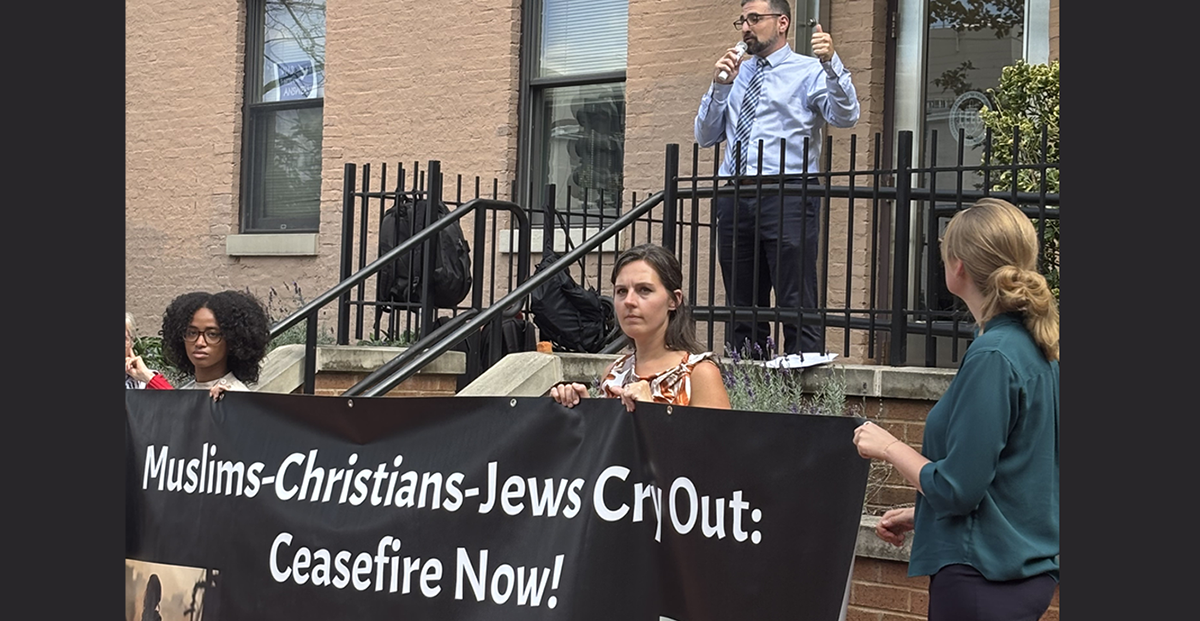
After long periods of discernment, eight Quaker groups signed a joint statement calling Israel’s war in Gaza genocide. “We believe with moral clarity, and in line with the definition of the crime of genocide, that the current actions in Gaza perpetrated by the Israeli government, constitute the crime of genocide,” the statement reads. The statement was posted to the American Friends Service Committee’s website on July 28.
The statement calls for a permanent ceasefire in Gaza and for Palestinians to have full access to humanitarian aid. It advocates for sanctions on Israel, including a complete weapons embargo and freezing the assets of settler militias. It also calls on legislatures to oppose any legal penalties for expressing pro-Palestinian sentiments.
In the war that began on October 7, 2023, Hamas killed approximately 1,200 Israelis and took 251 hostage. The Israel Defense Forces killed more than 67,000 Palestinians, according to the Council on Foreign Relations (CFR). In the first phase of an October 10, 2025 ceasefire agreement, Israel and Hamas agreed to end attacks. The initial deal provided for the return of 20 living hostages Hamas kidnapped on October 7, 2023, as well as the remains of 28 hostages who had died while being held captive, according to CFR. In exchange, Israel released 250 Palestinian prisoners incarcerated for life as well as 1,700 Gazans in detention. The agreement calls for 600 aid trucks to enter Gaza each day.
The pact was negotiated with the help of the United States, Turkey, Qatar, and Egypt. A second phase of the agreement establishes an International Stabilization Force, according to CFR. President Trump and former British Prime Minister Tony Blair are to lead a board that supervises a transitional government in Gaza.
The July document drafted by the Quaker organizations calls on Friends to advocate for peace and justice for Israelis and Palestinians:
Friends have a long history of working for peaceful coexistence and justice for all people in the Middle East. We have witnessed times when Jews, Muslims, and Christians have enjoyed peace and cooperation in the region. Since the creation of the State of Israel, our organizations have supported nonviolent efforts among both Palestinians and Israelis to protect human rights, prevent violence, address the root causes of conflict, and promote peacebuilding. We still believe a peaceful future for all peoples is possible.
Signatories include eight Quaker groups worldwide: American Friends Service Committee, Canadian Friends Service Committee, Friends Committee on National Legislation, Friends World Committee for Consultation World Office, Quakers in Britain/Quaker Peace and Social Witness, Quaker Council for European Affairs, Quaker Service Norway, and Quaker United Nations Office.
Friends Journal talked with the heads of several signatories about the decision to sign on to the statement.
“Before we determined and used the g-word there was a lot of discernment,” said Joyce Ajlouny, general secretary of American Friends Service Committee (AFSC). Ajlouny is a Palestinian American, and has served as the head of AFSC since 2017.
Amnesty International, Human Rights Watch, and B’Tselem (a human rights group in Israel) are three organizations that have determined that genocide is occurring in Gaza. The International Court of Justice determined that there is plausible evidence of genocide, Ajlouny noted.
According to the United Nations’ Convention on the Prevention and Punishment of the Crime of Genocide, which went into effect in 1951 after the end of World War II, genocide involves “intent to destroy, in whole or in part, a national, ethnical, racial or religious group.” Actions prohibited under the convention include killing group members, severely harming group members (mentally or physically), intentionally creating conditions hostile to the life of group members, deliberately preventing births in the group, and forcibly removing one group’s children and placing them with another group.
AFSC staffers’ belief that genocide was occurring was also based in part on a 2023 article by Raz Segal, program director of the Master of Arts in Holocaust and Genocide Studies at Stockton University in New Jersey, according to Ajlouny. Segal is an Israeli.
AFSC staffers in the region have also reported destruction that offers evidence of genocide, according to Ajlouny.
“Just five days ago, one of our staff had nine family members killed in an Israeli bombing,” Ajlouny said on October 1. The staff member had previously lost his sister, brother-in-law, and two nieces in a different IDF attack. One staff member is undergoing their eleventh housing displacement since the war began.
Ajlouny explained that recently displaced staff members who fled northern Gaza to go to the south have been offering informal education to children who cannot go to school because of the war. They recently held a graduation ceremony for a cohort of children whose education was disrupted.
Staff members in the region cannot find enough food to feed their own families, Ajlouny explained. One staff member has five daughters who cannot find menstrual products in the war zone. The war has destroyed infrastructure so much that survivors in Gaza lack access to toilets, cancer patients have nowhere to get chemotherapy, and dialysis patients cannot get treatment, Ajlouny noted.
AFSC also based its conclusion about genocide on a charge before the International Court of Justice (ICJ).
The ICJ is weighing South Africa’s allegation that Israel is committing genocide in Gaza. A final ruling could take years. The court delivered a preliminary opinion in January 2024 stating that the genocide accusation is “plausible.”
International legal processes have their place but have limitations, according to Mike Merryman-Lotze, Just Peace Global Policy director at AFSC. He previously worked for 13 years coordinating AFSC’s policy and advocacy work in Palestine–Israel and the Middle East.
“It’s not a mechanism for taking action and ending what is happening,” Merryman-Lotze said.
Britain Yearly Meeting designated several meetings over the course of three days at this year’s annual sessions in May to discern a position on whether genocide is occurring in Gaza, according to Oliver Robertson, head of Witness and Worship. Between 600 and 700 Friends attended Britain Yearly Meeting’s annual sessions; it was powerful for Friends to participate in such a large community discernment even though the process was long and difficult, Robertson noted.
Some Friends thought it was not Quakers’ place to determine whether Israel was committing genocide but that international courts should decide. Some Quakers believed issuing a statement on genocide could damage the public perception of them as peacemakers. Others believed that Friends can be both prophets and reconcilers, Robertson explained.
“We perform different roles at different times,” Robertson said.
Other Friends expressed concern about the impact of such a statement on the wider Jewish community, Jewish Quakers, and interfaith relationships. The statement contains a section about not attacking or blaming ordinary Jews or Israelis, Robertson noted.
Signatories to the statement commit to:
Reach out in love to Jewish, Muslim and Palestinian communities, confronting antisemitism, anti-Muslim and anti-Palestinian hate while refusing to be silent in the face of oppression.
Advocate for the universal human rights of all people in Palestine and Israel—ensuring they can live in freedom and dignity, without fear, and with lasting peace and security.
Jews in Britain and elsewhere struggle intensely with how to respond to the war, Robertson noted.
Friends from Britain Yearly Meeting wrote to Jews with whom they had interfaith relationships, according to Robertson.
Some of the replies included perspectives such as, “We don’t agree with the wording or the language you’re using, but we can see that you’re not trying to hate us or divide us,” Robertson said.
Britain Yearly Meeting’s minute states in part:
And so, we cannot say clearly enough: it is this current Israeli government that we are led to say we believe is committing genocide. Jewish people are not committing genocide. The Israeli people are not committing genocide. We abhor, and will challenge, any attempt to exploit our words to incite, fuel, or commit anti-Jewish and antisemitic hatred or violence. We abhor, and will challenge, any attempt to use our words to question the existence of Israel or the Israeli people’s right to live in peace and security.
Britain Yearly Meeting does not take a full boycott, divestment, and sanctions position, rather they support boycotting settlement products and divesting from companies directly involved in occupying Palestinian territories, according to Robertson. AFSC and the UN keep lists of businesses involved in the occupied territories.
In their discernment, Friends acknowledged violence and trauma on both sides and also expressed concerns about antisemitism and not wanting to negatively impact Jewish communities, according to Bridget Moix, general secretary of Friends Committee on National Legislation. The organization discerned internally, and Moix discerned with other heads of Quaker organizations.
“Quakers have tried very much to be on the side of peace and on the side of nonviolence,” said Moix.
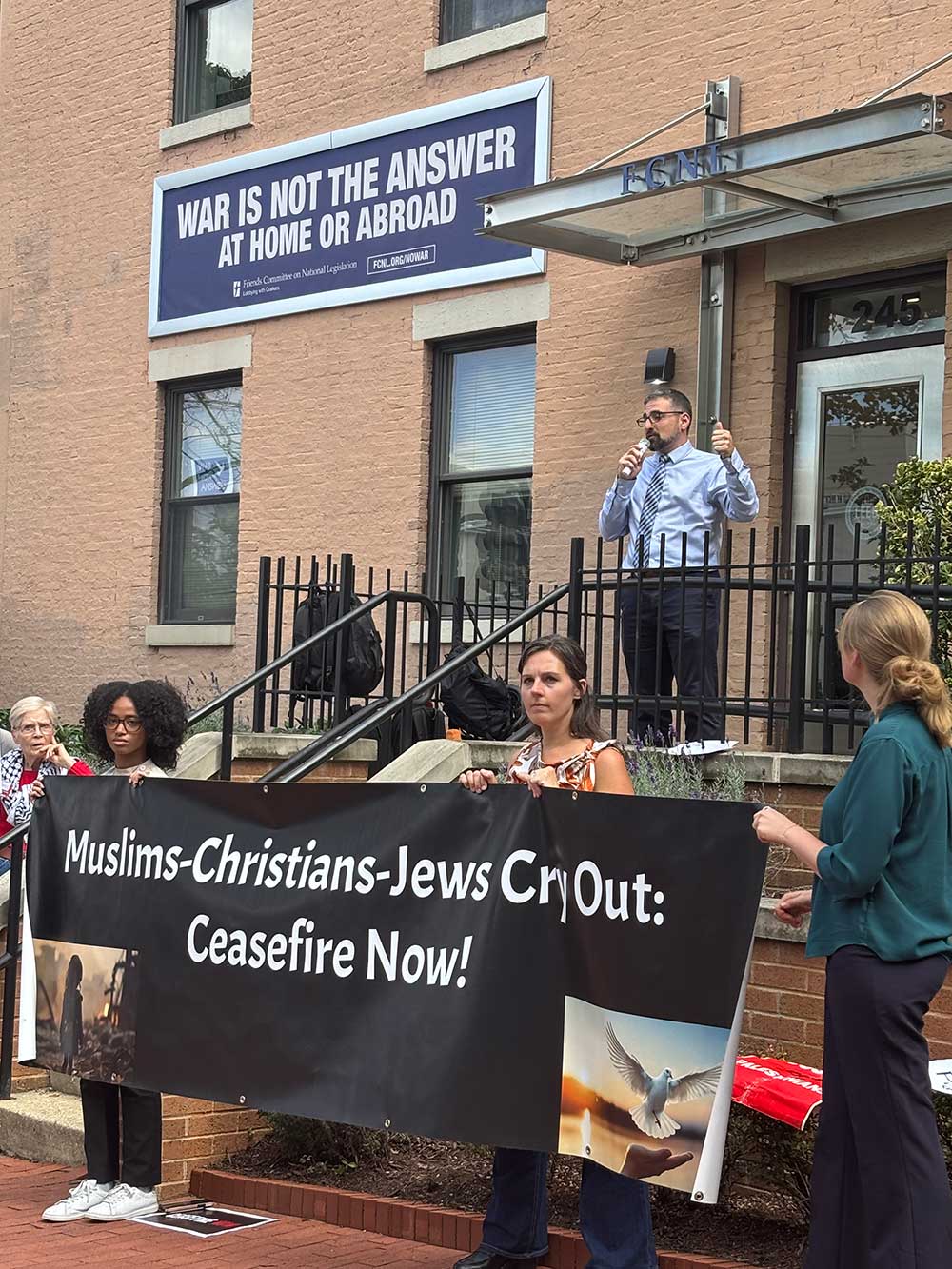
Friends World Committee for Consultation explained its decision to endorse the statement by saying:
We appreciate that even in a global peace church, different people have access to different sources of information and will have different perspectives shaped by different theological interpretations. All of us though share and cherish the core teachings of Jesus, including: “You shall not kill” (Matt. 5: 21), “Love Your Neighbour” (Matt. 19:19, Matt. 22:39, Mark 12:31, Luke 10:27), “Blessed Are the Peacemakers” (Matt. 5:9), “I was hungry, and you fed me” (Matt. 25:35).
As a World Office we are informed by the testimony of Friends who have experienced situations first-hand. We are also aware that there are times when silence could be understood as tacit endorsement. This is why we decided to sign a new statement based on and led-by the experience of Quaker groups that are either based in the Middle East or know it very well through their work.
Britain Yearly Meeting members have also contacted parliamentarians to urge them to discontinue military aid to Israel, Robertson noted.
“We see our actions as part of a wider effort,” Robertson said.
Friends can respond to the genocide statement by contacting their elected officials to advocate for ending the war, Merryman-Lotze observed.
Eighty-four Friends meetings, churches, schools, and organizations had endorsed the statement as of November 13, according to the post on AFSC’s website.
The statement can support Friends who are advocating for an end to genocide and the war in Gaza, according to Andrew de Sousa, director of Quaker Council for European Affairs.
“We hope that it will give courage to those who are doing it, to continue the work,” de Sousa said.
Concerning Genocide in Gaza
From the article;
“According to the United Nations’ Convention on the Prevention and Punishment of the Crime of Genocide, which went into effect in 1951 after the end of World War II, genocide involves “intent to destroy, in whole or in part, a national, ethnical, racial or religious group.” Actions prohibited under the convention include killing group members, severely harming group members (mentally or physically), intentionally creating conditions hostile to the life of group members, deliberately preventing births in the group, and forcibly removing one group’s children and placing them with another “
Isn’t this exactly what the Israeli people experienced from the Palestinians for decades?
Where was discernment and Genocide statement then?
Anti-semitism? No not us. Remember, “A lie, though told a thousand times, is still a lie. “
The FJ article by Sharlee DiMenichi begins “After long periods of discernment, eight Quaker groups signed a joint statement calling Israel’s war in Gaza genocide…..
The statement was posted to the American Friends Service Committee’s website on July 28.”
Further on, the general secretary of AFSC is quoted “Before we determined and used the g-word there was a lot of discernment”.
Toward the end of the article, the following statement is attributed to the general secretary of FCNL : “The organization discerned internally, and Moix discerned with other heads of Quaker organizations.”
The Religious Society of Friends is not a hierarchical organization. My question is:
Why were monthly meetings not involved in the process of discernment?
FCNL spent the better part of 2023 involving monthly meetings, individuals and Quaker organizations in adding the word abortion to their policy statement on reproductive rights.
Yet as far as I can tell, the joint statement was written without such input. Instead it was discussed “internally”, then “with other heads of Quaker organizations.”
Ordinary Friends were asked to endorse a statement they had not had the chance to be part of writing.
In my view, this was a mistake and I regret that, in our zeal to make peace we have done the opposite.
Thank you for writing this Claire. Although the eight organizations may have had good intentions, they lacked proper Quaker process. We Quakers were not included in the process. I suppose we all need to be more diligent in many, many ways. What they discerned was not in my name.
I’m thinking you might find Ziad Munson’s concise book on abortion politics interesting.
Upon years of thought, prayer, and reflection concerning the wars in Palestine and Israel, I tend to believe at this point that Hamas and its military allies have continuously pursued aims of genocide against the Israelis in their statements and actions.
Consider the suicide bombings of the Intifada. Some might regard these bombings as acts of protest. Even so, there is no denying that another purpose was to kill Israelis in full view of their families and friends.
Remember that the second intifada came soon after the Oslo Accords. Many of us were optimistic for a short time. The Nobel Committee even awarded the Nobel Peace Prize to Yasser Arafat, Yitzhak Rabin, and Shimon Peres.
Then an Israeli extremist killed a group of Palestinians after which Hamas retaliated with more killings. The first atrocity appeared to be an individual act while the atrocities in retaliation were admittedly a group act. Some Hamas leaders even characterized their retaliations as a jihad.
There have been so many more killings by both sides before and since these atrocities, as we know all too well. It seems like every time we imagine that we have identified the initial attack, we remember more attacks which preceded that one.
I suppose the World might adjudge the killings by Hamas to be small scale atrocities. If so, I believe it would be reasonable and fair to concede that Hamas lacked the military resources to exact killings on a larger scale. The difference in 2023 was that Hamas falsely assumed their military allies would join them in their attacks. This fateful miscalculation has been widely reported in the international media since then.
Now, many Friends are speaking up to condemn Israel’s horrific massive atrocities since 2023 while hardly mentioning what happened before. Are we taking sides, I wonder? Why would we want to take sides?
An excellent question, Friend Tom Louderback, and one that only the signatories of the eight organizations can answer, while the rest of us speculate.
On this day, Nov.29, in 1947, the UN General Assembly passed Resolution 181 calling for the partition of Palestine into Arab and Jewish states.
Friends may click the link below to explore the history behind the Israeli-Palestinian conflict, provided by Encyclopedia Britannica:
http://www.britannica.com/explore/israeli-palestinian-conflicts
You might find John Judas’s book interesting. As he tells it, US diplomats had hoped to see to diverse nation formed in Palestine but soon gave up that hope. They believed any country based on religion would be inherently undemocratic.
Judas adds that Harry Truman told visiting Israeli diplomats of his disappointment not long after the US had officially recognized the State of Israel.
So, the UN and the world defaulted to the idea that the West Bank would be a protectorate of Jordan and Gaza of Egypt. That lasted several years as we know. Then, both of those countries gave up on Palestine after the Six-Day War and they were forgotten by the rest of the world.
New England YM spent a great deal of time wrestling with the issue of genocide in Gaza at our annual sessions in August. Some Friends even felt we should not meet on the U of Mass Amherst campus because of the severe way the UMass administration responded to the nonviolent encampment in the spring of 2024. (Similar nonviolent actions around other issues have been handled with the severe response that UMass took to this protest by students, faculty, and townspeople).
We agreed to go ahead and meet on campus but held a moving meeting for worship on the site of the encampment.
We had a lengthy session of worship around the Gaza issue during one of our Mtgs for Business. And we listened to the heart-felt experiences of Rania Maayeh, head of Ramallah Friends School.
Friends were united about the need to respond, but because we did not have a clear proposal to consider we agreed to hold a Called Mtg for Business of NEYM this fall on the Gaza genocide issue.
Many Friends attended the resulting online (only) called NEYM Meeting for Business in October. All NEYM Friends were notified that this was happening. Those who chose to attend and take part did so.
The session was focused, well-clerked, and was able to unite in joining with FWCC, FCNL, QUNO, Canadian YM, AFSC, and other Quaker organizations in the statement described above.
We have come a long way on Israel-Palestine. Just a few years ago NEYM was barely able to unite around a very mild rebuke of Israel around its treatment of Palestinians and US complicity.
Much has changed. As brutal as 75 years of Israeli rule over many disenfranchised and/or ethnically cleansed Palestinians has been, the slaughter of 10s of 1000s of Palestinian civilians and children as collective punishment for the brutal violence of Hamas on Oct 7 has stirred many hearts in our YM. Obviously not everyone participated in this decision. But those who chose to did. And we were clearly in unity on this action.