



Talking with Quaker Candidates in Indiana Elections
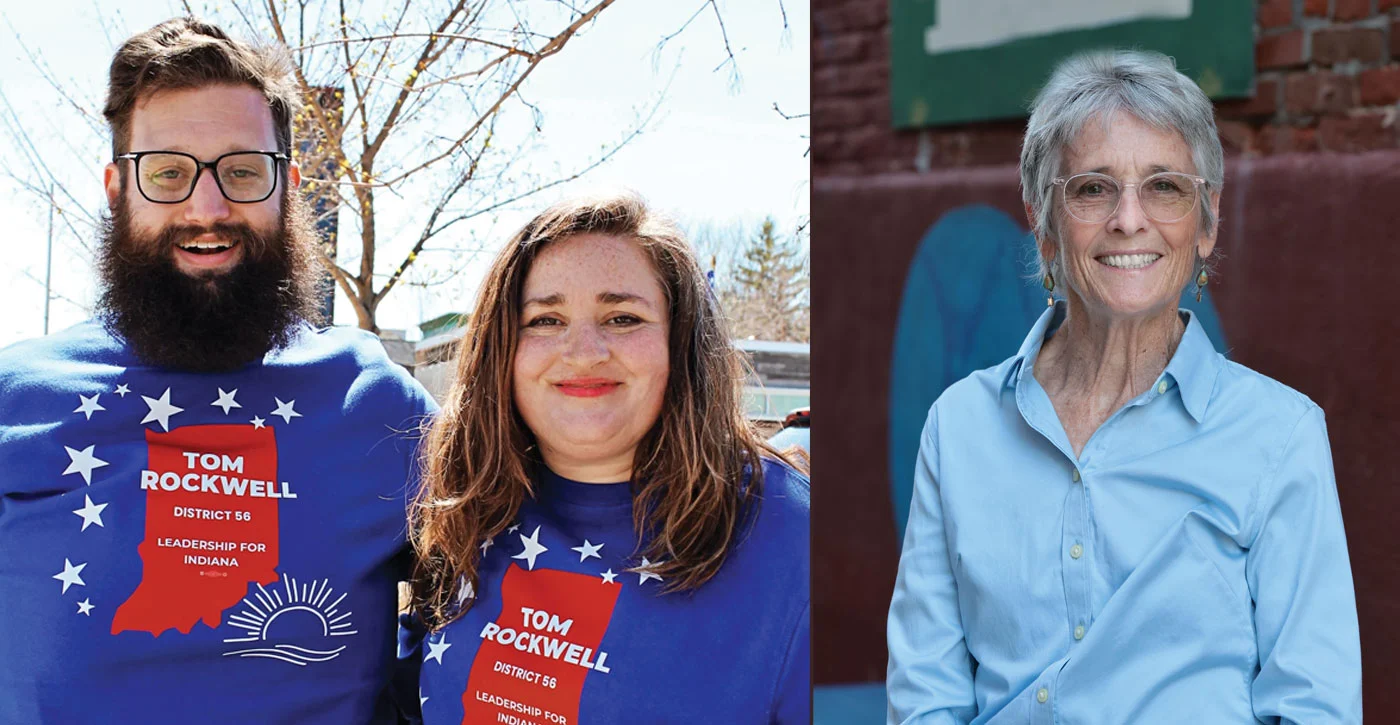
Commitment to Quaker values inspires some Friends to campaign for elected office. Friends Journal talked with two Quaker candidates running for the Indiana State House of Representatives about how faith influences their platforms and shapes their campaigns. Tom Rockwell, running in District 56, is a co-pastor at West Elkton (Ohio) Meeting and lives in Richmond, Ind. Rockwell is also the associate superintendent of Western Yearly Meeting. Nan Polk, running in District 54, is a member of New Castle (Ind.) First Friends Meeting.
Tom Rockwell interview
Sharlee DiMenichi: Please describe the process of deciding to run for the Indiana House of Representatives.
Tom Rockwell: Both my wife and I had been feeling concerned about the political situation more broadly, and felt like we were obligated to get involved, so we had a lot of discussions and maybe pseudo clearance committees about whether we should be getting involved. We were thinking we would wait a couple years until our life smoothed out a little more, but there were no Democrats running in our district, and that just seemed like something we could not stand. So then I decided to jump in, and subsequently my wife decided to run for township trustee too. So wow!
SD: How long did that process of discussion and clearness committees take?
TR: We talked about it for two months. I signed on to the race on the deadline, which was February 6.
SD: How have you gathered information about the needs and concerns of voters in District 56?
TR: I am really big on canvassing, so we go out two nights a week. We’ve been going for months trying to get more folks involved in that, and hearing people’s political concerns. Both nationally and in our area, there’s been a movement away from canvassing, which is strategically bad. It isolates people from their constituents. It also leaves people going to small circle political events that tend to have the same people who tend to be very privileged. It leads to candidates not learning very much about the people of their districts. There’s a real spiritual component to canvassing and being out and talking to people. Kat Griffith wrote an article for Friends Journal about canvassing and the spiritual side of it, which has been very influential for both my wife and me. I could not agree more with Kat that canvassing is the way to learn about your district.
SD: Where would funds for building affordable housing come from if you were in office?
TR: There’s lots of different places where you could get funds for affordable housing. There’s already a well-funded redevelopment committee within Wayne County, but a lot of that money goes toward building newer housing that’s aimed at upper-middle-class people. We need a more asset-based approach, including rebuilding housing that already exists. There are also lots of grants that we could apply for. I’m a big fan of matching fundraising from the private sector and putting public sector funds in there.
SD: What techniques would staff of publicly funded addiction treatment centers and programs use if you had your way?
TR: I would like to see a totally different approach. Right now we take as short-term an approach as we possibly can. Normally it’s hard to get into treatment at all in Indiana. There are very few options, and they get people back on their way as quickly as they can. We need to take a much longer-term approach. Give people even a multi-year inpatient method where they meet together in fellowship with other people who are struggling. There’s non-judgmental therapy to help people deal with the traumas they have in their lives. Right now we tend to isolate people’s trauma from their addiction. Indiana and the addiction treatment community more broadly has some hesitation about medication-based treatment. I would like to see things get more holistic and to focus on evidence-based, medication-based treatment. There are a lot of people who are missing out on getting to more stable lives because of judgmental feelings about medication-based treatment for addiction.
SD: Please tell me more about those judgmental ideas. Are you referring to the concern that people then become addicted to the medicine?
TR: Yes. Especially if you’re within an AA model, a 12-step model, which I’m a big fan of. I actually wish our churches would take on more of a 12-step AA model to the ways that they worship and hold each other accountable. But it also has some limitations where people get very puritanical about no medication assistance, and I think that’s profoundly unhelpful. We were at a worship service for Overdose Awareness Day a few weeks ago, and one of the speakers mentioned, “Oh, well, I’ve been off of medication or treatment for addiction for the last three months.” He had just gotten out of prison, he had just gotten off of the medication assistance, and that’s probably because of those puritanical views. It’s putting way too much pressure on him to possibly reoffend, to start using again. There’s no real evidence-based reason for that, and there’s no biblical moral reasoning for that either.
SD: How would you describe the human cost of addiction in District 56, particularly?
TR: Huge. Statistics are not as clear as I would like, but it seems like Wayne County has lost more people than any other county in Indiana, so the burdens are huge. Every family here is touched by addiction in some way, whether it’s a friend or a direct member of their family. It’s a huge burden on our economy. There are a lot of people who can’t hold stable jobs because of addiction, and then there are employers who leave because they can’t find stable people to work.
SD: What specific types of support would you offer to police officers, firefighters, EMTs, and first responders?
TR: I’d love to see more spiritual care available to all of them. We have an excellent advantage in that we have Earlham School of Religion and Bethany Theological Seminary in town. So there are a lot of people who could be interns who could help provide spiritual care.
Going beyond the spiritual, I would like to see their pay improved. I would like to see more officers. I’d like to see better training opportunities to get more new officers because we have really struggled with getting enough officers on the police force. The police academy classes are bringing in a handful of people every year. Officers are working a ton of overtime, which puts a huge burden on them and on the city budget. That’s happening in municipalities across the state.
SD: How does your Quaker faith shape your platform?
TR: Everything in my platform is about trying to see that of God in everybody, and getting us back to a place where we respect each other. We’re bombarded with technology in ways that cause us to be totally non-communal. I see this in our Quaker communities. A lot of people see people on Sundays and then don’t see much else of each other, and that’s really not what we’re called to do. My platform is a political version of trying to build up the kingdom of God and make us more community-minded.
SD: How does Quakerism influence your process of campaigning?
TR: Well, I think really wanting to hear from everyone and believing that there is that of God in everyone and that they have something to contribute has led us toward having a big focus on canvassing and really trying to get out and hear from everyone, including the majority of people in Wayne County who have just totally given up on the political process because it has ceased working for them.
SD: What would you like to add?
TR: There’s a big challenge we face that liberal churches more broadly and liberal Quakerism—which I would include unprogrammed Friends and liberal programmed Friends—have become a lot more individualistic over the last few decades. That’s a problem that all upper-middle-class, college-educated people are dealing with. We’ve gotten to a point where it’s much easier for us to just be on our own, and we’ve exited a lot of community institutions in a way that is not sustainable for us and is not serving us well. My campaign and a lot of other campaigns have had trouble raising funds, have had trouble getting volunteers in ways that many conservative campaigns do not. More conservative people and conservative religious groups are still more community-oriented than we are, and I think liberal Quakers, liberal people like to pretend that we’re very community-oriented. But the reality is, we are getting farther and farther away from that. People, because of their inward focus, are more and more anxious. They’re more and more focused on themselves, and it’s something that is just deeply not serving us in our political or religious realms.
Nan Polk interview
Sharlee DiMenichi: Please describe the process of deciding to run for the Indiana House of Representatives.
Nan Polk: That’s a very good question because it definitely was a process. I ran four years ago and was defeated—I think largely by straight ticket voting, as much as anything else. I talked to so many people who are hungry for a change. In Indiana, there’s been a super majority now for almost 25 years, and things won’t change if people don’t have alternatives. So I decided I’d run again.
SD: How have you gathered information about the needs and concerns of voters in District 54?
NP: I am a retired teacher, and I’m on our school board. I am a state education advocate for the League of Women Voters. I’m on a childcare board. I’m on a board called Hope Initiative that discerns needs in our community. It finds ways to partner and solve things like affordable housing and women transitioning after rehab. We focus particularly on women because we didn’t have a place for them until we got Hagar’s Hope. [Hagar’s Hope is a transitional living center for women in Henry County that opened in 2024.]
SD: What specific policies would you enact to protect religious liberty?
NP: We now spend tax dollars on private schools, which are about 70 percent parochial. We’re just not paying any attention to the separation of church and state, which is very threatening to freedom of religion.
SD: What are the most important ways the government can partner with churches to address hunger, addiction, and homelessness?
NP: A really good example of this kind of work happened in our area last month when we had torrential rain. We had 13, 14, I think some places even got 18 inches of rain. Since I’m on the school board, we had like 38 students that were displaced, were homeless, because their homes had been destroyed. So in trying to find out where they went and what was going to happen with them, I was very much amazed by the lack of government oversight and government organization. There was an emergency management system, but they could only answer people that had known to dial 211. There are still 30 students that are living in hotels, a month later. The churches came in with groups, and they were the ones that actually organized the relief effort, and were the boots on the ground. Our emergency management team later coordinated with them. That kind of scenario could work in other places also.
So many homeless people do have problems, mental problems and addiction problems, and it takes an organized effort to make a difference. It’s very difficult for religious organizations to solely fund those efforts. So government funding and the oversight that comes with government funding is definitely needed.
SD: How would you describe best practices in addiction treatment? And if you were elected, how would you promote organizations that offer those best practices?
NP: Very often, especially government entities, say, “Oh, we’re going to do this, and it’s going to fix the problem.” You can’t just fix the problem. In our community we’ve talked about trying to build tiny homes, but that doesn’t work unless there’s counseling that goes along with them. One of the entities we’ve helped establish that is working well is an organization providing transitional housing to women coming out of prison after attending rehab while incarcerated. They receive fiscal training, and they aim to leave transitional housing with a job and with some savings.
SD: What specific types of support would you offer to public schools that are not currently being offered?
NP: Public schools are not adequately funded, and the direct result is that teachers are not compensated well enough that we can entice people that have gone through the licensing process to come into teaching and stay in teaching. We have to put people through a process where they do appropriate licensure, which includes student teaching. We have an awful lot of teachers who are in the process. They’re in the classroom and there are some qualifications that they have to have, but many of them are just on the pathway to licensure. We really need people that are in there that are qualified.
SD: How would you increase broadband Internet access for rural residents?
NP: We have to just pony up and provide subsidies and get broadband. I live in a rural district where there are still a number of people that don’t have access to broadband. It’s very difficult to function today without that.
SD: How does your Quaker faith shape your platform?
NP: We believe that there is the light of God in all people. It affects how we treat people of different backgrounds, ethnicities, and religions. We’re all God’s children.
SD: How does Quakerism influence your process of campaigning?
NP: I try to find some quiet time, and before I go into campaign events, I seek leadings about about how to proceed. It’s such an integral part of life that it’s like breathing almost.
SD: What would you like to add?
NP: Why I’m running goes back to my faith, trying to seek justice in terms of seeking a way of life that is respectful and just and equitable. That all goes back to those Quaker values.
We want to hear from you, not an AI! Please be thoughtful and use your own words. Comments on Friendsjournal.org may be used in the Forum of the print magazine and may be edited for length and clarity.