



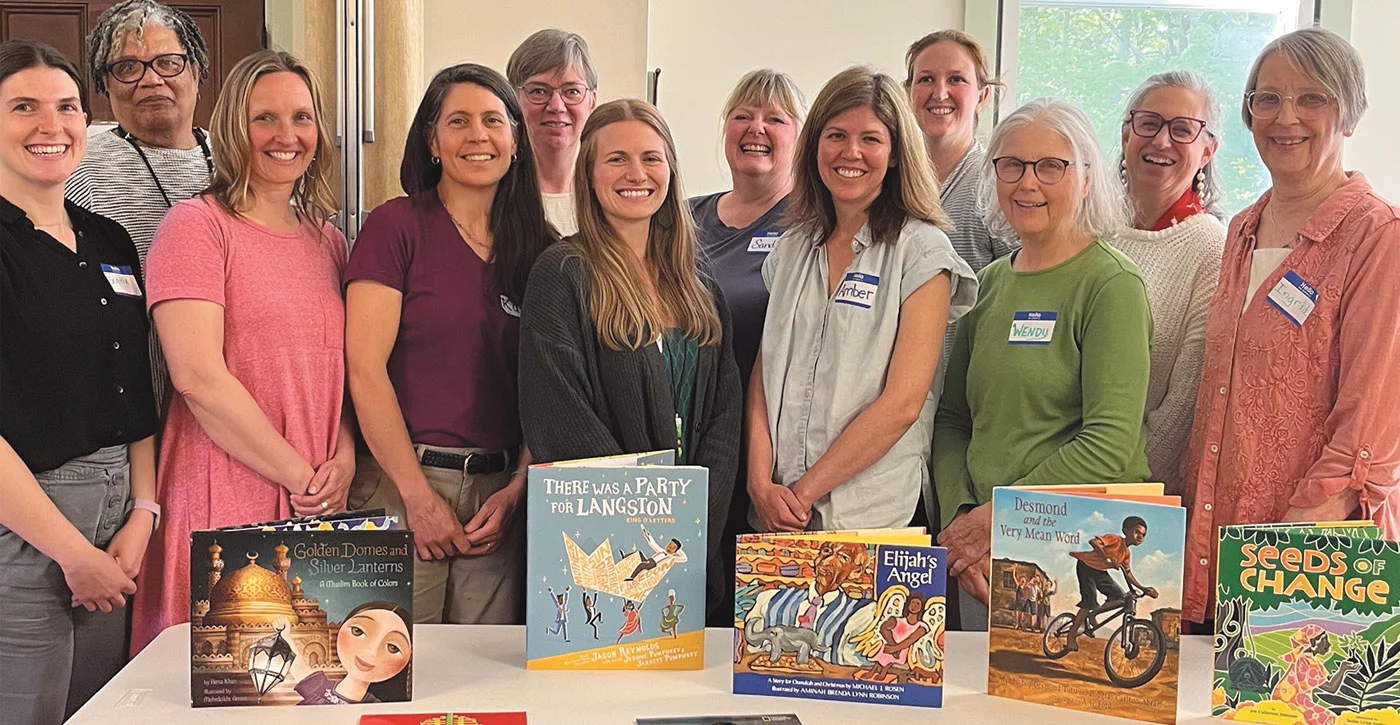
One Meeting’s Collaboration with Local Schools
Give peace a chance, yes, but why not get serious and give it a place in the curriculum: peace courses in every school, every grade, every nation. Unless we teach our children peace, someone else will teach them violence. —Colman McCarthy, journalist and founder of the Center for Teaching Peace
In these dark times when people are wondering what they can do, Durham (Maine) Meeting has found a path to peace education in local schools. In the fall of 2020, Durham Meeting held a series of conversations about becoming antiracist, including how we might live out our values in our local community. The Social Justice Book Project grew out of one of those conversations.
I have learned over many years as an early childhood educator that children benefit from seeing how others practice and nurture spiritual values. Socialization goals such as kindness and empathy are common in early childhood classrooms. In the Social Justice Book Project, we added a social justice framework to these activities.
Over the course of three years, we learned a great deal about how to use carefully selected books as a springboard for creating an anti-bias classroom culture and as a way to pursue topics of racial equity and environmental justice. This project has taught us not only the power of books but how to use them in a way that maximizes children’s social learning.
Each year we solicited volunteer public school teachers in five neighboring towns: pre-K to second grade. Supported by funds from the meeting and discounts at a local bookstore, teachers were given a selection of six to eight well-vetted picture books to use in their classrooms. Our committee, two consultants, and the teachers met several times during the year to share their experiences of using the books with students. After the first two years, a grant from Obadiah Brown’s Benevolent Fund allowed us to expand and document our work.
Our Social Justice Book Project team was fortunate to include several retired early childhood educators, one with extensive familiarity with children’s literature. Criteria were developed for selecting books written and illustrated by people from diverse groups that were represented in the books, as well as books developmentally appropriate for children four to eight years old. Identifying wonderful titles became an ongoing project as new relevant books are being published all the time.
Our strategy became clustering books under topics. Using several books with related content allowed the teachers to go deeper as they pursued goals of kindness, empathy, fairness, nonviolence, and appreciation of diversity. We organized books under three topics and developed a teacher guide about each of these: Creating an Anti-bias Classroom Culture, Exploring the Black Experience in America, and Wabanaki History and Culture with Attention to Care of the Environment. In Maine the Wabanaki people are very much present but not widely recognized. The curriculum and resource materials we developed are now being used in more than 30 classrooms. (The guides are available online at the Durham Meeting website, durhamfriendsmeeting.org/?p=6895.)
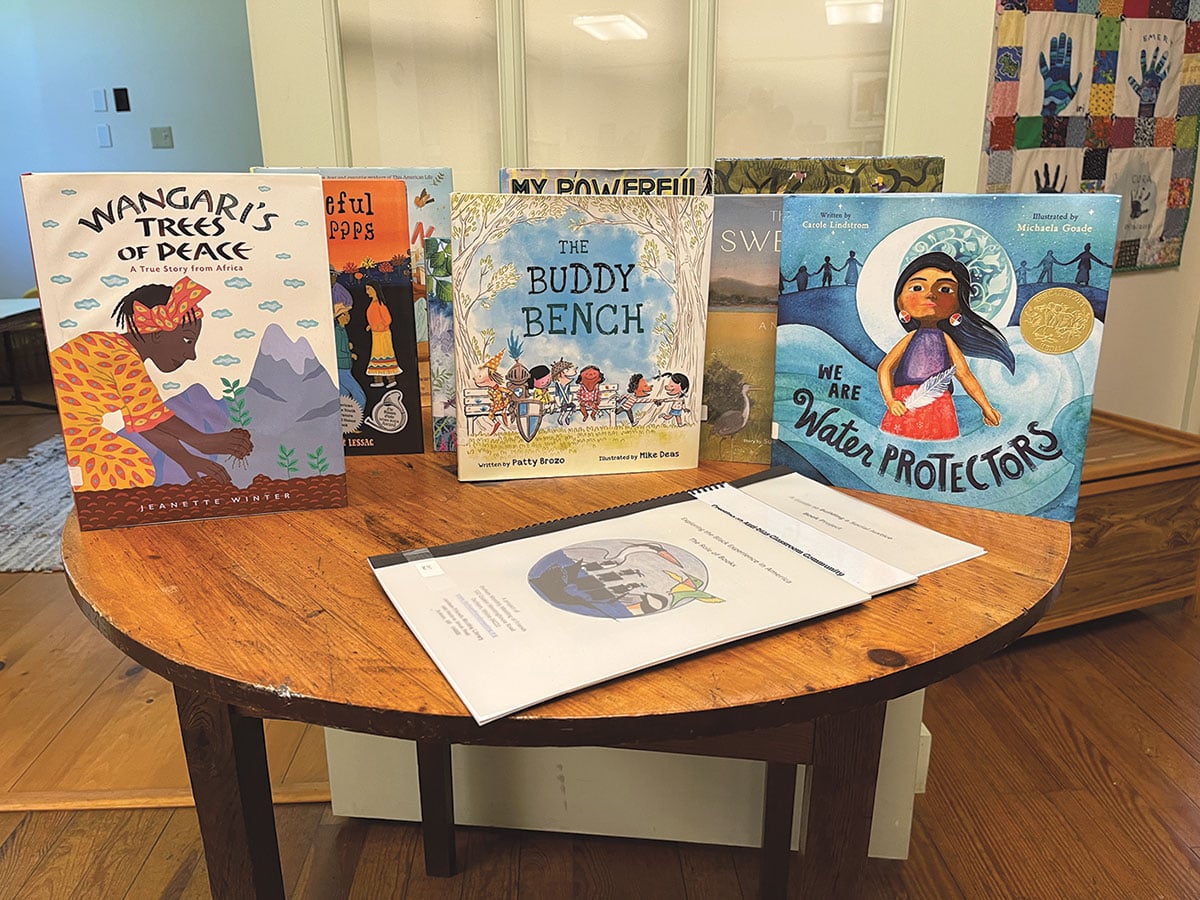
Here are a few example stories we’ve collected from the classrooms.
Kate, a kindergarten teacher, shared how she used Each Kindness (by Jacqueline Woodson, illustrated by E. B. Lewis) and The Buddy Bench (by Patty Brozo, illustrated by Mike Deas) to foster kindness, inclusion, fun, and friendship as cultural norms in her classroom. After leading an activity in which the children drew pictures of their hopes and dreams about friendships, the class drew up a set of agreements (behavioral norms). Kate then read Each Kindness, a story in which a girl regrets not being kind to a new girl in her class. Next came The Buddy Bench. During the first reading, the class noticed that there were children in the story who wanted to play but were not being included. The children in the story came up with the idea of a “buddy bench” where kids could go if they wanted to be asked to play. Kate’s class loved the idea, and they went outside to find their school’s buddy bench. Sitting on it and around it, the children heard the story read again. Then they did some role-playing to act out the story. Kate read the book again a few days later to invite more discussion.
The book Our Skin: A First Conversation About Race (by Megan Madison, illustrated by Jessica Ralli) became a touchstone in classrooms. The book explores differences in skin color, the false concept of race, and the birth of racism.
Emma, a combined first- and second-grade teacher, kept the book visible when reading other books in their study of the Black experience. She referred to it often when difficult questions were asked. “Well, remember in Our Skin how. . . . Let’s go back and re-read that page.” Jennifer, a kindergarten teacher, used the book to help children understand the science of skin color and how it does not define who we are. On her first reading of the book, she read only the section on skin tones. The children brainstormed words they could use to describe their own skin and then created self-portraits using crayons and paper with a wide variety of colors to choose from. On the next reading, they heard the beginning and focused on the message that the way a person looks does not define who they are. They participated in some survey activities to get to know their classmates better. The third reading of the book focused on racism. To reinforce this lesson, Jennifer referred to it as they read other books about the Black experience.
There is much to learn about social justice from children’s literature by and about the Indigenous population who cared for our land for thousands of years before it was stolen by colonists.
Jeanne read to her first and second graders a book titled We Are Water Protectors (by Carole Lindstrom, illustrated by Michaela Goade), which is about Indigenous people demonstrating against a pipeline that may affect their water quality. By combining multiple readings of We Are Water Protectors with other books about demonstrations, she helped students explore how gathering together with signs can be a way of making change. She showed students photographs of marches, including the March on Washington, to illustrate the power of community action. Even people who are opposed to the change or unaware of the issue can end up thinking, “Wow! Lots of people care deeply about this. Maybe I should learn more.” As a follow-up the children identified a cause that they cared about and made their own posters. When they took their posters home, several children asked their parents if they could take them to a protest.
Children often bring experiences from school home with them. We found it was important for families to know what books are being read, so they can be prepared for conversations that may arise. Brigitta sends a letter to the parents of her pre-K children when she is going to talk about race. She shares the topics of their conversations, what books she will read, and the reasons for these lessons. Jennifer sends a quick email to the parents of her kindergarteners daily and always includes the title of the book they have read.
Over the three years of this project, we learned that children readily identify unfairness and easily understand the importance of caring for the environment. These books offer them an opportunity to examine these topics from some distance, and yet through related activities, they are able to apply what they are learning to their lives.
This project and our work with the teachers gave us a glimmer of hope that kindness and empathy can be nurtured in our young children. Our committee and our Quaker meeting found joy supporting this project. We look forward to seeing the fruits of our labor of love. May this foundation of respect and appreciation for others, as well as peaceful means for resolving conflicts, create a blueprint that the children can build on to create a more just community for all.
We want to hear from you, not an AI! Please be thoughtful and use your own words. Comments on Friendsjournal.org may be used in the Forum of the print magazine and may be edited for length and clarity.