



Supporting Children’s and Youth Ministries
When considering how to support ministries for and by children and youth, Quakers often look for ways to teach young Friends and integrate them into the existing structure of the meeting. Friends who work with youngsters suggest that encouraging them to follow their own leadings to initiate or participate in ministries involves acknowledging people are innately wise regardless of age. Many Friends who work directly with children and youth note that basic spiritual needs are the same across the human life span. Children have profound spiritual and emotional experiences, according to Friends who work closely with them.
“What can feel surprising sometimes about children’s spiritual needs is how deep they are,” said Elizabeth Freyman, curriculum coordinator at Albuquerque (N.M.) Meeting. Children think about existential questions concerning death and dying as well as estrangement and belonging, according to Freyman. The key to understanding children’s thoughts on such matters is to refrain from talking and instead to listen to their explorations.
For instance, Freyman told a group of children the biblical story of Sarah and Abraham being “full of years” and dying Genesis 11-25). She asked the children which part was most important to them, and one child who had recently lost a grandparent responded that the part where they died was the most crucial. Freyman noted that adults usually do not talk about death with children. The child’s eyes filled with tears, as did Freyman’s. The young person agreed that children are usually not part of conversations about death.
Others who work in ministries with children and youth expressed similar views.
As children enter elementary and middle school, they think of how they can use their gifts, strengths, and interests to help their communities. They learn that they have inherent worth and also that they can contribute to the community in specific ways, which gives them a sense of agency.
Belonging and love are crucial needs at any age, according to Melinda Wenner Bradley, director of communications and training for Faith & Play Stories. Wenner Bradley serves on the steering circle of the Quaker Religious Education Collaborative and has a minute of religious service from West Chester (Pa.) Meeting, where she is a member.
Adults and children have many of the same spiritual concerns and questions, according to Xinef Afriam, teen and outreach coordinator for New England Yearly Meeting (NEYM). Young people are not “humans-in-training,” Afriam said; children and youth experience and feel things just as deeply as adults do.
“There is a sense of a universal reality that we’re all living in together,” Afriam said.
Although people at all stages of life are fully human and have similar spiritual needs, there has been a shift in what community and relationships look like in the digital age, according to Afriam. Starting as a volunteer, Afriam has worked with the NEYM community for more than a decade. They have seen a strong desire among young people for what sociologists describe as “third spaces.” A third space is a concept coined in the late 1980s by sociologist Ray Oldenburg to describe a place distinct from home and work or school in which people can relax together. Quaker third spaces offer young people a place to be themselves in community without having to adhere to rigid standards or spend money, according to Afriam.
Basic spiritual needs for all ages include belonging, purpose, and comfort during hard times, according to Kara Price, children’s and family ministries coordinator for NEYM. Children manifest their spiritual needs in a more emotionally genuine way than adults do. Children also may have less vocabulary to describe their spiritual lives.
Quakers who work with children and youth address their spiritual needs by assuring them that they are loved and valued members of the community, Price explained. “For young children, their purpose is just being,” Price said.
Young children also learn the importance of being kind and playing with others, according to Price. As children enter elementary and middle school, they think of such questions as how they can use their gifts, strengths, and interests to help their communities, according to Price. They learn that they have inherent worth and also that they can contribute to the community in specific ways, which gives them a sense of agency, Price explained.
When young people contemplate how they can contribute to the community, adults can support them by expressing confidence in their ability to handle heavy topics.
Michelle Downey, clerk of Fayetteville (N.C.) Meeting, has worked with children in her small meeting to rewrite adult queries into children’s queries and to reflect on them. For example, when discussing a query on earthcare, Downey showed the children images of trash islands in the ocean. “They were shocked to see that,” Downey said.
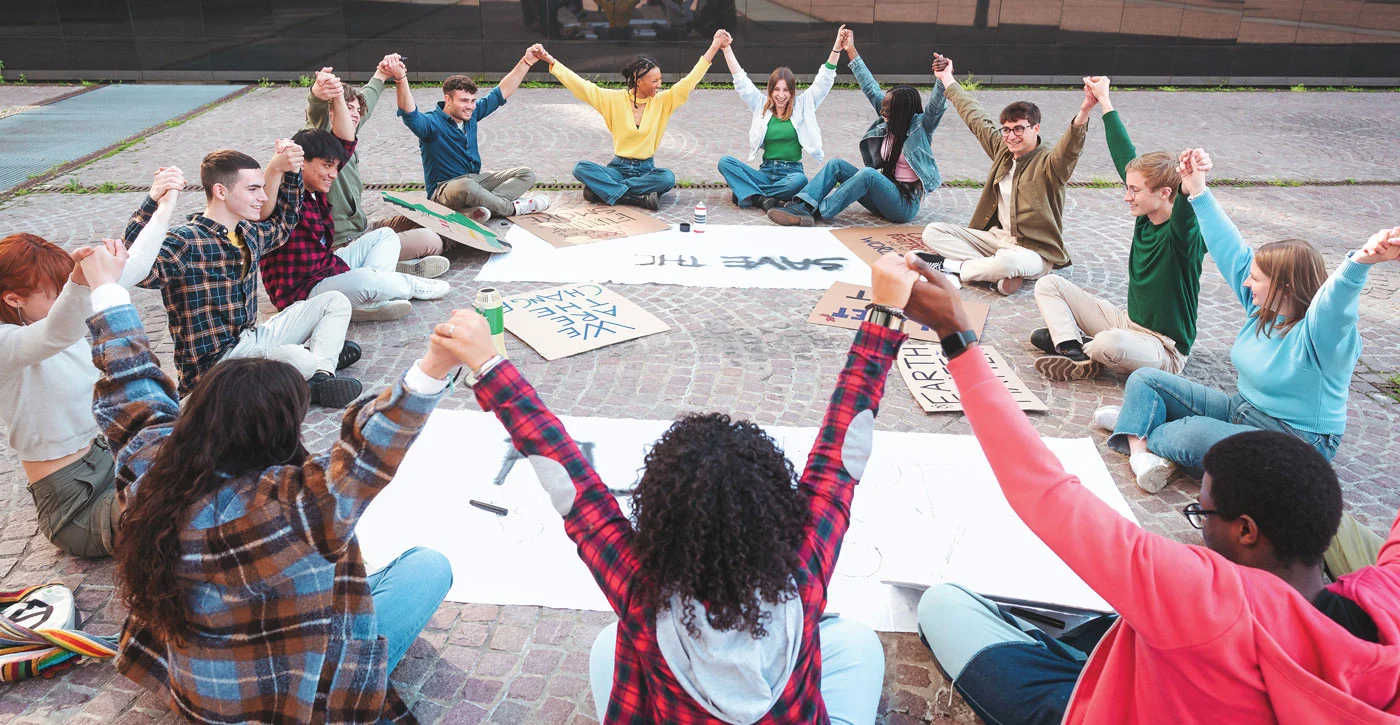
Allowing children to engage with social and environmental problems in developmentally appropriate ways encourages them to follow leadings to initiate or participate in ministries, which might include activism and service projects. Adults can support young people’s leadings to ministry by introducing them to the practice of discernment, cultivating relationships with them, and offering them clearness committees and support committees, Price explained.
For the weekend of March 28, 2026, Price coordinated a weekend retreat on the theme of witness for young people in New England Yearly Meeting. Many of the participants signed up for workshops on making protest signs and singing resistance songs. The retreat was aimed at helping youth understand experientially how Quaker communities can spiritually ground them to prepare them for witness, according to Price. Young people who attended discerned whether they were called to participate in a shared public witness, for which Portland (Maine) Meeting offered to let them use its parking lot.
Each year, NEYM holds a service-oriented retreat for youth, according to Price. Participants answer queries about service and seek to couch service in reflection. Young people have served at soup kitchens, animal shelters, and nursing homes. Young people also offered household help to individuals with and without disabilities, and volunteered at facilities distributing clothing and appliances to people in need. During one retreat, the participating youth found five dollars, previously placed, and needed to discern where to donate it, Price explained.
Sometimes young Quakers following leadings to initiate ministries encounter resistance from adults who question whether they have enough commitment, knowledge, and life experience, according to Freyman at Albuquerque (N.M.) Meeting.
“I believe that we live in an adultist-dominant culture,” Freyman said. “Just because we’re Quakers doesn’t mean that we’re immune to the ‘-isms.’”
Despite the adultism they face, many young Quakers do follow leadings to initiate or participate in ministries.
Freyman’s 18-year-old son recognized a leading to create safe spaces for queer youth by establishing gay–heterosexual alliance groups at his middle school and high school. One young woman from Freyman’s meeting started a campaign to ban the use of plastic bags in Albuquerque.
Young people in Brooklyn (N.Y.) Meeting hosted several punk rock concerts at the meetinghouse, according to Cai Quirk, youth and eRetreat coordinator at Friends General Conference (FGC).
“The young people talked about how playing music in their punk group was one of the ways that they felt Spirit moving in them and that it was an important way of supporting folks in the local community,” Quirk said. The concert engaged youth from the community around the meetinghouse, attracting concertgoers who began to attend meeting for worship there, according to Quirk.
Other young Friends have experienced support for their leadings. For instance, Price grew up participating in NEYM’s youth programs where adults encouraged her to follow her leading to run a marathon to raise money for leukemia research.
When Price was in her early 20s—before she held her current position—junior-high-age youth spontaneously organized a public witness. Annual sessions were being held at a college campus where the New England Patriots football team was also staying. The young people took issue with the pay professional athletes earned in contrast with people living in poverty, so they made signs and held a sit-in on a campus sidewalk. The adults from the college said the Patriots are also paying guests of the college. Older adult Friends at annual sessions were proud of the children’s protest. Adult staff of NEYM discerned with the children how to respond to complaints by college staff members. The following year, Price was on staff at NEYM. The Patriots had a death in their community, and the same young people who had protested the year before discerned that they should send the team a sympathy card.
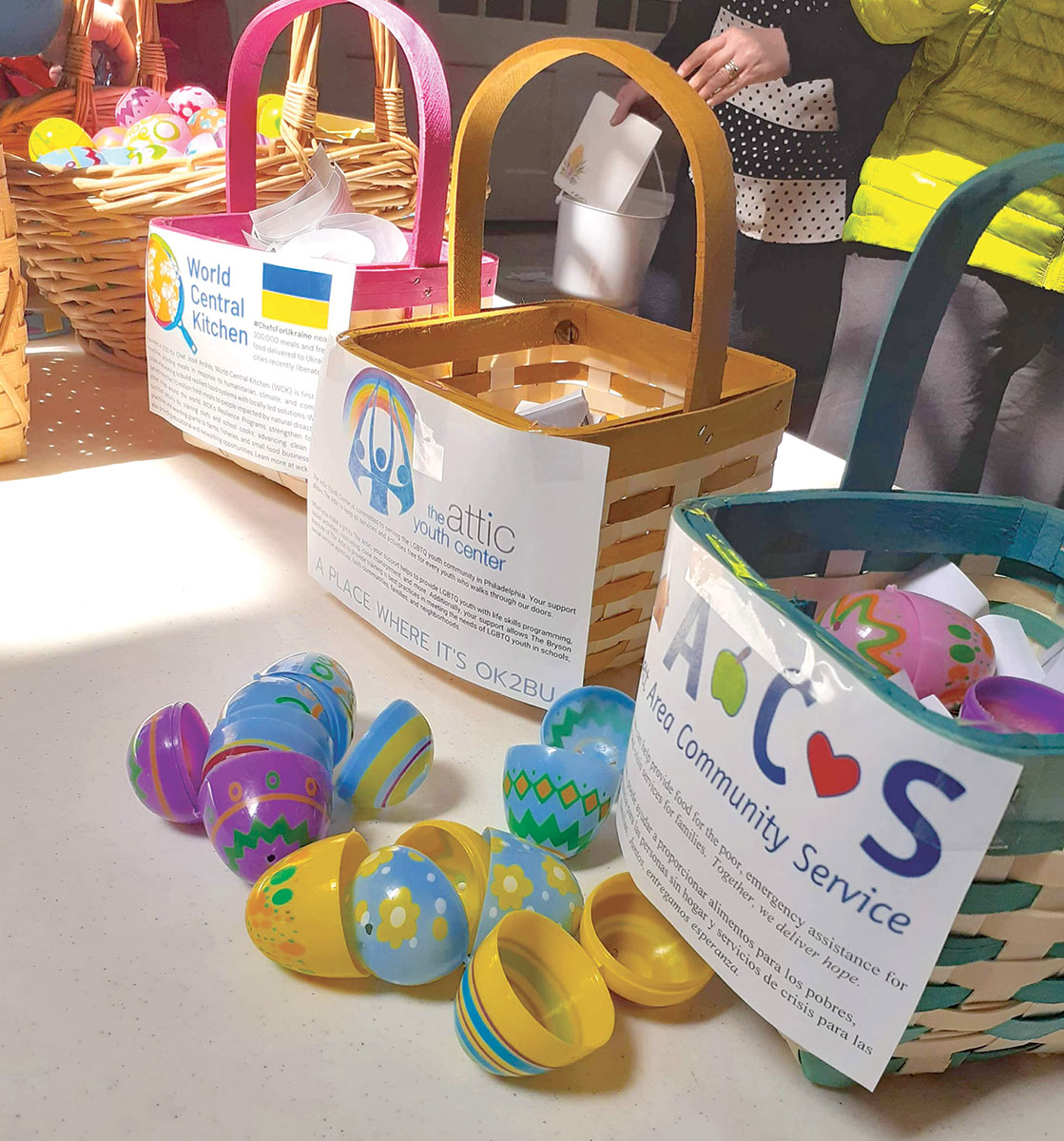
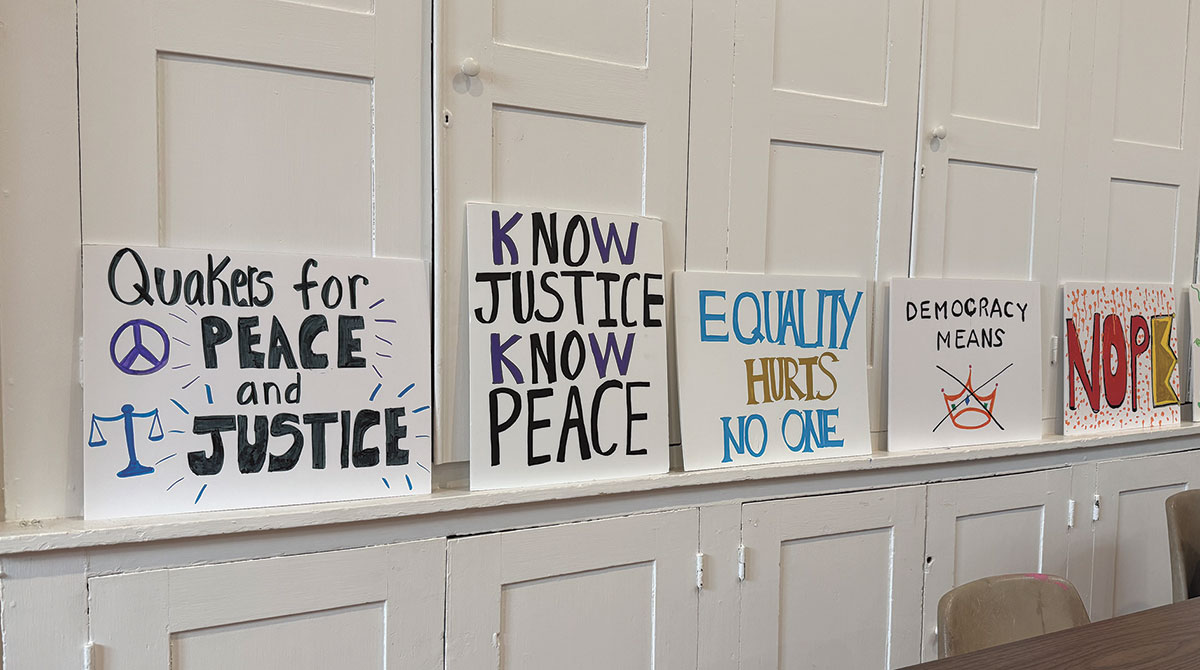
At West Chester (Pa.) Meeting young people made protest posters that they keep on a shelf at the meetinghouse for Friends to borrow who are participating in demonstrations. Middle-school Friends host an annual Easter egg hunt. Each egg contains a voucher for one, five, or ten dollars. There are Easter baskets with the names of service organizations, such as those addressing LGBTQ justice, animal rescue, and food insecurity. The children find the eggs, open them, then put the vouchers in the baskets for the organizations they most wish to support. At business meeting, adults support the children’s choices by allocating money from the meeting’s budget according to the baskets in which they placed their vouchers.
One of the young people at Brooklyn (N.Y.) Meeting felt called to volunteer at the meeting’s monthly community dinner, which serves people seeking food and community regardless of their financial means. This young man is now clerk of the meeting’s Community Dinner Committee, according to Beth Kelly, the children, youth, and young adult community director for New York Yearly Meeting. He brought his friends to volunteer, and the meeting community encouraged him to deepen his public ministry.
“Nobody said, ‘You can’t serve on the Community Dinner Committee because you’re a kid,’” Kelly said.
At Chatham–Summit Meeting in New Jersey, one young woman started an annual peace festival for children. Three peace festivals have been held, which feature artists, guided meditation, and performances by children’s choirs and dance troops, according to Kelly. The person who initiated it received adult support in the form of transportation and access to publicity for the event.
Allowing children to engage with social and environmental problems in developmentally appropriate ways encourages them to follow leadings to initiate or participate in ministries, which might include activism and service projects.
Adults who wish to support young people’s leadings to ministry can stay open to promptings of Spirit that are not what the grownups predict, according to Quirk. For example, young people might feel led to pursue a profession, join an activism group, or live into a gender identity that is unfamiliar to those around them.
Quirk explained youth leadings in this way: “The leadings that youth are having might not be as outward as ‘I’m going to go sit in a fishing boat in front of this giant oil tanker.’ That might not be the place that kids are having leadings, but having the sense that ‘something is leading me towards expressing myself in a different way than is expected of me.’”
We want to hear from you, not an AI! Please be thoughtful and use your own words. Comments on Friendsjournal.org may be used in the Forum of the print magazine and may be edited for length and clarity.