



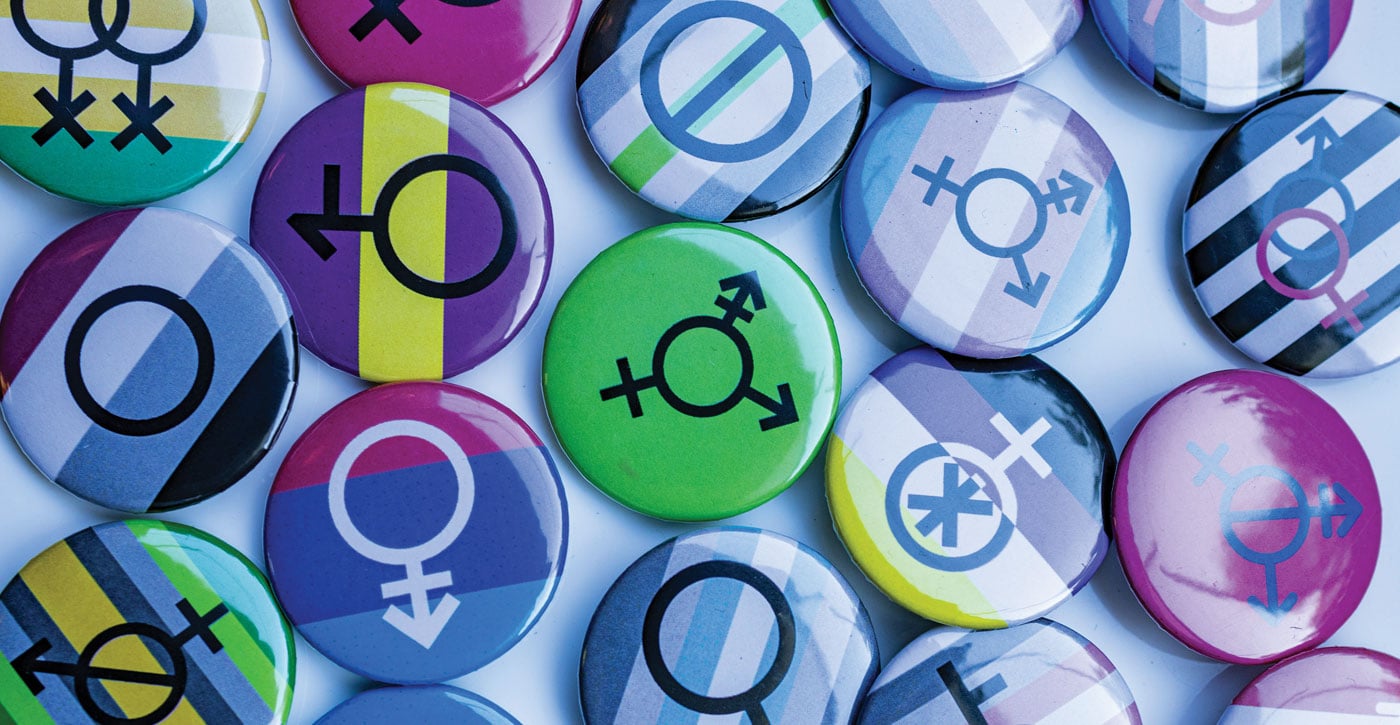
I have two “they” in-laws. I don’t mind having in-laws who use they/them pronouns. It doesn’t offend my linguistic sensibility to say “they are” about a single individual because I believe grammar is a system of communication and exists to serve those who use it. Grammar changes to accommodate social change; it always has. The language lover in me is fine with “theys.”
While I am comfortable referring to an individual as “they are,” I will admit to often forgetting to ask how “they” are. It is hard to overcome decades of usage. It is particularly hard since I knew one of my in-laws before they started referring to themselves as “they.” My daughter patiently corrects me, and I just as patiently reframe my remarks or my questions. In the case of my second in-law, I often respond to the gender they present to me, and this daughter just as patiently corrects me.
Then there is the problem of clarity. When talking to my daughter with my granddaughter, I often wonder who she is referring to when she says, “They are going to the store.” Does she mean her partner or her partner and her daughter? But context usually clarifies this and rather quickly.
My struggles to remember and my issues with clarity, however, are trivial when compared to my commitment to respect the choices individuals have made. Besides, politically speaking, I don’t need a person to be a “he” or a “she.” I dislike the gender binary as much as anyone. After many years of feminist activity in this country, I still find the assumptions around gender expression rigid and therefore stifling.
I have no problem with the pronouns. And the Quaker in me is comfortable with continuing revelation on the matter of linguistic rigidity. I find, however, that I struggle to understand people who are gender nonconforming making physical changes to their bodies. This is not part of a religious conviction. It is part of a political commitment.
My convictions take a simple form.
There is sex; there is gender; and there is sexual orientation. In the world that radical feminists of the 1970s imagined and fought to bring into being, there would be no necessary connections among these three categories of being. Either sex (and we were aware that there might even be a third sex) would be free to express gender in any way that felt right to the individual, and neither the sex nor the gender expression need have any necessary connection to sexual orientation.
I grew up in a world where this vision was unimaginable. I grew up being told that, as a biological woman, I had to be feminine and I had to love men. I grew up knowing the consequences of not adhering to this rigidity were social ostracization or worse: electric shock treatments and confinement in a mental institution. I twisted myself into dresses and high heels, took up as little space as possible, and tried to fall in love with boys. I did this for years until I came to understand that this prescription was part of a system of government called “patriarchy” and that it served the interests of those who benefited from this system of government. Feminism freed me from this charade and allowed me to express myself as female, masculine, and lesbian.
I could not say that gender is a social construct not a biological construct, so there is no reason you can’t adopt masculinity as your gender preference while remaining a biological woman. None of these understandings would have spoken to this person’s condition.
The transgender movement has troubled my waters. Despite my continued adherence to the radical feminist vision of the 1970s, I cannot in good conscience simply say that transgender people are the victims of a patriarchal plot to cement biological sex and gender preference into an indissoluble link. I have had many conversations with transgender people in which I have asked why they could not express their gender preference while remaining their biological sex. And I have had many answers to that question.
The turning point came for me one night while talking to a woman who was contemplating an operation to change from female to male. This operation was extensive, painful, and expensive. I asked if the pain and cost were worth it. This person looked me in the eye and said, “I would die happy if I could just spend one day on this earth as a man.”
This was a depth of longing I could relate to. I felt the same way as a girl who loved girls but was forbidden to express that love. I knew I could die happy if just for once I could hold and kiss the girl I loved.
Recalling my own experience, I found I could not say to this person what the radical feminist in me was prepared to say. I could not say that my generation fought a revolution so that your generation could express your gender preference in any way you wished, regardless of your biological sex. I could not say that we fought a revolution so that you would not have to change your body to accommodate your gender preference. I could not say that gender is a social construct not a biological construct, so there is no reason you can’t adopt masculinity as your gender preference while remaining a biological woman. None of these understandings would have spoken to this person’s condition.
All l could do was put my arms around my acquaintance and offer a hug.
I find myself now—on both a personal and a political level—embracing the transgender movement and supporting those who make that choice. I believe that at this time in our history as a country and as a democracy, this form of troubling the waters rocks.
I believe the transgender movement has pushed many people to the far right. I feel an underlying anger in so much of what is happening in our country, triggered by outrage at the idea that a person might be able to change something the outraged perceive as fundamental, God-given, as one’s biological sex. Though many who feel this outrage may not recognize it, their anger is fueled at some level by a commitment to patriarchy. If women as a subservient second class can change themselves into men, where will that leave the oppressing class? We know that misogyny is pervasive in the MAGA movement and in Project 2025, so it is no surprise that transgender people are in the cross hairs of the current government.
I am still troubled, however, by a nagging sense that there ought to be a better way to trouble the waters of gender binaries than by physical alteration. And I am still trying to sort out my concerns that it might in fact reinforce the perception that body type must follow swagger or mincing. But then I realize that none of the transgender people I know either swagger or mince. The genders they express are complex, interesting, and often unique. And then I realize that virtually none of the non-transgender people I know swagger or mince. There are flat-chested women and bosomy men, and an extensive range of gender expression prevails within the communities I am familiar with. In a certain sense, almost everybody I know is “queer.”
So clearly we should be subjecting the concept of gender itself to scrutiny and revision. In a very real sense, the transgender movement is forcing this task upon us. As we face an almost comic form of swagger in our current government, with its concomitant requirement that others then mince, the transgender movement represents a powerful counter value.
Always an advocate of continuing revelation, I find myself now—on both a personal and a political level—embracing the transgender movement and supporting those who make that choice. I believe that at this time in our history as a country and as a democracy, this form of troubling the waters rocks.
Judith, thank you for sharing your vulnerable journey of changing your opinion. Changing our minds is such a radical act these days, and I admire the work you’ve done to become a companion to trans and nonbinary people.
Rhetorical Question: Why did you even ask “Why?” Let’s just believe others and be glad for them. People are not required to explain themselves or educate us.
Some years ago I was told that spirits (that is, people who have passed into the spirit world) of one gender sometimes overcloak those of another gender, often at a very young age, which is not a loving thing to do but it happens, and the person on earth goes through life wanting to be that different gender, only realising they’ve missed out on living their own life once they pass, and learn the truth. This seems a very reasonable explanation to me, though it doesn’t help the overcloaked person on earth unless they happen to go to a good medium who could verify this. I firmly believe that God created male and female, and each sex has a varying amount of the characteristics of the other sex, and that a significant percentage of people were created by God to be attracted to their own sex.
This all makes sense for me. No matter what the reason, it is wrong to judge anyone. I only mention the transgender information in the hope that it may be useful to some of us.
Thank you Judith for this. It is unlocking my view wider on the transgender question.
Before I share some of my concerns about this article, I want to offer my respect and appreciation to the author. It takes courage to change your mind, and even more courage to share that process with others as vulnerably as she has. I am grateful for Friends who model for me how to continue broadening your mind and heart as you age.
My concern is with Friends Journal’s decision to publish this piece in its current form, especially without a content warning. The piece repeats hurtful comments that well-meaning people say to and about trans people all the time. “It’s so hard for me to remember non-binary people’s pronouns;” referring to a transmasculine acquaintance as a woman; “The transgender movement is pushing people to the political right;” “I’m sure there must be a better way than surgically altering your body.” Does it matter that the author shares these points in order to, at least in part, refute them? Of course it does. But that refutation is partial and conditional (while the author’s learning, hopefully, continues), and the risk of harm to a group of people already in the cultural crosshairs is not insignificant.
I believe in the power of identity-based affinity spaces where, for example, cis people can speak together about their work to understand and join in solidarity with trans people. Affinity groups allow people to be messy in ways that are essential for learning and growth. They also recognize that marginalized people don’t need to be exposed to all the rough edges of that process.
Friends Journal is not an affinity space for cisgender people. When you publish something about transgender people, in a frightening time for us, when we are already harried by micro and macro aggressions at every turn, it should uplift trans peoples’ voices, add new perspective, equip people for effective solidarity, and– at a minimum– not cause additional harm.
This Friend speaks my mind, from beginning to end.
A content warning, added to the web version of this article, would reduce the harms against transgender people who were not prepared for the statements shared in this article.
Thank you, Friend, for this message. You say more eloquently & concisely what I was led to say. It can be hard for others to understand how painful & frightening it is for trans people to hear cisgender people rehearse & repeat the same questions, suspicions, & obsessions with our genitals in their effort “just to understand” our experiences.
At a minimum, Friends Journal should add a content warning to this article.
I invite cisgender Friends who would like to know more about trans experiences to keep one very important thing in mind:
Any person’s transition, regardless of which side of the gender spectrum one begins, does not have to have the same goals as anyone else’s — nor does it have to be any goal that any cis person thinks it should be. For a wide variety of reasons, the majority of us do not choose any form of “bottom surgery.” We transition socially. Many of us transition hormonally. Some of us take cosmetic steps to present in ways we feel comfortable. There is not even a single thing called “bottom surgery” — rather, there are several possible procedures. Not every trans person wants to be hypermasculine or hyperfeminine. Some choose to “pass” & others do not or cannot. Many of us choose to express ourselves along the entire spectrum of gender presentation. Despite this, the author repeatedly claims that my trans family are the ones stuck in the gender binary & that we want to blur sex & gender back together. Nothing could be further from the truth, as the lived experience of every brave & fiercely distinct trans sister, brother, & sibling should prove.
Transgender people are not a conceptual challenge, a linguistic affront, a theoretical conundrum, a curiosity, a fetish, or a threat to anybody. We are not a ‘transgender movement.’ We are neither a ‘transgender issue’ nor a ‘transgender question.’ We are all just human beings who deserve to live in peace & safety — something that the author does not choose to emphasize. There are as many transgender experiences as there are transgender people. If we have an experience that a cisgender person doesn’t quite understand, we should not have to justify ourselves or dim our light to spare your discomfort or merit your consideration, sympathy, support, or protection.
I must speak the message that is on my heart to give. I realize my words may not feel comfortable to all. No trans person is comfortable these days.
Very well said, Ophelia Eryn Hostettler. I am sure my trans daughter and friends in her “tribe” would heartily agree with you. Thank you for speaking out.
As to Judith Fetterley’s article, I understand, at least in part where her sentiments come from. When my daughter first told me she is a transwoman at heart and soul, I felt the same way I felt when I first experienced an earthquake after growing up in a state that had no earthquakes in my childhood and youth – it rocked my foundational belief in the ground as “unshakeable.” By the time I witnessed a friend at work coming out as trans, I understood and supported his decision. By the time I accompanied my daughter for her final surgery she needed to make her image of herself match her inner reality, I was “cool” with it and rejoiced with her when she told me after the procedure that for the first time, she felt truly herself.
I loved my daughter when she was my son and I love her now as my daughter. LOVE IS the first motion and I am blessed.
Thank you, Judith Fetterley, for your “Troubling Waters” looking beyond the binary. I am a 70+ year old cisgender father of a 20 year old whose gender/sex and pronoun world has my world spinning. I had to google “cisgender” before using it here. But love of these people keeps me trying to understand, respect, and use their descriptions of choice. Thank you for your candid and ballsy essay along these lines. Friend speaks my mind.