



The Story of the Friends Church in Bolivia
The Aymara culture is one of the oldest and most significant cultures in Bolivia. It is characterized by its cultural richness, ancestral traditions, and deep connection with nature. With this in mind, we can examine its defining characteristics, its customs, and its importance within Bolivian society.
Aymara culture originated many years ago and has pre-Inca roots. It developed in the Andean Altiplano, and today, the Aymara people mainly inhabit western Bolivia, particularly in areas near Lake Titicaca. However, over time, their population has decreased, as many individuals migrate to cities or to other countries in search of better living conditions.
The Aymara language is an Indigenous language that continues to be spoken by many people in Bolivia. It is one of the country’s official languages and constitutes a vital component of its cultural identity.
In terms of social organization, Aymara culture is based on communal life and cooperation. One of its fundamental values is ayni, which means mutual help among individuals. Regarding their worldview, the Aymara people hold a spiritual perspective of the world. They believe in Pachamama (Mother Earth), whom they venerate and to whom they offer gratitude through rituals and offerings. Nature is considered sacred.
They also maintain their customs and traditions. Among the most notable are celebrations such as the Andean New Year; the use of traditional clothing, including polleras (layered skirts), shawls, and hats as well as traditional music and dances that are accompanied by instruments such as the zampoña (pan flute) and the charango (small stringed instrument).
Economically, the Aymara are mainly engaged in agriculture (potatoes, tunta, chuño, quinoa, and barley); livestock raising (sheep, llamas, and alpacas); and trade in local markets, including the exchange of goods.
In our country, Aymara culture is fundamental to our national identity, as it preserves traditions, values, and ancestral knowledge that enrich Bolivia’s cultural diversity. For this reason, it represents an invaluable heritage. Its customs, beliefs, and way of life reflect a deep respect for nature and the importance of community. Therefore, it is essential to value and preserve it for future generations.


Left: Adult class at the 2025 yearly management meeting, in Lacaya, Los Andes Province. Right: Sunday school for children at Cañuhuma Church, Franz Tamayo Province


Left: Sunday school for children at Hichapata Church, Franz Tamayo Province, a community with difficult access. Right: Social service distribution of clothing and provisions to children and families by the church at the plaza where Cañuhuma Church is located.
The Work of the Central Friends Church with the Aymara Culture in Bolivia
The Board of the Iglesia Central Amigos de Bolivia (Central Friends Church of Bolivia) currently oversees 17 local congregations located in various regions where Aymara culture is present. This institution plays a significant role within these communities, not only in the spiritual realm but also in social and communal spheres. Its work aims to share the message of the gospel while respecting the culture and traditions of these people.
The Central Friends Church is dedicated to evangelism: bringing the Word of God to various communities, both urban and rural, particularly to people of Aymara descent. This mission is carried out through worship services, evangelistic campaigns, and family visits within different communities of the Department of La Paz, Bolivia. In many cases, preaching is done in the Aymara language, facilitating a deeper understanding of the message. In this way, the goal is to ensure that people are spiritually edified and blessed through the Word of God and acts of praise.
In addition, the Central Friends Church of Bolivia contributes to the spiritual formation of individuals. Members organize Bible studies, Sunday school classes, and educational sessions adapted for children, youth, and adults. These activities serve to strengthen faith and promote fundamental values such as love, respect, and unity. For this purpose, the institution has developed its own teaching materials, which are distributed to various local congregations for implementation.
The church carries out important social work. In various Aymara communities, it provides support to families in need by distributing food and clothing and offering assistance during difficult times. In this way, love for one’s neighbor is expressed through concrete actions. On a recent occasion, clothing and provisions were distributed to families in the community of Cañuhuma, located in the Franz Tamayo Province, a remote area far from the seat of government, where the church maintains a local congregation.
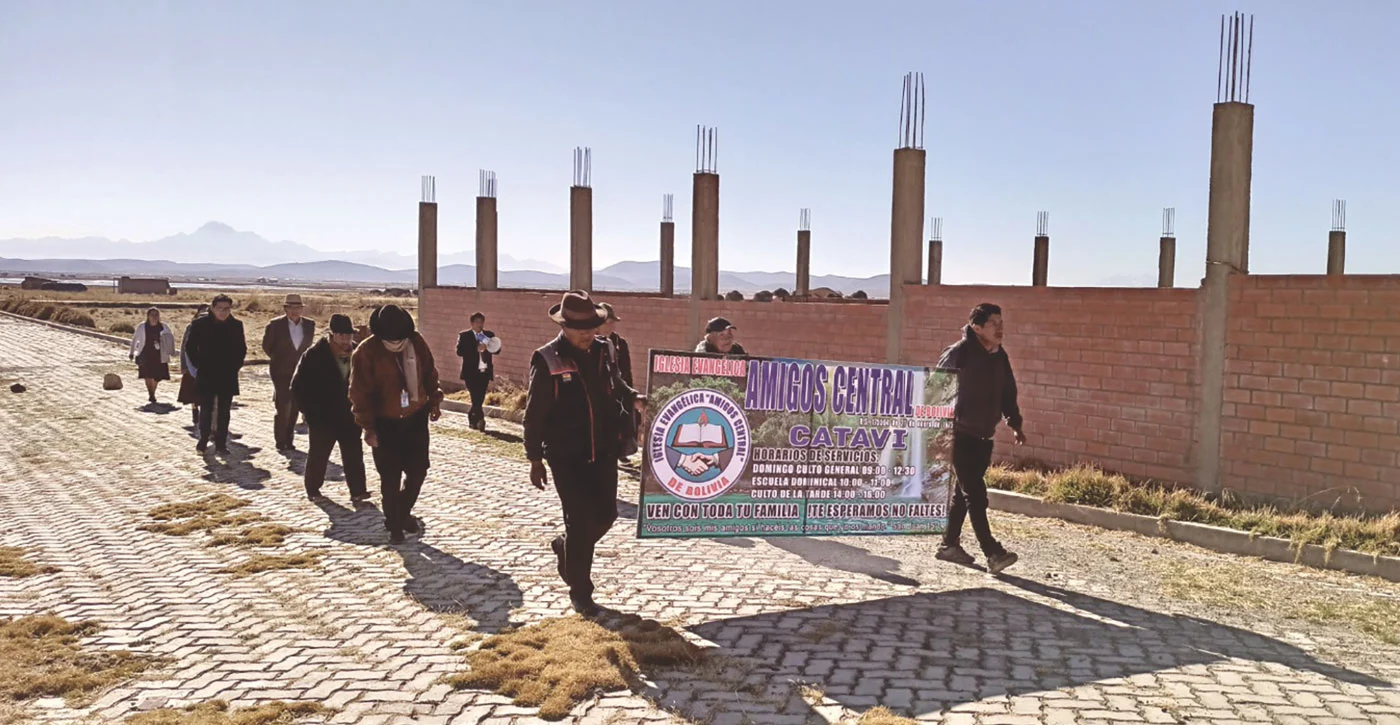
Regarding culture, our church seeks a balance between biblical teaching and respect for local customs. We recognize the importance of values such as solidarity and ayni, values that are compatible with Christian principles of mutual help and service. Community members recently collaborated in the construction of a local church in Catavi, located in the Andes Province in the Department of La Paz.
The history of the Evangelical Friends Church in Bolivia is the result of the faith, sacrifice, and obedience of men and women who responded to God’s call to preach the gospel. This legacy has its roots in the Quaker movement founded by George Fox, who taught the importance of living in obedience to the Word of God. His testimony inspired many to bring the message of salvation to different parts of the world.
Driven by the biblical mandate to go and make disciples of all nations, missionaries from the United States arrived in Bolivia with the purpose of preaching the gospel and establishing the church.


Left to right: Mattie Blount and Emma Morrow, the first missionaries in Bolivia, Sorata, Larecaja Province, 1919; the sisters dressed in traditional cholita attire, May 14, 1919; missionary Mary Barnard, in Coroico, Bolivia, 1928.
Beginning of Missionary Work (1919)
The presence of the church in Bolivia began in 1919, specifically with the arrival of the Central Friends Church of Bolivia. That year marked the beginning of the missionary phase, with missionaries arriving from the United States. This missionary work continued until 1975, covering approximately 56 years of labor and growth.
Subsequently, the period of the National Church began in 1975 and continues to the present. Last year marked the fiftieth anniversary of the national work, representing a significant stage of consolidation and development under its own leadership.
Adding both periods together, we affirm that the church—that is, the missionary work of Quakers—has been present for 107 years in Bolivia. In 2019, the centennial of the arrival of the gospel in the country was celebrated, commemorating 100 years since the Word of God was brought by missionaries from the United States.
It is also important to note that some local churches are approaching their ninety-eighth anniversary, such as the church in Coroico, which holds monthly meetings to commemorate its history.
The arrival of the missionaries is a highly significant event in the history of the Quaker Church in Bolivia. They came from the United States, moved by their conviction and by God’s call, with the purpose of preaching the gospel.
Their arrival was grounded in the Word of God, as written in Matthew 28:19: “Therefore go and make disciples of all nations” (New International Version). In obedience to this mandate, the missionaries came to proclaim the gospel to the people of Bolivia. Likewise, they obeyed what Scripture says in Acts 1:8: “You will be my witnesses in Jerusalem, and in all Judea and Samaria, and to the ends of the earth” (NIV).
We must also mention that the gospel spread through the Quakers, whose founder was George Fox, who lived from 1624 to 1691. His life left a profound impact, touching many souls and inspiring sincere spiritual reflection. It is said that on one occasion, Fox appeared before Judge Bennet in the city of Derby, where he declared that the judge ought to tremble before the Word of God. This statement was made with firm spiritual conviction; however, the judge, possibly with anger and mockery, called them “Quakers” (a term meaning “those who tremble”). Since then, this name has identified the movement, and it is still known by that designation in many congregations today.
Likewise, here in Bolivia, Fox’s life serves as an example to follow, especially for his courage, faithfulness to God, and commitment to the truth. His testimony inspires us to remain steadfast in faith and in preaching the gospel, following the call that God has made to His church.
Quakers established themselves mainly in the departments of La Paz and Beni, especially in the city of Riberalta, as well as in various communities of the Altiplano. Their missionary work developed extensively among Aymara communities, where they preached the gospel and strengthened the Christian faith.
The Quaker work in Bolivia began in 1919 in the town of Sorata in Larecaja Province. Sisters Mattie Blount and Emma Morrow, two young missionary women, decided to travel to this region of the Bolivian highlands to share the Word of God. Sorata is located approximately 150 kilometers from the capital, and it was there that they began their missionary work.
The missionaries were warmly received by the local inhabitants, who became the first Quaker Christians in the area. As a sign of appreciation and identification with the local culture, the people dressed the sisters in traditionalcholita attire, which included the pollera (skirt), the manta (shawl), and the hat. This gesture allowed the missionaries to integrate more fully into the community and build strong bonds with the first Quaker believers in Sorata. Thus began the expansion of the Quaker work in Bolivia, leaving a spiritual legacy that endures to this day.

Expansion to the Yungas (1928)
In 1928, missionary work expanded to the Yungas region, a warm-climate area located about 100 kilometers from the seat of government, La Paz. It was in this region that the Word of God began to spread, with the arrival of new missionaries committed to preaching the gospel, including Mary Barnard, who came to strengthen and build up the work in the town of Coroico.
Preaching the gospel in this region was not easy, as access was extremely difficult. The road connecting La Paz to the Yungas is now known as the “Death Road” due to its danger. At that time, missionaries had to travel from the Altiplano to the Yungas on foot, horseback, or mule, facing great challenges to reach their destination and fulfill their mission.
Young missionaries such as Paul Enyart also arrived, contributing to the strengthening of Quaker missionary work in Bolivia. He remained in the Yungas region working alongside other missionaries, thus consolidating the growth of the church.
In 1930 two Quaker missionaries were married in Bolivia for the first time, Paul Enyart and Mary Enyart. Through this union, their family continued supporting and strengthening the work of the Lord.
During that same decade, a mission building was constructed in Coroico with the help of local residents and the labor of local missionaries. This building was an admirable construction and still stands today, although with some modifications. It represents the effort, dedication, and commitment of the first Quaker missionaries in Bolivia.

Expansion to Eastern Bolivia (1950)
The work continued to expand. In 1950, missionaries Max Green and Lessi Green arrived in the city of Riberalta in the Department of Beni. They initiated and strengthened the Quaker work in eastern Bolivia, contributing to the growth and consolidation of the Evangelical Friends Church in Bolivia.
In 1951, a missionary couple, Walter Langton and Emma Langton, arrived to strengthen the work in the town of Coroico. They were a great blessing to the Quaker brothers and sisters in that region, contributing to the growth and strengthening of missionary work.
The missionary work in Bolivia was not easy, especially due to transportation difficulties. At that time, missionaries traveled by truck along the steep roads of the Yungas, facing numerous risks.
The testimonies of many Quaker brothers and sisters who lived in those places confirm that the missionary work was a great blessing to their families. We express our deep gratitude to the missionaries who came from the United States, obeying God’s call.


Friends working on infrastructure in the community of Quiripujo, Los Andes Province.


Left: Youth activity of Central Friends of Bolivia. Right: A meeting for worship.
The Church Today
Currently, the annual meeting of the Central Evangelical Friends Church in Bolivia continues the work and legacy left by our Quaker missionary brothers and sisters from the United States. The church now has 57 established congregations in different departments and provinces, especially in La Paz, Beni, Pando, and Oruro, always working in the Lord’s mission.
In 2025, the fiftieth anniversary of the national work was celebrated, an event of great significance for the church. Approximately 800 people participated in this gathering, including young adults and children from different monthly meetings.
These gatherings reflect the fruit of missionary efforts and the growth of the church in Bolivia. Through images and photographs, one can observe the unity, commitment, and faith of believers, who continue forward with the mission entrusted to them. From its beginnings in 1919 to the present day, the Evangelical Friends Church in Bolivia has journeyed for more than a century.
Thank you for these articles and pictures. My name is Joyce Furman. I am the granddaughter of Mattie Blount Marca. I came to the US with my Mother, Mary Calcina, when I was 1 year old. I am now 78 years old and I live in Kentucky with my husband Rodney. It is a blessing to see and read how the Bolivian QuackLibertyer and now Friends Evangelical Church had started and continues to grow in their ministry to the Aymara people..