




Fostering a Wisdom of Peace in Guatemala
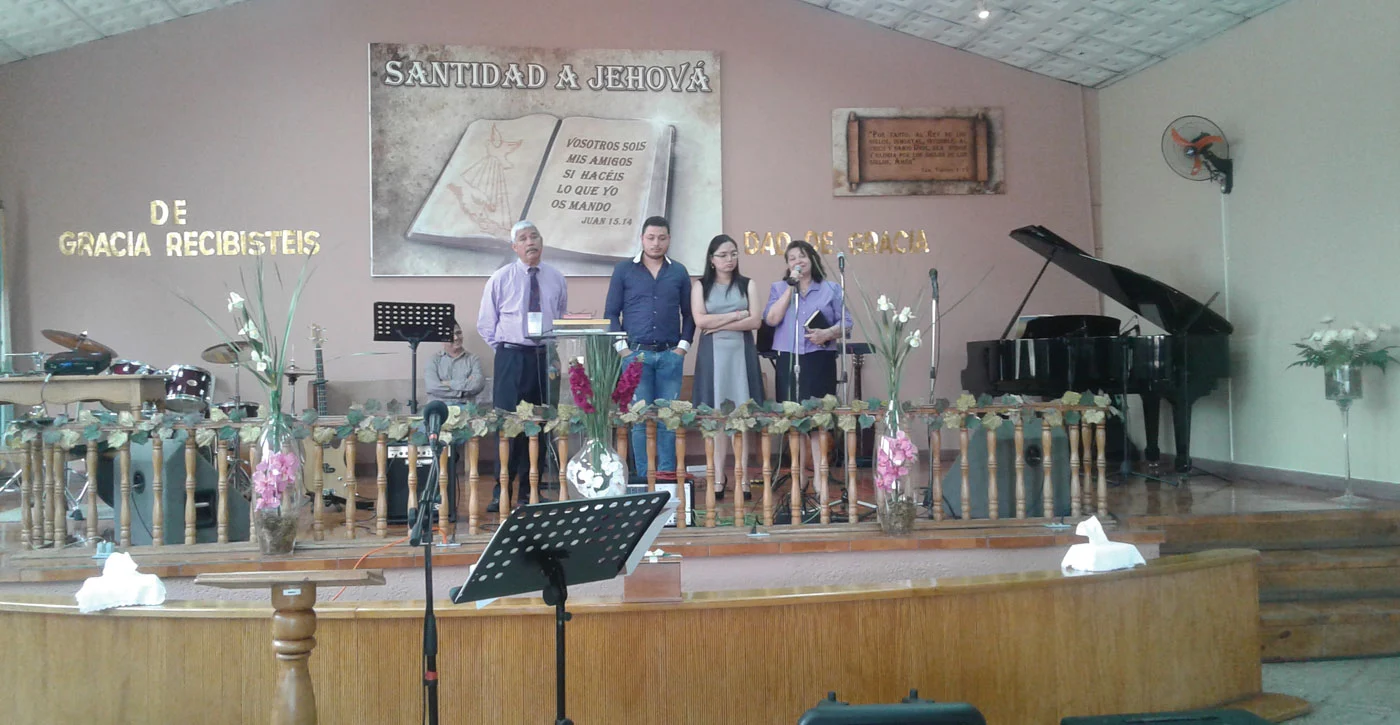
My name is Gustavo Adolfo Recinos. I’m a member of Friends Church in Guatemala City. I have belonged to my congregation for 40 years, and I believe that my contributions have been significant in helping establish a foundation of peace and harmony.
The analysis of my congregation’s situation begins with the recognition that we, as a church, have struggled to enter into a sphere of peace and concord. We cannot speak of peace and harmony while incidents of violence within the Lord’s Church still occur. These are manifested through verbal aggression, accusations, and defiance of authority, all of which reflect poorly on the church in the eyes of the general public. Yet who can refrain from expressing opinions when faced with such events? Although the church’s constitutional framework encourages reflection that will lead toward understanding and harmony, peace often remains little more than an ideal.
I joined the Friends Church in the 1980s, the harshest years of the military conflict that Guatemala experienced. While I cannot state this with certainty, I suspect that the historical context influenced the church to adopt a heated and confrontational tone. When I speak of violence, I refer to discussions that escalated into heated arguments and passionate exchanges, which created a tense and unpleasant atmosphere.
People’s feelings were hurt. Accusations were made in insolent tones, and confrontations often seemed to foreshadow something beyond mere disagreement. For a long time, I believed this environment could be explained by the church’s organizational model: when we are naturally inclined toward debate, we begin with disagreement and try to reach consensus. However, between disagreement and consensus there is much to navigate, and at times, we found ourselves floundering in a sea of fruitless arguments, which generated anxiety and took a heavy toll on the church’s spiritual health.
I also thought about the fact that the geographical center around which our church revolves is in the eastern region of Chiquimula, Zacapa, and Izabal, where people tend to have more forceful and aggressive temperaments. This might have contributed to our discussions inevitably ending in bitter disputes.
The peace accords that brought Guatemala’s armed conflict to an end were signed in 1996 during the administration of President Álvaro Arzú Irigoyen. He brought together the revolutionary forces of the URNG (Guatemalan National Revolutionary Unity) and the Guatemalan army. After many rounds of negotiation, they finally reached agreements that laid the foundation for a long-awaited peace. Hostilities had begun in 1957, leading to four decades of armed conflict and approximately 250,000 deaths.
It is worth mentioning that under the shadow of the civil war, other serious social problems emerged that later plunged society back into an atmosphere resembling war: drug trafficking, organized crime, and gangs. Even after peace was achieved, these forces continued to victimize Guatemalan society, creating a climate of fear and constant mourning.
Our justice system, led by the judiciary, the public prosecutor’s office, and the national police, has remained weak and deeply corrupt, which has resulted in an ongoing chain of events that has consistently shocked society with the outrage of institutionalized injustice. I’d like to believe that the church’s role is decisive and that it should influence society’s structure in a way that transforms it from its very core. Yet under these circumstances, I believe the opposite has occurred: evil permeated society so deeply that it eventually contaminated the heart of the church.
Amid these tangled disputes, many noble brothers and sisters experienced persecution within the church and eventually left, believing it was futile to try to change such an inflexible and harmful system. But as the saying goes, no trouble lasts forever. Gradually, we have arrived at a place where we have learned to be more reasonable and cautious in our contributions. Unfortunately, an entire generation had to pass away in the wilderness of anger, indifference, and pain before this transformation occurred.
Our governing structure has not changed significantly; the statutory framework remains intact. So what changed? I believe there were devout brothers and sisters who understood that their greatest contribution to the Church was prayer: constant intercession asking God to lead us into a new springtime in which understanding would prevail. Tentative steps toward reconciliation began to emerge at the beginning of the twenty-first century. New leaders appeared—some more educated than others—and despite differing opinions, this ultimately led us toward greater love and harmony.
Now I ask: what would have happened if we had begun with the Bible? When Jesus says in John 13:35 (all quotes New International Version), “By this everyone will know that you are my disciples, if you love one another,” the biblical foundation is unmistakable and would likely have led us down a very different path. I do not believe that the believers of that earlier era were less spiritual than we are today, nor do I think they were incapable of recognizing Scripture as an essential guide for daily church life.
I’m analyzing the historical background of my own church. I do not intend to generalize these conclusions for the entire Quaker world. However, if we look at Latin America, our historical circumstances have been remarkably similar. El Salvador experienced a civil war; Honduras, although it did not officially declare one, fought insurgent groups such as the Cinchoneros and also participated in the Nicaraguan Contra War during the 1980s. I will omit Nicaragua because, despite its civil conflict, we had virtually no Quaker presence there until recently. Similar stories could also be told about Bolivia, Peru, and other countries.
We must overcome historical paradigms and understand that secular circumstances should never determine the behavior of the church. Rather, the gentle, loving, and peaceful character of God’s people should gradually influence society, with the hope of leading others to Christ Jesus.
Only then will we possess our greatest advantage. Society thinks backward from humanity’s failures, whereas God’s people think forward toward humanity’s potential. Change begins with ourselves. There is an epitaph that says something like this: “I wanted to change the world, but I could not. Perhaps if I had begun by changing myself, then my family, and afterward my community, I might have succeeded.” And this is where I wish to focus this apologetics discussion by addressing several questions.
How do we come to the Church? Perhaps some of us fall into pride and assume that our importance within the Church should be measured by how much we can change its structure from the inside out. Yet we arrive without experience or spiritual maturity. Galatians 6:1 refers to “you who are spiritual,” implying a maturity that none of us possesses at the beginning. Spiritual growth resembles wine: it requires time to mature.
Scripture also warns about appointing novices. In 1 Timothy 3:6–7, we read: “He must not be a recent convert, or he may become conceited and fall under the same judgment as the devil. He must also have a good reputation with outsiders, so that he will not fall into disgrace and into the devil’s trap.” Yet, there is no formal induction process. No one tells us to wait patiently, to learn first. And what should we learn? We should learn to pray, read Scripture, meditate upon it, practice mercy, understand grace, forgive ourselves, and initiate a process of internal cleansing before we begin to contaminate others.
Although discipleship is expected to accomplish this, reality often proves otherwise. Mentoring should be personal and intentional, much like the relationship between Greek philosophers and their students. Over time, such careful guidance produces a refined and well-formed disciple. Some people arrive impressing the church with their talents or academic credentials. As a result, they are sometimes appointed to leadership positions before they are truly prepared: physically, mentally, or spiritually.
Why must people be physically prepared? Because the work of the Lord is demanding. Those unaccustomed to such responsibilities may become exhausted, discouraged, or ineffective. Ministry requires strength and perseverance. Why must people be mentally prepared? Leaders must possess emotional stability as well as intellectual maturity. Under pressure, unresolved emotional weaknesses often emerge, causing leaders to become irritable, withdrawn, inflexible, or authoritarian as a form of self-protection.
Why must people be prepared spiritually? This is the decisive issue. Without spiritual maturity, we should not expect someone hastily placed into leadership to produce the calm and wisdom that arise from an intimate relationship with God—the Father, the Son, and the Holy Spirit. Sometimes we undervalue the Father’s role and fail to learn from Him stewardship, respect, and authority. Many people reduce the Holy Spirit to an impersonal force that powers the worn-out machinery of the Church. Nothing could be further from the truth. The Holy Spirit is a person—gentle, harmonious, and compassionate—who does not merely surround us but dwells within us and should be central to our spiritual growth.
And what of the Son? The New Testament presents Him so close to us that we sometimes begin to treat Him like a servant expected to fulfill all our requests. As the influential non-Quaker Argentine pastor Juan Carlos Ortiz once observed, our prayers can become like shopping carts, and we unconsciously expect Jesus to satisfy every desire while overlooking His primary role as our Redeemer.
Renewing the way we educate believers within the Church would make us wiser and more spiritually discerning. Such wisdom would not arise from speculation or human reasoning but from living in harmony with the King of Kings and Lord of Lords, before whom every knee—including our own—will one day bow. We must remember that the institution we serve has endured for more than two thousand years. It is a mold that no one has been able to reshape because it offers grace, faith, hope, love, and instruction. “Go into all the world and preach the gospel to all creation” (Mark 16:15).
The Church was not established to be changed or redesigned; it was established to be obeyed, regardless of our personal opinions. It does not operate according to the standards of a corporation. It is not negotiable; it is an inviolable standard. Its development is inherent in its nature and stands above us. It was not designed to satisfy our preferences but to instruct us—and at times to discipline us. It should be loved like the anvil upon which red-hot iron is forged through repeated blows, becoming both refined and immensely useful.

We want to hear from you, not an AI! Please be thoughtful and use your own words. Comments on Friendsjournal.org may be used in the Forum of the print magazine and may be edited for length and clarity.