



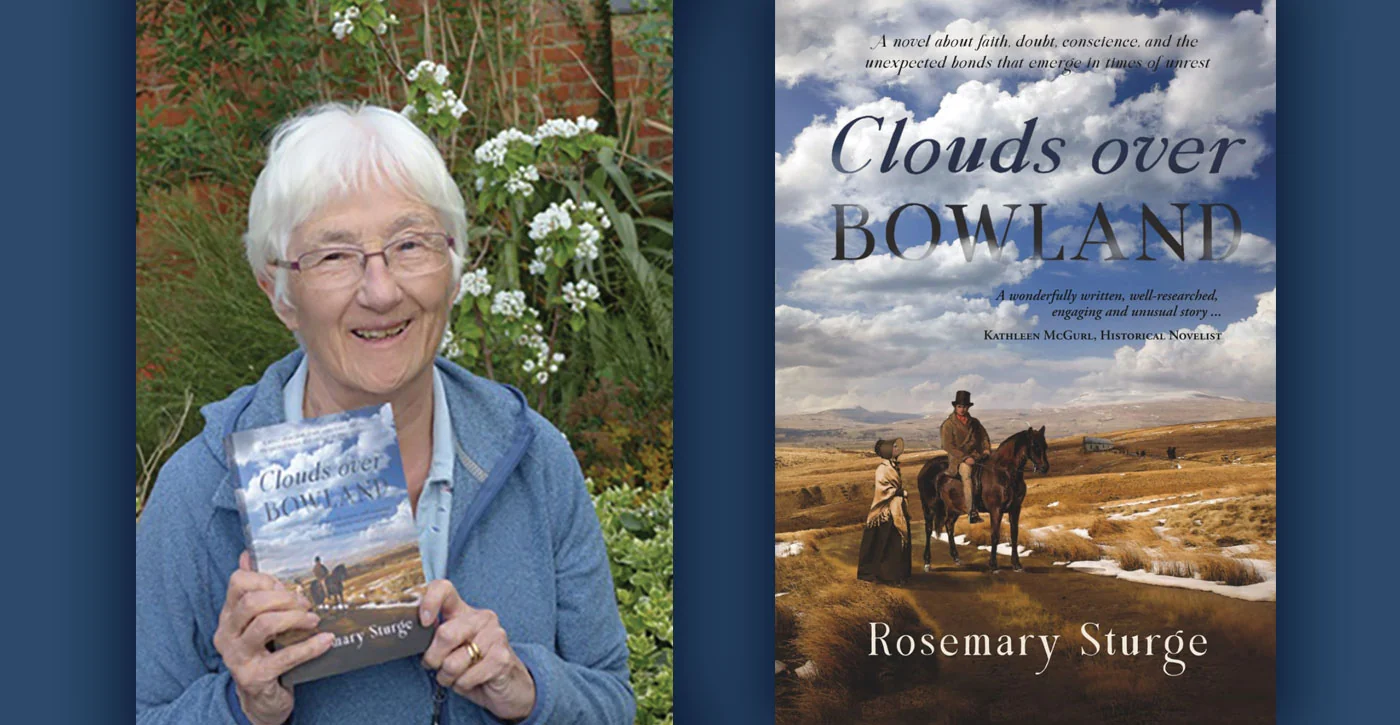
An Interview with Historical Fiction Author Rosemary Sturge
British Quaker Rosemary Sturge, who worships with Northampton Meeting in the English Midlands, has written many historical mystery novels. Her latest work, Clouds Over Bowland, focuses in part on a character named Dorcas, the young adult daughter of a Quaker farming family in an English town where French prisoners of war are held at the end of the Napoleonic Wars.
Sharlee DiMenichi: Please tell me about the decision to tell part of the story in Clouds Over Bowland using Dorcas’s journal entries.
Rosemary Sturge: I grew up in a Quaker family. I lived in an area which we call the 1652 country because it’s where George Fox met up with Margaret Fell and lots of other people were attracted to the Quaker movement. We knew quite a lot about Quaker history, and this journal keeping was something people of all ages were encouraged to do and still do today. And it just seemed to me that this was a way of presenting this young woman by her doing something. She’s really using it as a diary of her hopes and thoughts, and commenting on things that are happening. Dorcas is really writing a diary of her everyday life, not all that spiritual.
SD: What inspired you to write about French prisoners of war during the Napoleonic Wars?
RS: In 1814—the year the book takes place—the Napoleonic Wars were ending, but there were still lots of prisoners on both sides. I thought it would be interesting for people to imagine what might happen. I have absolutely no evidence of local Quakers in that area being involved with the prisoners, but they were beginning to be very interested in prison conditions. Elizabeth Fry was active about that time. She was in London, but she was beginning to concern herself with the conditions in prisons generally. I brought this concern into the story, but it is quite imaginary. I haven’t been able to find out a lot about any getting together between Quakers and French prisoners. I believe they did go to visit them on ships in Bristol Harbor to see that they had all the necessities of life.In the beginning of Quakerism, there was quite a lot of noisy turmoil, enthusiasm, and preaching on the street corners. But then we went into what’s called the Quietist period when people still wore the Quaker dress. They met to worship on Sunday and sometimes other days of the week as well. But they didn’t engage with society anymore. They lived quietly in their own homes in communities. Local people believe that parties of prisoners were taken out to repair stone walls, as happens in the book.
SD: How did the character of Hugh Armstrong evolve during the process of creating him?
RS: I wanted somebody who came in as an outsider, didn’t know the local people, and didn’t know anything about Quakers. I brought him down from Scotland and set him in this area, which I know quite well. I didn’t live in Bowland, but I knew people who did, and so I could picture what it would be like.
SD: And what inspired you to make Dorcas, rather than her twin, Susannah, a protagonist?
RS: Hugh had his problems. He had physical problems. He had problems that began in his childhood. You need a slightly awkward girl for him to get to know and for them to realize how much they like each other. It’s nice for Dorcas to tell her side of the story. Susannah’s getting it quite easily because she’s very pretty, and she already has an admirer who’s a very suitable person for her to marry.
SD: What motivated you to center the story on Quakers, and could you talk more about the vantage point of someone from the outside who is meeting Quakers for the first time?
RS: That was partly the reason for creating Hugh. He is somebody who comes from outside and is completely baffled by these people, particularly things like silent worship. His experiences of religious life had been very different, and so he is meeting some people who are completely different from what he would have expected, and I just wanted to acknowledge the Quakers in the district. There still are a few Quaker families living in Bowland but not very many these days.
SD: What is a typical writing day like for you?
RS: I’m not very organized. I have spells of doing quite a lot of writing. That’s probably because I’m now retired, and when I retired, I was determined I was going to write because I’d always wanted to. I took a university course in creative writing, and this wasn’t my first book. I like to look at periods of history to see how they were similar to our own times or how they were different and find out about them. I enjoy doing the research.
SD: That brings me to my next question: How would you describe the process of researching Clouds Over Bowland?
RS: This particular book is talking about the area where I grew up, or really close to where I grew up, so I already knew a lot about the Quaker history. When I was growing up, I knew someone who was very elderly that Quakers in America might remember, a Quaker lady called Elfrida Vipont. She was very knowledgeable, and she talked to us as youngsters about Quaker history. She organized a worldwide Quaker pilgrimage to 1652 country, and many Friends from the United States attended. So a lot of that was already in my brain. I obviously had to research some other things. You can’t rely on the Internet to tell you everything because they don’t always get it right. But they can certainly help you a lot. And I wrote quite a lot of this during the COVID time.
SD: What are some of your most vivid memories of growing up in the region where the book takes place?RS: They were vivid, or I wouldn’t have written. The description of the farm and having a meal in the farm with the families is one that is just very beautiful. It’s not as popular as the English Lake District. It’s just south of the English Lake District, so it doesn’t get overcrowded. Life has not changed as much there as in other parts. It’s not industrialized, and the countryside is beautiful. It was very vivid in my memory, and I enjoyed writing about it.
We want to hear from you, not an AI! Please be thoughtful and use your own words. Comments on Friendsjournal.org may be used in the Forum of the print magazine and may be edited for length and clarity.