




Supporting Gifts and Leadings in Our Meeting Community
Earlier this year, in a meeting with my small spiritual accountability group, I found myself dipping into an unexpectedly tender topic. Usually these meetings are simple: I share what I’ve been up to in my witness in the world—mostly writing and speaking—and they offer thoughtful appreciation and some insightful feedback. I leave feeling enormously supported. What a gift! This time, however, I found myself mentioning the knotty situation faced by an organizing group where I had served as a central member for years. We had the prospect of finally being able to engage with a key community in the city, but taking that step risked alienating another group that is painfully easy to leave out. I wanted the engagement but not the alienation.
They lingered with me on this one, probing and wondering. One woman reminded me of the importance of following my heart. With that single new point of clarity, I was able to return to my working group and invite them to share what was on all our hearts—so I could share mine. We took the next step with the leadership of the man I most wanted to follow. I reported this news back to my accountability group, thanking them for holding me in this tender place and reminding me to keep my heart in the center. It was so simple yet so profound.
Much of what is needed to support our own individual gifts and leadings can be provided by an active and connected community. As we learn about and embrace each other’s gifts and leadings more fully and openly, our support can naturally increase, without the requirement of formal corporate recognition.
My mind goes back to the origin story of this experience: the working group that Central Philadelphia (Pa.) Meeting created in 2003 tasked with creating a framework for supporting gifts and leadings in our community. How might we enrich the life of the meeting, the three of us in this group asked ourselves, so that everybody could find a way to engage with the question of how to better discern their gifts, follow their leadings, and grow more fully into their ministries?
Over the previous decade, our meeting had developed a system for supporting a handful of members who had been formally recognized as ministers. We’ve had individual ministries with a variety of focuses: making the Religious Society of Friends more welcoming to People of Color, Quaker decision making and clerking, fair trade, hearing voices and healing, radical action for peacemakers, centering love and respect, and twenty-first-century Quaker media outreach. We’ve developed a robust process for naming ministries, offering spiritual and sometimes financial support, and receiving reports. I believe we can be proud of the work we’ve done to build such a system. We maintain it with care and attention, the ministers and the ministries both benefit, and the impacts ripple out far beyond our meeting. But recognition from the meeting as a minister is a high bar. What about everybody else?
In theory, much of what is needed to support our own individual gifts and leadings can be provided by an active and connected community. As we learn about and embrace each other’s gifts and leadings more fully and openly, our support can naturally increase, without the requirement of formal corporate recognition.

Our little group wondered and imagined how we might encourage such mutual support in our community. Many of us are new to, and awkward with, conversation on this level. Though there may be much in our hearts, the words do not come readily to our lips. While our goal is a community where sharing about leadings and ministry is as natural as breathing, we might need to set up explicit opportunities to practice. We might choose to have the “news of ourselves and others” part of meeting for business explicitly include news relating to gifts and leadings. We might encourage the question “How does Truth prosper with thee?” as an appropriate greeting at our fellowship hour after worship, or perhaps have tables where it could be the designated topic of conversation. We might offer questions about discernment and faithfulness as topics for small group (“Friendly Eights”) dinners, or there might be other corporate opportunities for acknowledgment of the gifts in our midst and the fruits of the Spirit among us.
We could encourage the formation of small groups for support and testing of gifts, leadings, and ministries. In taking such steps toward faithfulness, we would develop our skills in discernment. And the process of receiving support could generate the energy for giving it to others.
We might encourage more acknowledgement of individual gifts and ministries at meeting for business. There is much to be thankful for in the way the work of the Spirit is manifested in our community. When a specific contribution of a recognized minister is being noted in meeting for business, it can be an occasion to say: “There are these—and others that we don’t even know about . . . and we are grateful.” Though we must ultimately live in a deep faith that there is much we will never know, to the extent that we learn of each other’s gifts and ministry, we are enriched both individually and corporately. It creates possibilities, reminds us that we are not alone, and calls us to notice our mutuality as a community.
Building on all these conversations, our working group brought a proposal to the meeting in 2004 that incorporated formal support for that handful of named ministers, plus informal support for everybody else, all under the care of a new Committee on Gifts and Leadings. Fifteen years later and finally a member of that committee for the first time, I saw that the second part of the charge was still underdeveloped. We noted a suggestion; “there may be an occasion when it is appropriate to have a period of worship sharing where people can offer up their ministries that may never appear on the agenda of meeting for business, but enrich our community life through individual faithfulness.” In response, we held a workshop in late 2019 on Naming and Celebrating Our Gifts.
The role of support for gifts and leadings among members of our community can be seen in terms of a nesting layer of relationships: the individual’s relationship with Spirit; the relationship among the individual, their spiritual accountability group, and Spirit; and the relationship among the individual, the group, the committee, and the meeting as a whole.
We started by noting that we’re all one body but many parts. All of us have gifts. As we name and celebrate our gifts, they are more available to all of us, and we are richer. After an activity that got us moving around and making contact with others, we invited an initial naming of gifts. We reflected for a minute, then people called out, “I would like to celebrate ‘X’ for their gift of ‘Y,’” and one of us wrote both the name and the gift on a big sheet of butcher paper.
We offered queries for individual reflection: Do you have gifts that you can name with ease? How do you feel about having or naming these gifts? Is it different depending on the gift? What makes it hard to notice other gifts you may have? This was followed by queries in small groups: What is easy/hard about recognizing and naming other people’s gifts? Are there people whose gifts you are curious about? How might you satisfy that curiosity? Is it harder to think of certain kinds of gifts than others (i.e., spoken ministry as compared to hospitality)? Are there potential traps in naming gifts? How might they be avoided? What would allow us as a group to better name and celebrate gifts? What difference might that make for our community?
Back together, we asked people to use sticky notes to add additional people and their gifts to what we already had, and closed with group reflection and worship sharing. It was a rich and truly celebratory time.
Since then, our committee has continued to attend to the ministries, now just three in total, of members that are under the formal care of the meeting: receiving regular updates via our committee liaisons, ensuring that their spiritual accountability groups are playing a supportive role, and meeting with them yearly in preparation for a presentation to meeting for business.
We have also been actively encouraging small groups for clearness, discernment, accountability, and/or support to gather around people who are exploring their own leadings. The issues are diverse: applying values to financial planning, naming land and tree care as art, supporting people with learning differences, using writing gifts in service to Quakerism, accompanying veterans in trauma healing, shining a light on the foster system, and supporting Friends in Russia.
Support for these community members’ gifts and leadings has taken a variety of forms. The most common is a group of two or three people who meet regularly with a person for ongoing discernment and support, often called “a spiritual accountability group.” But there are others.
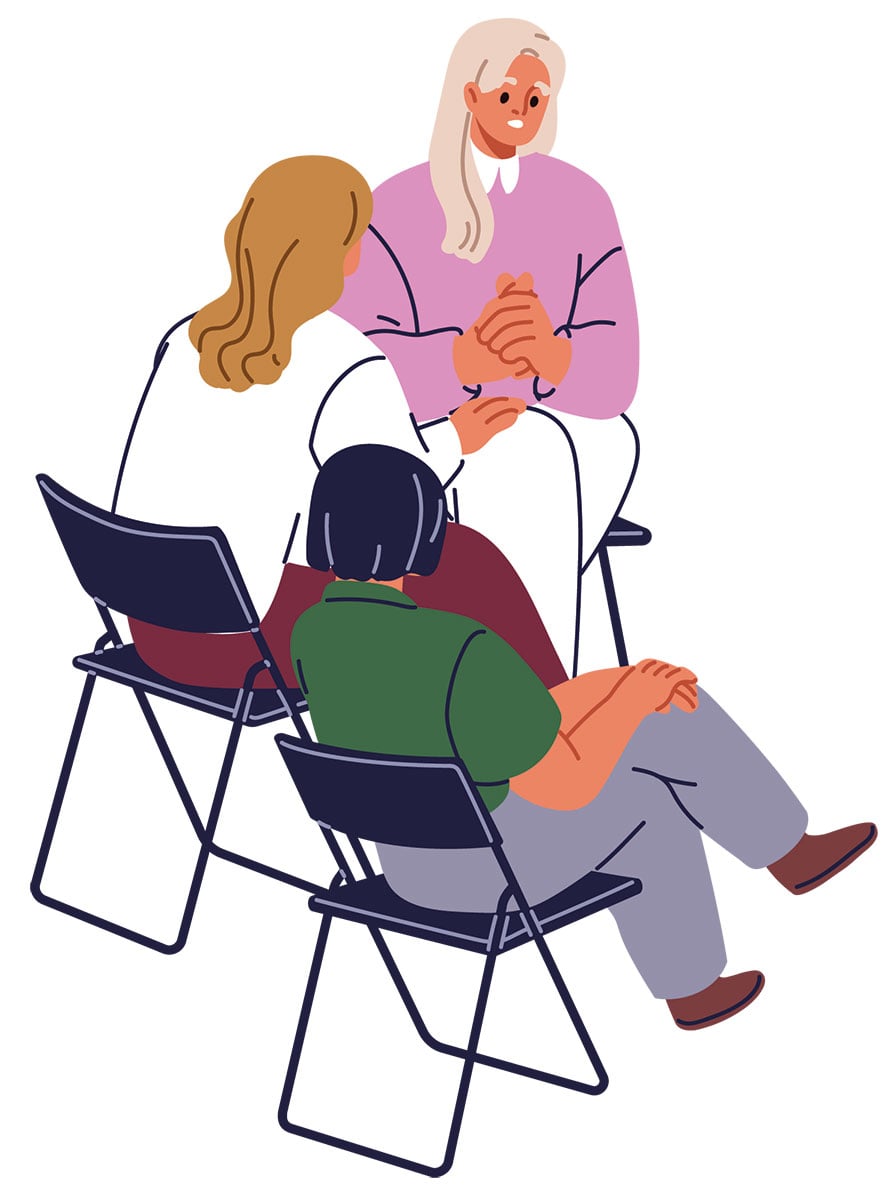
A group that has been meeting for many years with one member whose ministry was once under the formal care of the meeting has transitioned to an occasional accompaniment group. We responded to a request from a seasoned Friend with a well-established social justice ministry to check in with him once or twice a year as a way of maintaining his accountability to the meeting. We set up a group of three people on an email thread with a longtime member to receive occasional updates and remind her of their support. Two members of the committee are in touch with a member who has been less present, staying alert for a possible expanded role in supporting her and her ministry. One woman asked for clearness around a work-related ministry, and after several meetings, she was clear to initiate a mutual support group for those in the meeting doing similar work.
Our committee has also held several programs for the entire meeting. At each of them, three community members—whom others might not know that well—get to share about a way they are led in their lives. These have been deeply centered and much appreciated opportunities, offering windows into the richness and diversity of gifts and leadings that are present in our community.
The role of support for gifts and leadings among members of our community can be seen in terms of a nesting layer of relationships: the individual’s relationship with Spirit; the relationship among the individual, their spiritual accountability group, and Spirit; and the relationship among the individual, the group, the committee, and the meeting as a whole. Our committee gets to support right relationship and accountability in many ways in this process: recognizing and building on what is working well, noticing where friction might impede attention to Spirit in any of these layers, and identifying ways to help realign the process.
I think back to that moment in my own accountability group, when I was called to lay strategy aside and listen to my heart: how I was able to act on that new clarity, standing on a surer foundation.
What kind of difference does all this attention to gifts and leadings make? I don’t know for sure. But I do know that I love serving on this committee. I love receiving a request for support and thinking together about who might be blessed to serve on a discernment or spiritual accountability group with that person. I love the point in our agenda when we pause and hold our community in the Light, listening for a name that might rise to the surface as someone whose unstated gifts or leadings we might better hold. Last time the name of one person came to two of us at the same moment.
Recently, a 30-something attender with deep roots in Quakerism reached out for support with her job running an anti-hunger coalition in one of the suburban Philadelphia counties. Nobody in the community knew her well; most members were stretched with different commitments; and it was unclear how our committee would assemble yet another discernment/support group. As we were considering, an attender who had expressed interest in our Gifts and Leadings Committee offered to serve. The name of another attender, who was in the process of applying for membership was suggested. She had experience running a social-service project and, despite expecting a baby, said yes. Now we just needed an experienced meeting member to provide more ballast. I felt a connection to all three of them and was drawn to serve but already had a full plate and was lovingly counseled against overextending.
As others who were approached declined, I kept thinking what a joy it would be to have a chance for intimate sharing with these three young women, and I offered. Our first meeting was, indeed, a joy. We got to learn about the extraordinarily good work this woman was doing. The other two asked deep and searching questions, and she felt held in a way she was longing for. The others felt connected, valued, and drawn closer into the community. By being present to this woman, we had joined those who care about the hungry in this country: a gift to all of us. I felt moved and blessed by the opportunity to build these relationships. What better way could I possibly have used that time?
Others in the meeting have had similarly rich experiences with Friends whose passion and leadings take different directions: supporting children with challenges in the classroom, bringing financial empowerment to the Latina community, strengthening the spiritual foundation of Quakerism, and seeking to shift a life emphasis from career to vocation.

I think of a sentence from our original working group’s report to the meeting: “Drawing out each other’s faithfulness is the heart and soul of the ministry of all believers.” I think back to that moment in my own accountability group, when I was called to lay strategy aside and listen to my heart: how I was able to act on that new clarity, standing on a surer foundation. I reflect on that experience—multiplied who knows how many times in all the little groups, formal and informal, that have proliferated in our meeting over the years—and can only imagine what power has been unleashed as a result.
We want to hear from you, not an AI! Please be thoughtful and use your own words. Comments on Friendsjournal.org may be used in the Forum of the print magazine and may be edited for length and clarity.