



Silence and the Possibility of Radical Love
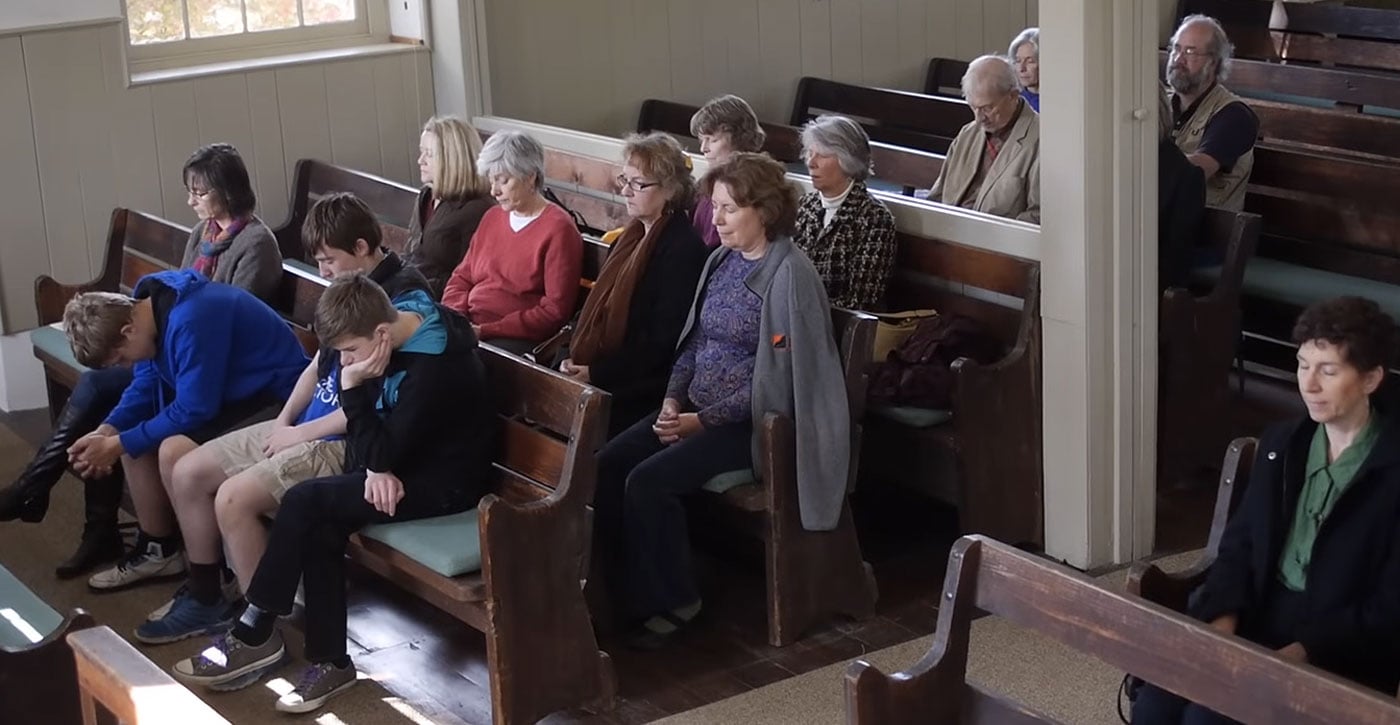
Five days a week, one can enter a red door on the bustling boulevard of St. Giles Street in Oxford, England, to find a room full of people sitting in silence. Much like the rings of rippling water, wooden chairs are placed around a table at the room’s center, on which one might find various translations of the Bible, a red-covered copy of Quaker Faith and Practice, and a glass cup filled with cuttings from the adjacent garden.
The first time I entered that door was on a Sunday in December the year I transplanted my life from America to England. What had compelled me to come to the meetinghouse was intuition: the sense that silence—what the Quakers are commonly known for—could appease the noise in my head.
I had never associated prayer with sound until, sitting in the silence, I realized that language had been integral to my Catholic upbringing. My family became Catholic some years after we left Seoul for Hong Kong; I must’ve been around eight by the time we started attending church, which we joined primarily because my mother sought a Korean-speaking community. So perhaps it wasn’t surprising that we came to faith with the constant reminder of how our words determined not only who we were and what we believed but also where we could belong.
But in the meetinghouse, things were different. Where I had once heard a priest talking, a gong ringing, or the electric piano clunking a familiar tune, the only sounds I could hear were bells chiming from a nearby church, the occasional chirp of a bird, or people coughing or shifting in their seats. In my attempts to pull spiritual language from these experiences, a mundaneness spun itself into all manner of symbols: perhaps the church bells represented the Spirit of God; the birds, the grace of nature; our little noises, that of human fallibility, a reminder of life and mortality and all the big questions often associated with the spiritual journey.
Was this prayer? All I could do was try to mimic what those around me were doing—closing their eyes and holding their palms facing upwards on their laps—and seek in the silence what I had been taught to “gain” and “absorb” in a churchlike setting. But even in my days of programmed worship at the Korean Catholic Church of Hong Kong, I had always felt a little stuck; I had never been fluent in biblical Korean and struggled to follow the homily. I found myself distracted instead. That Sunday, with the Quakers, there were no words to follow and only the silence, which both moved and unnerved me. If there was something it was trying to teach me, then what was the lesson? And even if I did unlock its meaning, how was I meant to respond?
It may appear ironic that I was exploring the relationship between faith and language at a Quaker meeting, where worship is, for the most part, wordless. During my first meeting, I didn’t know what to do with the silence or how to know if what I received came from beyond me. Later, one woman would tell me that she visualized a silent mind as having two doors on opposite sides. “Keep both open at all times,” she explained. “Let everything come in, but if something does not serve you, gently allow it to leave.” In Quaker Faith and Practice, the workings of silent worship are described not via prescriptions but in anecdotes. To one person, silence appeared as a spark; to another, a force that successfully gathered a motley group of people; and to yet another, as a process of tripping through his mind’s mundaneness until a still, quiet voice emerged.
After that first meeting, I decided to return, if not for the balm that quiet offered my hurried mind, then for the curious fact that no one asked me what I believed. Though I knew that Quakerism fell within the purview of Christianity, the word “God” was not one I heard frequently that day; rather, it appeared that faith was a shared but nevertheless a private venture, a common path that people walked at varying paces. This openness consoled the part of me whose faith had been assailed by questions of belonging for years.
It was also liberating to consider that silence is not unique to Quakerism, just as the concept of grammar does not belong to a specific language. Rather, silence is a structure that shares an intent—that of reaching towards the Divine—but takes different forms not only across distinct religions but within each tradition as well. In the Christian monastic tradition, for example, the Rule of St. Benedict encourages silence among monks as a means of practicing humility and avoiding evil. When the English travel writer Patrick Leigh Fermor arrived at a Benedictine abbey in Normandy to write a book on monastic conditions, he could not fathom how the monks could thrive in such quiet. After an adjustment period that he likens to a purge in his 1953 book A Time to Keep Silence, he eventually came to recognize the gift of the monks’ self-emptying practice: how it connected them more deeply to one another and the world than talk ever could.
After all, though silence is personal, it is also universal. We all know what it sounds and feels like. To imagine the world’s silences, then, is to explore the possibility that we can always reach one another through a common language. From a biblical perspective, I wonder if silence is the spiritual equivalent of the Tower of Babel, had it not fallen. But to describe silence as a form of language can feel as sacrilegious as the tower-builders’ task, as if I am tethering to the ground something that is supposed to be heaven-bound.
What I can testify is that for me, silence in a worshipful setting develops meaning in its ability to unite seemingly disparate lives. It helps me realize, as Quaker Thomas Kelly once described, how “our separate lives were all one life, within whom we live and move and have our being.” In addition to much else, maybe that’s what faith is when represented in silence: the possibility of radical unity.
Or, one could argue, the possibility of radical love.
If to love is to open room in ourselves for somebody else’s presence, such that their plight becomes our plight, their joy our joy, then to love radically might entail a similarly radical departure from our own limited views into a realm of common humanity. Even when my sense of religiosity waned during a period of agnostic theism between my Catholicism and Quakerism, the most abiding arguments for faith that kept me tethered to it came from testimonies by people who argued that the central mission of faith is one of letting go of the self: how I might find, in encountering the great mystery of God, an erasure of all the selfhoods that can trip me up. I may never be able to leave myself and the messiness of my lingo and skin color; I will always carry my subjective truth with me. But if I can set parts of myself aside to make room for something else—be it God, a sense of civic duty, or a feeling of unity with the natural world—then I can become a participant in an attentive act that philosophers like Simone Weil and Iris Murdoch have taught me to consider a form of prayer.
I find this approach to faith and prayer remarkably freeing. It teaches me to rest the ”ors” and ”buts” of my identity and embrace the ”ands.” My faith can absorb the misunderstood homilies as much as the long hours of silence on St. Giles Street; the loud piano in addition to the whispering trees; Korea, Hong Kong, America, and England; my Catholicism, agnosticism, Quakerism, and possibly other spiritual paths that I have not yet explored.
That first Sunday, I sat in silence with a room full of others knowing very little about what it meant to hear God’s voice. If anything, any dialogue I encountered was between myself and my mind, which chattered with the anxieties I had discussed at length in conversations with friends that week, friends who had bid me clarity and patience as I navigated my move to England.
Clarity. Patience.
In the unforgiving intensity of that first silence, I realized that I did not actually know what these words meant. As they ceased to hold meaning to me, my thoughts slowing down and heart quickening its beat, I had the distinct sense that I had received something that originated from beyond myself. This might be it, I thought, what Quakers called “ministry.” But before I could interrogate that thought further, I surprised myself: I was already standing up in that room full of strangers who would later become friends, and I was opening my mouth to speak.

Loved this testimony. Sometimes you just have to be still to hear the voice of GMenifeod.