



Quakers in Costa Rica Support Asylum Seekers Deported by Trump
This article was originally published online on Dec. 5 and republished in the Feb. 2026 print edition.
Over the past 11 months, the Trump administration has mounted an aggressive attack on immigrant communities in the United States. We have witnessed an unprecedented targeting of immigrants at workplaces, at homes, in courts, and on the streets. The immigrant detention machine is making immense profits from detaining more people for longer periods of time, with the budget for immigration detention increasing by $45 billion over the next three years. Meanwhile Immigration and Customs Enforcement (ICE) is using commercial and military planes to deport thousands.
The administration has also taken advantage of a rarely used aspect of immigration law to escalate “third-country deportations” in which migrants are sent to countries other than their homelands. In March 2025, this practice made headlines when Trump sent over 200 Venezuelans to El Salvador, where they were imprisoned in CECOT, a maximum security prison designed to hold gang members. But these were not Trump’s first third-country removals to Central America. On February 12, 2025, 360 people were sent on military planes to Panama. And on February 20 and 25, 2025, two planeloads of migrant families, most from Eastern Europe and Central Asia—including 81 children—were sent to Costa Rica.
None of the families sent to Costa Rica spoke Spanish, and many had no idea where the country was. Most were expelled without signing papers authorizing their removal, and U.S. immigration officials did not tell them where they were being sent. Upon their arrival in Costa Rica, these families were driven to CATEM, a remote facility on the border with Panama, a former pencil factory that was converted into a shelter for migrants. With their arrival, it became a prison. Costa Rican authorities kept their passports and travel documents, and the families could only leave CATEM to go to the grocery store with a police escort.
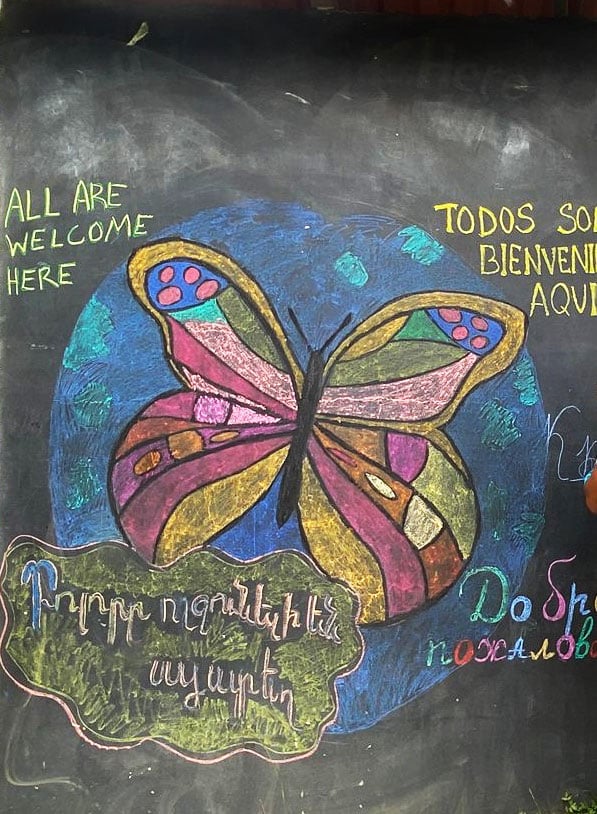

Left: A mural at the Monteverde Community Center created by the Monteverde Friends Meeting youth meeting and the migrant families. Right: Welcome signs in English, Spanish, Russian, and Armenian.
When they heard this news, members of Monteverde Friends Meeting (MFM) were shocked. MFM was first established in the mountains of Costa Rica in the early 1950s by families from Fairhope (Ala.) Meeting and other meetings whose young men had been sentenced to prison for refusing the draft. The Peace and Social Concerns Committee of MFM has long been active in supporting migrant communities. In recent years, they have made regular trips, driving four hours north to the town of Los Chiles (near the Costa Rican border with Nicaragua) to take donations of food, clothing, and other necessities to those transiting through the region. On a recent trip in February 2025, they noticed that the situation of people moving through the area had begun to change drastically since Trump took office just a few weeks earlier, with more individuals returning south than traveling north toward the U.S. border.
From this deeply rooted concern for migrants, members of MFM felt called to take action in support of the families deported to Costa Rica. On March 5, 2025, the meeting issued a public statement urging the Costa Rican government to uphold the human rights of these families and treat them with dignity and respect. In this statement, they joined other organizations in calling on the government to share information about the treatment these families were receiving, asking whether they were receiving medical care and legal support, and inquiring pointedly into the freedom of movement they were being allowed.
Thanks to this public pressure for greater transparency, in April, Marcia Aguiluz Soto, the regional director of Latin America and the Caribbean for American Friends Service Committee (AFSC), was able to visit CATEM with two partner organizations: Jesuit Service for Migrants Costa Rica (SJM-CR) and the Center for Justice and International Law (CEJIL). They met the families there and heard their stories, exchanging phone numbers so that they could continue to support families from a distance. They spoke with a Russian dissident who had to escape with his wife and six-year-old son after being caught working to document fraud in the 2024 presidential election. They also spoke to an Azerbaijani publicist who ran afoul of authorities for accepting a contract from the political opposition and had to flee the country with his wife and their six-year-old daughter.
Like these two men, most of those deported had planned to request religious or political asylum in the United States, where many of them also had close relatives including spouses and children. In the past, asylum seekers entering the United States were granted an initial hearing to determine whether they had a “credible fear” of persecution that could be the basis of an asylum claim. Now, Trump’s inaugural proclamation “Guaranteeing the States Protection Against Invasion,” in which migrants are described as “Aliens Invading the United States,” is systematically being used to deny asylum seekers the due process rights they are entitled to under U.S. and international law. The families sent to Costa Rica were never granted the opportunity to present their cases in a hearing of any kind. Instead, after being held in facilities where they suffered freezing temperatures and limited food, they were forcibly removed and sent to a country they had never imagined going to. As the Azerbaijani father testified in Revista Dominical (“Sunday Magazine,” a publication in Costa Rica): “I had never heard of Costa Rica and I didn’t want to go there. But they shackled us, hands and feet, and forced us to get on the plane.”
Listening to these stories and learning about this mistreatment left Marcia and her colleagues feeling outraged and wanting to fight for the rights of these families in the face of the mistreatment they had received at the hands of both U.S. and Costa Rican authorities. They pressured the Costa Rican government to return people’s travel documents and let them leave CATEM if they wished to. When a local journalist, Mauricio Herrera, decided to submit a habeas corpus petition on behalf of the families, AFSC joined as a co-petitioner alongside SJM-CR and CEJIL. They asked the Costa Rican Constitutional Court to review the legality of the detention of the families in CATEM. In June, the Court determined that the families’ rights to personal liberty had been violated and ordered their release. They also instructed the government to assess each individual’s needs for support and to compensate for the harm caused by the detention. This decision, the first of its kind to push back against Trump’s third-country deportations, is an important step for migrants’ rights and provides a precedent to support continued advocacy in Costa Rica as well as internationally.
During this time, members of the MFM Peace and Social Concerns Committee had continued to follow the situation and had been in touch with Marcia and AFSC, asking how they could help. Marcia suggested that MFM might provide temporary support to some of the families remaining in CATEM. By late June, only a few families remained in CATEM. The government had not made clear the whereabouts of the other families, but it is likely that many were forced to return to the countries from which they had initially fled, or they had decided to try again to enter the United States. In the end, MFM “adopted” six families from Afghanistan, Armenia, Azerbaijan, and Russia, and agreed to support them for up to one year. Beyond the meeting, the broader Monteverde community also stepped up to support this effort, which is known locally as Proyecto Bienvenidos/as (Project Welcome).


Friends serving food at a fundraising lunch at Monteverde Friends Meeting.
Despite the Constitutional Court ruling, no government support nor economic compensation to these families has been forthcoming. As the Russian dissident said in Revista Dominical: “The government here said they would be very happy to have us join Costa Rican society. But at the same time, they have put so many obstacles in our way and haven’t contacted us to be of support in any way. They don’t care about us. To them, we are not people, just obstacles.” So, since arriving in Monteverde in mid-July, the families have relied on the help of Proyecto Bienvenidos. Each family has been provided with temporary housing and a weekly stipend for food as well as transportation for their children to attend the local public schools. To date, Proyecto Bienvenidos has raised funds to cover these expenses through informal fundraising and outreach as well as by gathering donations at a coffee house talent show held in September. To meet these basic needs, Proyecto Bienvenidos established an initial budget of $36,000, of which roughly $12,000 still remains to be raised.
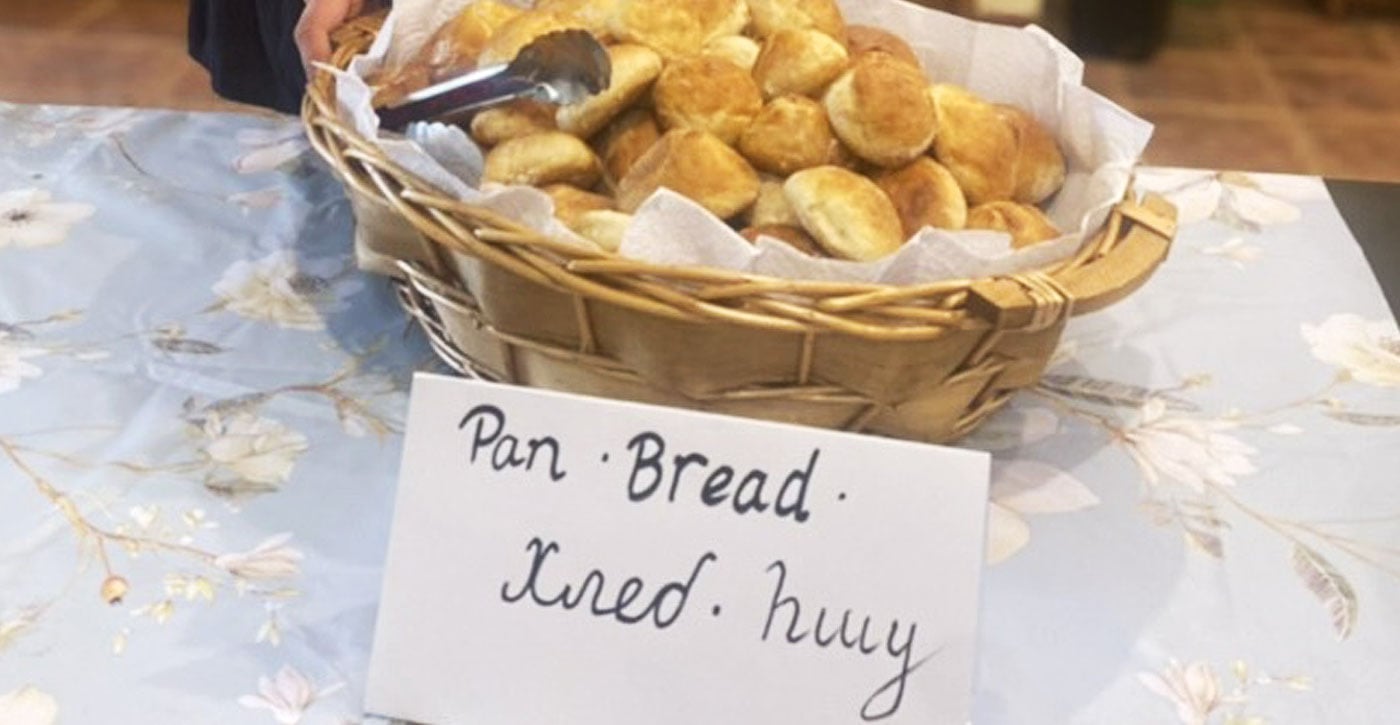
The families are also working to find ways to support themselves. They have been preparing and selling lunches at MFM once or twice each month. The couple from Azerbaijan are professional stylists and have been offering haircuts. The dissident from Russia is a personal trainer and has offered fitness classes, and his wife has been purchasing the equipment she needs to offer manicures. But they face language and cultural barriers, bureaucratic hurdles, and logistical challenges in the remote mountainous area of Monteverde.
Over time, it has also become clear that the families have other needs that were not considered in the initial budget. The adults in the families have been unable to access the free healthcare that is available to most Costa Ricans. Children and adults alike need mental healthcare to help them recover from the traumas they experienced. To help the families find a way to earn a living, they need formal Spanish language classes, vocational training, and resources to pursue Costa Rican certification in their different professions.
We live in challenging and often frightening times where we are confronted by so much violence that we can do little about. But now more than ever, Quakers are called to put into action our shared values of peace, justice, and honoring the divine Light in each person. Supporting Proyecto Bienvenidos is an opportunity to take concrete action that in some small way can redress harm and move toward healing. The profound gratitude expressed by all the families welcomed by MFM is strong proof of the power of love during these difficult times.
Learn more about Proyecto Bienvenidos on the MFM website at monteverdequakers.org/projects.

We want to hear from you, not an AI! Please be thoughtful and use your own words. Comments on Friendsjournal.org may be used in the Forum of the print magazine and may be edited for length and clarity.